

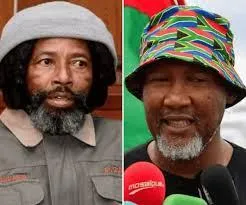
AbaThembu nation King Buyelekhaya Dalindyebo has recently announced that he has removed Mandla Mandela, the grandson of Struggle stalwart Nelson Mandela, as the traditional leader of the Mvezo Traditional Authority.
Image: X
AbaThembu nation King Buyelekhaya Dalindyebo’s announcement that he had removed the grandson of former president Nelson Mandela, Mandla Mandela, as inkosi of Mvezo is nothing to worry about because he has no powers to remove traditional leaders under his kingship.
This was the view of Inkosi Langa Mavuso, the National House of Traditional Leaders deputy chairperson, in reaction to Dalindyebo’s announcement that he had deposed Mandela as the inkosi of Mvezo Traditional Authority in the Eastern Cape.
The king also announced that two other amakhosi had been deposed as he claimed that they stole their positions.
When asked about the king’s decision to remove him, Mandela declined to comment, referring media questions to the king.
In response to the king’s announcement, Mavuso said only the government can remove a traditional leader from the position using the relevant law.
The Traditional Leadership and Governance Framework Amendment Act, which governs traditional leaders, states that such a leader may be removed from office if convicted of an offence with a sentence of imprisonment for more than 12 months without an option of a fine, is physically incapacity or mental infirmity, wrongful appointment or recognition, or a transgression of a customary rule or principle that warrants removal.
“The law does not allow the king (to depose an inkosi), so he cannot,” said Mavuso.
“It is the family of inkosi who had the power to appoint an inkosi, not the premier and not a king, because they (family members) are the custodians of the chieftaincy.”
He also disputed King Dalindyebo’s claim that the position was only given to the first democratically elected president for honouring his role in the Struggle against apartheid, and not to Mandela.
“Even the father of Nelson Mandela was the inkosi, but he was deposed. Mandla is now rebuilding the chieftaincy of his family.”
Mavuso said it was not the first time King Dalindyebo attempted to depose an inkosi, as he previously tried that with Inkosi Thandisizwe Mtirara.
“Inkosi Mtirara took him to court, and he (Dalindyebo) was found wanting by the court,” said Mavuso.
It was alleged that the bad blood between King Dalindyebo and Mandela worsened when the king recently hosted the Israeli delegation in Mthatha.
King Dalindyebo’s spokesperson, Princess Ntando Dalindyebo, who is also his daughter, had previously said that certain ANC leaders and traditional leaders, including Mandela, had advised the king against it because of the allegations that the Israeli government was committing genocide against the people of Palestine.
The king made the announcement to remove Mandela from the traditional position during an event, which seems to have been attended by religious leaders. He said he did not want any inkosi who did not respect him to continue holding traditional powers in his AbaThembu Nation.
“I want each inkosi who is not on good terms with me to leave the land of Dalindyebo,” he told the crowd.
He said the Mvezo chieftaincy was given to Nelson Mandela as an honour “not to him (Mandela)”.
“He must leave me alone because he lacks respect. Today I pronounce that Mandla Mandela is no longer the inkosi of Mvezo.
“While we are busy working hard to save our children here, he is busy with the plight of the Palestinian children. Palestine must give him the land where he is going to be the inkosi, not here in the Thembu land,” said the king.
He said the AbaThembu land belongs to the king not to amakhosi.
“Amakhosi are ruling over the land at the behest of the king,” he said.
The king still holds power, although the Mthatha High Court had sentenced him to 12 years for arson, kidnapping, and defeating the ends of justice in 2015.
He was released in 2019 through President Cyril Ramaphosa’s remission of sentences.
When asked if the king has the power to depose an inkosi, Ntando said his father derives the powers “customarily”. She did not answer any more questions.
Eastern Cape Congress of Traditional Leaders of South Africa Chairperson, Inkosi Mwelo Nonkonyana, concurred with Mavuso, saying traditional leaders are appointed by royal families concerned in accordance with customary law and applicable legislation, and they do not serve at the pleasure of their Majesty Kings.
He said the removal of traditional leaders in the Eastern Cape Province is regulated by the Eastern Cape Traditional Leadership and Governance Act No.1 of 2017 if there is evidence of wrong conduct or wrongful appointment.
Nonkonyana said the process of removing an inkosi should start with the premier appointing a tribunal to investigate a complaint against the inkosi.
He said that the investigation must be handled by an impartial tribunal, which must give a traditional leader concerned an opportunity to defend themselves.
He said the tribunal must submit its findings and recommendations to the premier, who should then decide after consulting the House of Traditional Leaders.
“It stands to reason that only the Premier of the Eastern Cape Province has the power to remove traditional leaders who can only do so in accordance with applicable legislation.”
Nonkonyana said Dalindyebo’s announcement about Mandela’s chieftaincy was not big “at all”.
“He is known for just speaking off the cuff, and it (announcement) does not have an impact,” said Nonkonyama.
bongani.hans@inl.co.za