

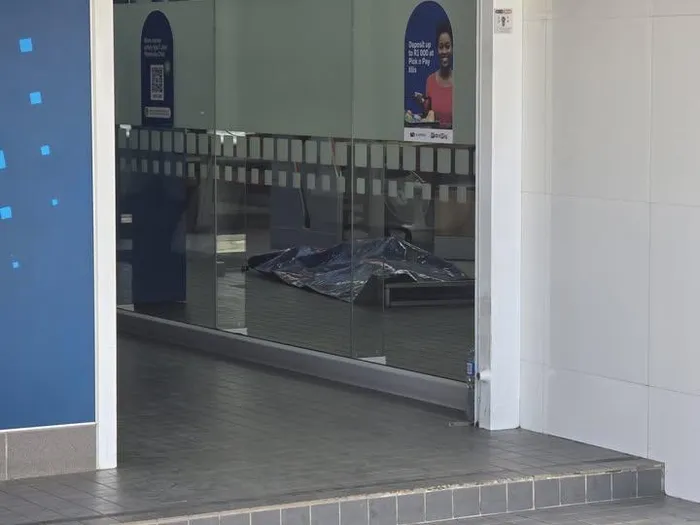
A dead body covered in a body bag, lies on the floor of a bank in Stanger. Cultural experts weigh in on the shocking incident.
Image: Taurus Medical & Security Services
THE incident in which a grieving family took the body of a deceased relative to a branch of Capitec Bank has stirred national debate, with cultural and psychological experts saying the act was stemmed from desperation.
Cultural expert Professor Musa Xulu said the public presentation of a corpse goes against long-standing Zulu cultural practices governing how the dead are handled. Traditionally, once a person dies, the family enters a structured mourning period, focused on preparing for burial.
“Under normal circumstances, a death certificate issued by the Department of Home Affairs is enough proof of death,” he said.
Xulu explained that traditionally, burial practices were immediate and guided by strict customs - that was before the use of body storage facilities like mortuaries.
He explained that traditionally in the Zulu culture, burials happened swiftly, where adults would be buried in the afternoon, while children would be buried earlier in the day, this is to avoid decomposition of the body.
"Those dying during battle would be left on the battlefield for wild birds to feed on them. That was to avoid bringing the spirit of death by violence into the family, as this was seen to contain generational curses," he said.
Today, this way of burying is still the same, but mortuaries and administrative processes with the Department of Home Affairs tend to make the period of waiting longer, replacing immediate burials, although the cultural principles remained.
He said that occasionally, a family member may go to the mortuary to check if the body was still there, and even when someone dies, and there was no insurance policies, there was limited interaction with the body.
In the Zulu culture, when one has made a mistake or is asking for forgiveness from the ancestors, they slaughter a goat or a chicken; therefore, the family will have to cleanse the body through slaughtering of an additional goat or chicken to apologise to the ancestors, who are custodians of dead bodies.
The physical presentation of the body would have been caused by despair due to delayed payment.
“It is taboo to show the body in public. Once a body is at the mortuary, there is very little interaction with it. The living and the dead do not mix in that way,” he said.
"The modern financial systems always promise payment within 48 hours of the claim. A delay in payment seems to be the reason for the un-cultural presentation of the body," said Prof Xulu.
Counselling psychologist Rethabile Oliphant explained that the public outrage fails to account for what acute grief does to the human mind.
“The experience of acute bereavement is not merely emotional; it is a profound cognitive,” Oliphant said.
He explained that when a family unit enters the initial stages of loss, the psychological impact can be categorised by a significant decline in rational decision-making capabilities, and that grief often causes what is commonly referred to as “brain fog”, where emotional distress overwhelms rational thinking.
“In that state, the bereaved are often operating from the limbic system(the emotional centre of the brain) rather than the prefrontal cortex (the rational center). This explains why actions that may seem "irrational" to an outsider feel like the only available option to the grieving,” he said.
Oliphant described the period between death and burial as the most vulnerable stage of grief, where the "acute phase" of grief—the window between death and burial—is the point of maximum vulnerability.
It is precisely during this window that society and its institutions demand the most "rational" behaviour from a family.
“Families are forced to interact with rigid institutions (banks, insurance companies, state departments, and funeral homes). These systems often require precise paperwork, calm negotiation, and adherence to strict timelines,” he said.
“When there are delays, especially involving funds needed for burial, it compounds the trauma. What might seem like an irrational act to outsiders can feel like the only option to someone in that emotional state.”
Oliphant added that when these institutions were unresponsive or when the process of obtaining help is protracted, it compounds the existing trauma. A delay in funds or permits is not just an administrative hiccup; it is a secondary assault on a family already in a fragile state, he said.
The incident has drawn mixed reactions. Some members of the public have condemned the family’s actions as inappropriate, while others have expressed sympathy.
“There will always be those who focus on the extremity of the act,” Oliphant said. “But many people understand the internal experience of desperation that can push families into decisions they would not make under normal circumstances.”
Both experts agree that institutions need to factor grief into their systems.
“Speed is a form of empathy,” Oliphant said, suggesting that fast-tracked processes for bereaved families could prevent similar incidents.
Prof Xulu noted that burial brings emotional closure.
“When burial is delayed, mourning feels incomplete. That can intensify desperation,” he said