

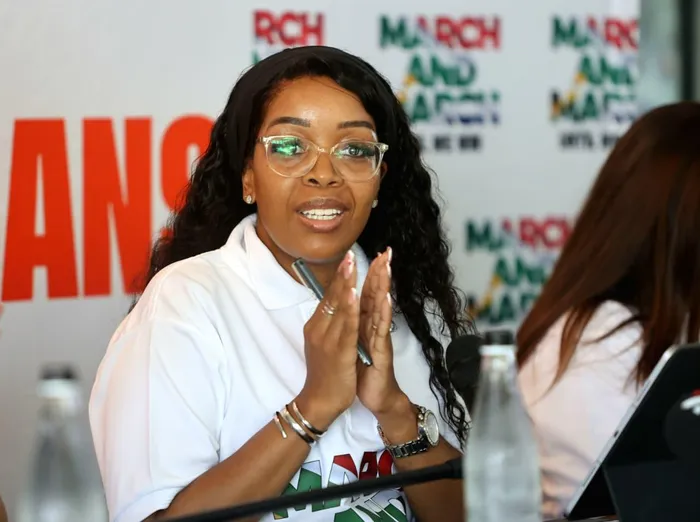
KZN Premier Thamsanqa Ntuli leads a crucial stakeholder meeting addressing the contentious issue of education rights for undocumented foreign learners, as voices from various sectors call for a reevaluation of court mandates.
Image: TUMI PAKKIES/Independent Newspapers
Government departments have been urged to challenge court judgments that mandate the provision of services, including basic education, to undocumented foreign learners.
Stakeholders argue that the government should assert its right to state that it no longer possesses the resources to comply with such mandates.
This call to action was made during a high-level, multisectoral stakeholder engagement led by KwaZulu-Natal Premier Thamsanqa Ntuli. The meeting aimed to address tensions and strengthen social cohesion in light of the increasing influx of undocumented foreign nationals.
KZN Department of Education HOD Nkosinathi Ngcobo stated that the department operates strictly within the constitutional and legislative framework applicable across South Africa. He highlighted that the Constitution’s Section 29(1)(A) guarantees the immediate right to basic education for everyone, regardless of immigration status.
Although the South African Schools Act, Section 5(1A), typically requires foreign learners to present documents such as a birth certificate, passport, visa, or permit, it critically mandates admission even without these documents.
Ngcobo explained that the Admission Policy for Ordinary Public Schools includes clauses 15 and 21, which made the production of required documents a compulsory precondition for admission.
“The Child Law Centre took the Department of Basic Education to court on that. And what is now famously known as the Phakamisa Judgment. The High Court declared clauses 15 and 21 of our admission policy in ordinary schools invalid to the extent that they required production of birth certificates or passports as a precondition for registration.
“The court held that undocumented learners may not be deprived of access to a basic education due to failure to produce official documentation. The judgment further clarified that Section 39 of the Immigration Act, which prohibits learning institutions from providing training or instruction to illegal foreigners, does not apply to children seeking access to basic education,” Ngcobo explained.
He further noted that the judgment means public schools must legally admit undocumented learners while encouraging parents or guardians to regularise their immigration status and secure necessary documents.
Ngcobo added that KZN schools currently have 18,793 foreign and 130,826 South African undocumented learners, totalling 149,619. This figure is slightly lower than the department’s highest record of 157,245 undocumented learners in 2023.
March and March leader Jacinta Ngobese-Zuma expressed concerns, stating that departments are "bending over backwards to do more than they should," even though legally, they do not have the duty to do so. She highlighted Sections 26 and 27 of the Constitution, which state that the government must take reasonable legislative and other measures within its available resources to achieve the progressive realisation of these rights.
“This specifically gives government an opportunity to say we no longer have resources. Let us go to court and challenge the Phakamisa Judgment and say that yes, you did say this, but now we are unable to do that. It also does not force the government to provide all these things within the public sector. That’s why there’s the private sector. You’ve got private health care. You’ve got private education,” Ngobese-Zuma said.
“Why is our government bending over backwards to stretch our public resources to give to people who have a government that is supposed to be providing for them and who are even in the country illegally? Why is the Department of Education and Health and every other department of government not going to court and trying to reverse the very same judgments that are holding us back right now? It is within your jurisdiction. You are the policymakers. You are the decision makers. You can’t allow courts to make decisions for you. That is not what the Constitution says,” Ngobese-Zuma added.
KZN Community Police Forum Board chairperson Mabutho Mtshali expressed his concerns about the laws, questioning why a stand has not been taken to change them. “Those who are in Parliament, why are they even in Parliament when we have laws like this that allow for things like these to happen to our children?” Mtshali asked.
Premier Ntuli acknowledged the need to amend the legislation. “The issue of the Phakamisa Judgment, challenging that judgment, maybe we’ll round off by saying, as a province, we need to consider the action. We need to get some advice,” Ntuli said, adding that their state attorney and his team were present at the round table.