

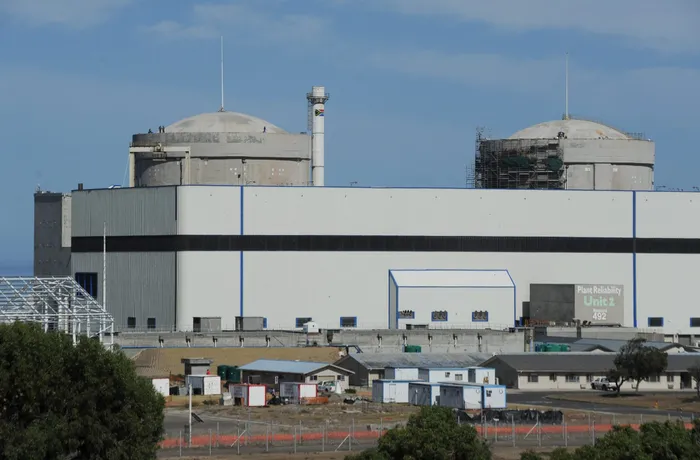
Eskom's Koeberg nuclear power station. The power utility's plan to build a new nuclear power station is being challenged in the Western Cape High Court.
Image: File
The government is facing a court case over the approval of another planned nuclear power plant in Duynefontein, Western Cape.
The Southern African Faith Communities’ Environment Institute, Earthlife Africa, and Greenpeace have hauled Eskom, the Forestry, Fisheries and Environment, and Energy and Electricity ministers, Willie Aucamp and Dr Kgosientsho Ramokgopa, respectively, to the Western Cape High Court over their approval of the new nuclear facility.
The organisations want the High Court to rule on whether the Department of Forestry, Fisheries and Environment’s chief director’s decision to grant an environmental authorisation for the proposed nuclear-1 power station in the Western Cape was lawful.
They are also challenging the decision by former minister Dr Dion George to dismiss the internal appeal, together with the contested approval.
In addition, the organisations allege that the moves are inconsistent with Section 24 of the Constitution, read with the National Environmental Management Act (NEMA) and the applicable Environmental Impact Assessment (EIA) regulations.
They accuse the chief director and the minister of failing to ensure compliance with the mandatory requirements of the Nema and the regulations. The regulations require a project-specific description and assessment of the need and desirability of the proposed activity.
The organisations insist that the approvals “are unlawful because the environmental impact assessment report and EIA review report did not assess feasible and reasonable alternatives to the proposed activity, including the option of not implementing the activity, which they describe as the no-go option, as required by NEMA and the regulations”.
According to their court papers, the decisions were based on outdated and incorrect assumptions and information concerning electricity system planning, including the requirement for nuclear “baseload” generation plants, and were irrational and materially influenced by an error of law and/or a material error of fact in that the EIA report, the EA decision, and the appeal decision proceeded on the basis.
“Renewable energy technologies cannot provide a reliable baseload supply, and that baseload power plants (predominantly coal and nuclear) are required. The financial cost of nuclear power would be competitive with renewable alternatives,” the organisations stated.
Additionally, they state that the integrated resource plans are determinative of, or a substitute for, the project-specific assessment required under NEMA and the EIA regulations, on the basis that the energy mix is a policy or political determination.
“The decision makers proceeded on an ‘envelope of data’ approach in circumstances where no vendor, design or validated severe accident performance had been identified in respect of the proposed nuclear power station, with the result that it was not possible to determine, in a credible worst- case scenario, the likely source term, dispersion pathways, emergency planning requirements or the duration and extent of environmental contamination,” they added.
They contend that such impugned decisions are inconsistent with Section 24 of the Constitution and are unconstitutional, unlawful, and invalid, and are reviewable under the Promotion of Administrative Action Act, 2000, or the principle of legality.
Parties interested in the case have been given 20 days to file their court papers from February 24.
loyiso.sidimba@inl.co.za