

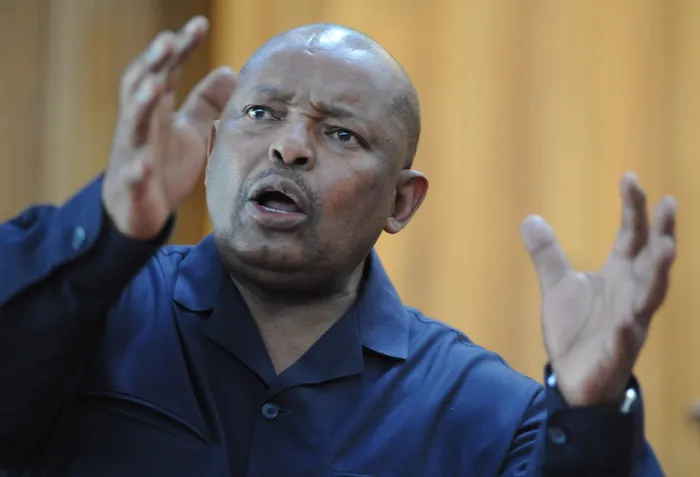
The co-founder of the Congress of the People (COPE) Mosiuoa Lekota who died on Wednesday after a period of illness.
Image: Independent Newspapers Archives
Tributes continue to pour in for Mosiuoa Lekota, the co-founder of the Congress of the People (COPE), who died on Wednesday at a Midrand hospital after a period of illness.
Lekota, 77, was a seasoned anti-apartheid activist who cut his political teeth in the student movement. After South Africa’s first democratic elections in 1994, he became the country’s first premier of the Free State, serving until 1996. A year later, he was elected chairperson of the National Council of Provinces.
He went on to serve as Minister of Defence from 1999 to 2008.
In 2008, Lekota left the African National Congress (ANC) and co-founded COPE with former trade unionist and ANC leader Mbhazima Shilowa following the exit of President Thabo Mbeki. Lekota and Shilowa had staunchly supported Mbeki after his defeat by Jacob Zuma at the ANC’s 2007 elective conference in Polokwane.
COPE secured 30 parliamentary seats in 2009 but later declined amid leadership tensions between Lekota and Shilowa. The party failed to win any seats in the May 2024 national and provincial elections. Last year, Lekota withdrew from active politics due to ill health.
Raised in activism, Lekota was imprisoned on Robben Island in 1974. Two years earlier, he had been expelled from the University of the North for his involvement in the student representative council and the Black Consciousness-aligned South African Students’ Organisation (SASO), where he was studying social sciences. He matriculated from St Francis College in Mariannhill in 1969 and played football for the Mariannhill Rangers, earning the nickname “Terror” on the pitch.
After his release in 1982, he became active in the United Democratic Front (UDF), serving as publicity secretary in 1983. He was later arrested in connection with the Delmas Treason Trial and released in 1989 after the Appeal Court reviewed his sentence.
Following the unbanning of the ANC in 1990, Lekota became convenor and later chairperson ++of the party in the Southern Natal region, based mainly in Clermont, west of Durban. During this time he managed to ingrain himself in the civic movement of the townships that resisted to be incorporated under the Zulu Government. It is in the same township of Clermont, in 2008, where residents would turn against Lekota for "betraying", and demanded that a stadium named after him after his release from jail be renamed, since he had dumped the ANC.
In 1991, he was elected to the ANC’s National Executive Committee and National Working Committee. In December 1997, he was elected ANC national chairperson, a position he held until 2007, when he was succeeded by Baleka Mbete.
COPE interim leader Tebogo Loate confirmed his passing in a statement, saying the Lekota family had requested privacy. The party said it would communicate memorial arrangements and extended condolences to the family and the nation.
John Steenhuisen, leader of the Democratic Alliance, described Lekota as “a patriot and a man of substance,” praising his commitment to principle and constitutionalism.
RISE Mzansi honoured his enduring message of restoring dignity and integrity in politics. The GOOD Party, led by Patricia de Lille, extended condolences, describing him as a resilient founding leader.
The ANC said Lekota’s death marks the loss of a leader who served South Africa before and after democracy. The Economic Freedom Fighters (EFF) and ActionSA also paid tribute, recognising his contribution to the democratic project. Lekota is survived by his wife Cynthia and his four children Kotane, Kopane, Nakubutu and Masetjhaba Lekota.