

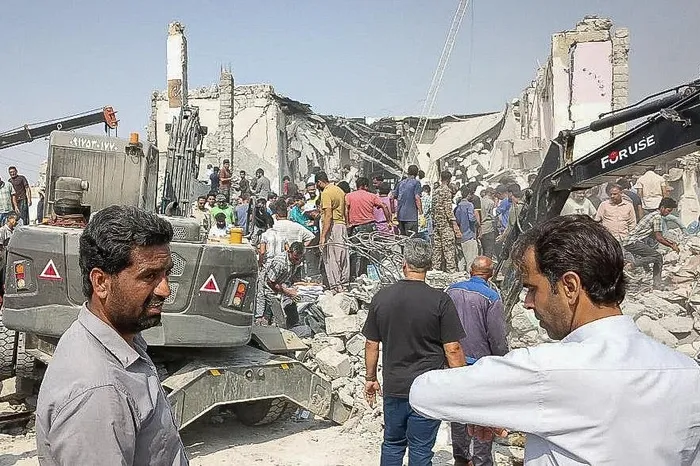
This picture obtained from Iran's ISNA news agency shows the site of a strike on a girls' school in Minab, in Iran's southern Hormozgan province. The United States and Israel launched strikes against Iran on February 28, 2026.
Image: ALI NAJAFI / ISNA / AFP
The war in Iran is escalating, with Tehran responding to US–Israel attacks with missile and drone strikes across the region. Operation Epic Fury and Israel’s Operation Roaring Lion began on 28 February 2026.
More than 7 000 km to the south, Prof. Barend Prinsloo, Director of the Centre for Geopolitical Security and Strategy at the North-West University (NWU), warns that South Africa will soon feel the effects through energy prices, shipping patterns and political exposure.
War modelling suggests the current conflict tempo may be sustainable for only about another ten days. If correct, longer-term impacts on fuel markets could be limited, and South Africa might even benefit slightly if shipping reroutes around the Cape of Good Hope.

Professor. Barend Prinsloo, Director of the Centre for Geopolitical Security and Strategy at the North-West University.
Image: Supplied
He points to three scenarios that could determine how the conflict may unfold.
Scenario 1: The ten-day conflict estimate (stalemate)
“The ten-day estimate rests on uncertain inventory arithmetic: how many rockets Iran still possesses versus how many missile interceptors Israel and the United States can continue to deploy. Iran’s Shahed drone stock could still be in the tens of thousands.
“The opening strike wave shows the scale of the US role. Reports cite more than 100 aircraft flying as a coordinated package, while US Central Command states that more than 1 000 targets were struck in the first 24 hours. Sustaining that pace may prove difficult, and missile interceptor stocks are slow to replace. If large salvos continue, the US and Israel will face hard trade-offs unless allies add major defensive capacity.
“Regionally and among BRICS+ countries, Iran appears increasingly isolated as it continues ‘retaliatory’ missile and drone strikes on multiple Gulf states. The United Arab Emirates illustrates how quickly alignments can fray: it took part in BRICS+ naval exercises off South Africa in January 2026, yet it was later attacked by Iran during the current escalation. Similarly, recent moves suggest the US and Israel are less aligned with some usual partners, including the UK, Spain and France.
“In this scenario, Iran, the US and Israel would see their offensive and defensive capabilities deteriorate, and without external support the conflict would fizzle into sporadic skirmishes. Regime change in this scenario is unlikely.”
Scenario 2: Rejuvenating diplomacy through clerical succession (Iranian regime survives)
The second scenario relates to the possibility of stalling Iranian regime change through the selection of a new Supreme Leader. On 1 March 2026, Iran announced an Interim Leadership Council comprising President Masoud Pezeshkian, Chief Justice Gholam Hossein Mohseni Ejei, and the cleric Alireza Arafi. The new Supreme Leader must be an Islamic cleric.
On Tuesday, 3 March 2026, the Israel Defence Forces (IDF) reportedly bombed the building where the Assembly of 88 Islamic clerics was meeting. Reports have circulated that the leading cleric, Alireza Arafi, may have been killed along with other clerics. If confirmed, Israel may be seeking to prevent a rapid succession that could stabilise the system and open space for diplomacy, even though that outcome is not assured.
Scenario 3: Regime change in Iran (the US achieves its objective)
“If the regime were overthrown within ten days, few viable successor options would remain, and democracy would be unlikely to emerge immediately. The United States has expressed scepticism that Reza Pahlavi could govern Iran and has not identified another plausible alternative leader.
“In this third scenario, Iran would be left with a severely degraded navy and fragmented internal armed forces. History suggests that such forces tend to coalesce over time, forming armed factions that may lead to Iran’s descent into a prolonged internal conflict for control of the state. This scenario implies that Operation Epic Fury is more likely to produce ‘regime destruction’ than ‘regime change’.”
Impact on South Africa
“For South Africa, there is little evidence that BRICS+ states are providing Iran with operational support beyond diplomatic condemnation. China and Russia have criticised the strikes but have not moved towards direct assistance.
“Should the ten-day scenario materialise, South Africa’s historically close political and corporate alignment with Iran could begin to count against it, particularly if Washington frames the conflict around proliferation and defence supply chains. Allegations suggest that between 2004 and 2005 MTN secured its Iranian operating licence by promising South African support for Iran’s nuclear programme at the International Atomic Energy Agency and facilitating defence equipment. President Cyril Ramaphosa served as MTN’s non-executive chair during this period.
“The revocation of former foreign affairs minister Naledi Pandor’s US visa in December 2025 suggests targeted pressure. The US–South Africa Bilateral Relations Review Act of 2025 seeks to review and potentially sanction South African officials and African National Congress leaders over concerns about alignment with Russia, China and Iran. President Trump has also cited Pretoria’s ties with Tehran as justification for imposing 30 per cent tariffs on South African goods.
“In the short term, the most immediate impact on South Africa will likely come through energy prices and fuel supply disruptions. Over time, the greater risk may lie in political and financial exposure if South Africa is viewed as an outlier in its ties to Tehran while the United States appears willing to apply punitive measures,” he concludes.