

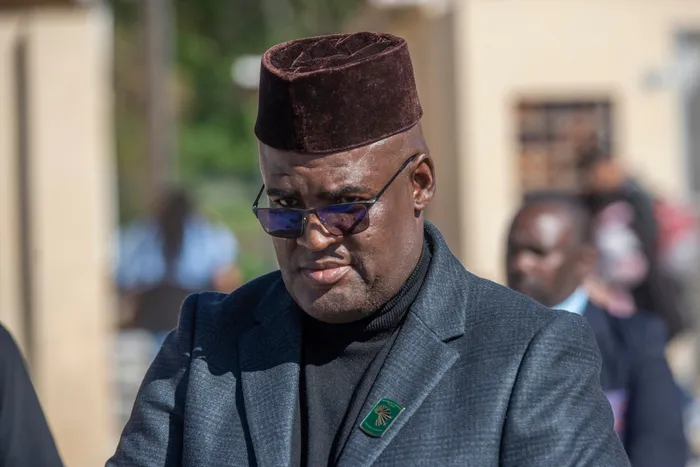
Land Reform and Rural Development Minister Mzwanele Nyhontso has announced the disbandment of the KwaZulu-Natal Ingonyama Trust Board (ITB), a move the board says is "illegal" and is seek legal advice on it. KwaZulu-Natal Premier Thami Ntuli and the soul trustee of the Ingonyama Trust, King Misuzulu kaZwelithini have been briefed.
Image: ARMAND HOUGH Independent Newspapers
A legal showdown looms between Land Reform and Rural Development Minister Mzwanele Nyhontso and Ingonyama Trust Board (ITB) following the minister's disbandment of the latter, citing a deepening governance crisis.
Nyhontso appointed an administrator to ensure continuity in land management and protection of community interests. Several board members have resigned leaving only four on the board. King Misuzulu kaZwelithini serves as chairperson and the sole trustee of the Ingonyama Trust, which administers nearly three million hectares of land across KwaZulu-Natal.
The ITB issued a strongly worded rebuttal, describing the minister’s actions as “unlawful, ultra vires and inconsistent” with both the Ingonyama Trust Act and the Public Finance Management Act (PFMA) and is seeking legal advice and reserves all rights to challenge the intervention through the courts.
The Board argued that vacancies do not render it inoperative, as the legislation provides for the continuation of its functions and outlines processes to fill vacant positions.
“The lawful response to resignation is the filling of vacancies through the prescribed statutory process, not the displacement of the Board through an extra-statutory arrangement,” the Board said.
It also challenged claims that the lack of a quorum had paralysed operations, pointing to provisions that allow a second meeting to proceed with those present forming a valid quorum.
Regarding the appointment of an administrator, the Board contended that the minister does not have unilateral authority under the PFMA to make such a designation.
The Board added that the resignation of four members since September 2024—due to reasons including personal development and career opportunities—should not be interpreted as dissolving the institution or undermining its legal standing.
In a statement, the ministry said the decision to dissolve follows the resignation of several board members before the end of their terms.
According to the minister, the Administrative Regulations of the Act require at least five members to form a quorum for board meetings. Although provisions allow for a second meeting to proceed without a quorum if the first fails, Nyhontso determined that this mechanism was no longer sustainable.
“The current composition has created a governance position that is no longer viable for effective administration,” the ministry said, citing operational instability and the urgent need to ensure lawful land management for the benefit of communities.
To maintain continuity, an administrator will be appointed under section 49(3) of the Public Finance Management Act (PFMA) to oversee the Trust’s day-to-day operations while the board is reconstituted.
KwaZulu-Natal Premier Thamsanqa Ntuli confirmed he had been consulted, along with the king, prior to the decision. He described the Trust as a “cornerstone of KwaZulu-Natal’s rural economy” and a key instrument for advancing economic growth and poverty reduction.
“We remain committed to supporting initiatives that empower rural communities, improve land administration systems, and accelerate development in areas under the jurisdiction of the Trust,” Ntuli said.
The Department of Land Reform and Rural Development indicated that the process to reconstitute the board will follow legal requirements and include the necessary consultations, with further details expected in due course.