

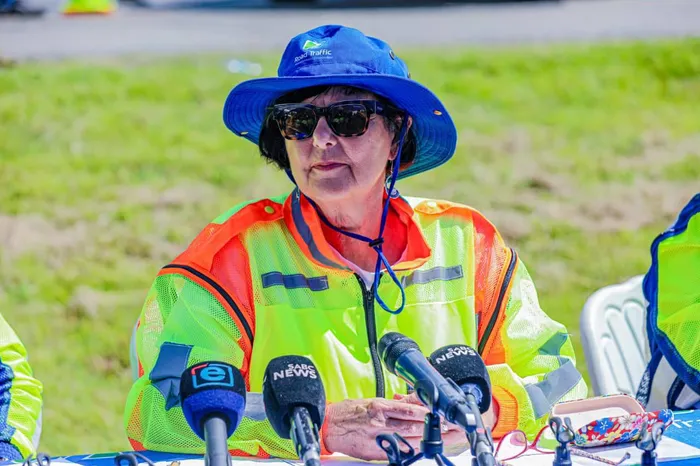
With South Africa recording its lowest road fatalities in six years for the period from January 1 to March 15, 2026, Transport Minister Barbara Creecy launches the 2026 Easter Road Safety Campaign, urging all road users to embrace personal accountability for safer journeys.
Image: Supplied
Minister of Transport Barbara Creecy launched the 2026 Easter Road Safety Campaign, placing personal accountability at the heart of the national drive to curb road fatalities during the upcoming major religious holidays, including Eid-al-Fitr and the Passover Seder.
Speaking at the launch in Gauteng on Friday, Creecy noted positive early-year statistics, but stressed the need to avoid complacency as the country heads into one of its most high-risk periods on the roads.
The campaign, running for the next two months under the renewed theme "It Begins With Me", comes as preliminary data for the period January 1 to March 15, 2026, shows a positive shift in road safety.
According to the minister, this period recorded the lowest number of fatalities in six years, with a 10% decrease in deaths and an 11% drop in crashes compared to the same period in 2025.
She said six provinces, including Gauteng, Western Cape, KwaZulu-Natal, and the Eastern Cape, recorded a decrease in fatalities.
“This progress was not accidental; it is the direct result of coordinated law enforcement, strategic partnerships with civil society, and a shift in the collective consciousness of our road users.
“However, we cannot rest on these laurels. As long as one family still receives a knock on the door with news of a tragedy, our work is not done,” said Creecy.
She emphasised that human behaviour is the direct cause of over 80% of road crashes.
“This is more than a slogan; it is an appeal for personal accountability. We are calling on every driver, passenger, and pedestrian to take ownership of their conduct on our shared roads.”
She said the enforcement strategy will be “uncompromising”, with a targeted focus on public and freight transport safety, as well as pedestrians, who currently account for almost half of all road deaths.
The Department of Transport faces a significant challenge, with NATIS data indicating that 342,048 vehicles, primarily minibuses, buses, and trucks, are not roadworthy, and 338,659 professional driving permits have expired.
“We are engaging with the taxi and bus industries to address these worrying figures and ensure vehicle roadworthiness. Vehicles found with defective brakes, smooth tyres, or steering faults will be impounded immediately to protect passengers,” warned Creecy.
For the first time this year, Creecy stated that traffic authorities have been instructed to deploy students to patrol critical pedestrian locations near highways instead of allowing them to go home.
The focus will be on preventing pedestrians from crossing and walking on highways, and patrolling entertainment areas to deter inebriated individuals from running across major roads.
The campaign will also see an unprecedented saturation of mobile and static checkpoints on high-risk routes, including the N1, N2, N3, and N4.
The minister confirmed an intensification of traffic policing on these critical corridors with the deployment of the National Traffic Police.
Furthermore, the Cross-Border Road Transport Agency has been called upon to intensify monitoring and enforcement along key corridors due to increased cross-regional mobility during April.
Industry stakeholders pledged their support for the campaign during the launch.
Lucky Ntimane, spokesperson for the National Liquor Traders Council, reaffirmed their commitment to work alongside the government.
“As liquid traders, we recognise that we are not bystanders in this conversation. We are active stakeholders,” Ntimane said.
Theo Malele, representing the National Taxi Alliance (NTA), echoed this sentiment, but highlighted the specific challenge of pedestrian fatalities in built-up areas.
“We need to make mention of something that we mostly shy away from. The statistical information indicates that most of the people who lose their lives are pedestrians,” Malele commented, calling for greater education on shared road spaces.
He added that the NTA has gone to “impress upon the taxi operators that the taxis have to be fit for the road”.
Minister Creecy concluded by urging long-distance travellers to stagger travel times and stop every two hours to combat fatigue, while appealing to pedestrians to “be visible, and do not cross major highways while under the influence”.
As South Africa prepares to observe Human Rights Day, the minister reiterated the government's view of road safety as a human rights issue, the right to life, and freedom of movement, and its commitment to achieving the UN target of halving road deaths by 2030.
“Let us work together to ensure that 2026 is our safest year on the roads yet. It begins with you. It begins with me,” she said.
karen.singh@inl.co.za