

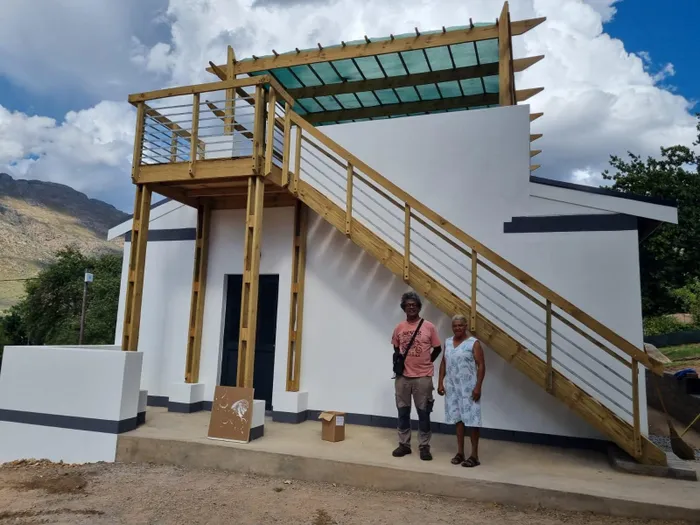
Rodney February of WWF and Maureen Visagie, vice-chair of the Elandskloof Community Property Association at the newly constructed community hall in Elandskloof.
Image: Supplied
A first-of-its-kind community centre has been unveiled in Elandskloof near Citrusdal in the Western Cape on a community-owned farm. The Elandskloof community, who were dispossessed in 1962, had their land restored to them in 1996.
The bricks used in the construction are unique. They are regular-sized bricks but are made from the biomass of invasive alien black wattle trees felled from the riverbanks on the farm, put through a chipper, and combined with a specially developed binder to create low-carbon material.
Almost 8.5 hectares were cleared to construct the new community centre which will be used for gatherings and events. The centre's exterior and interior, including finishings, were unveiled at an event in Elandskloof on Wednesday.
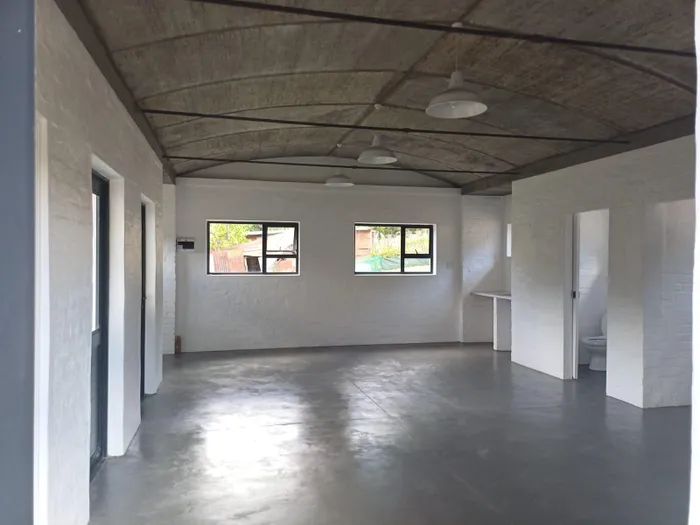
The domed ceiling made from invasive alien plant material.
Image: Supplied
Elandskloof lies in the Groot Winterhoek Strategic Water Source Area (SWSA. Its riverbanks are full of black wattle as well as other invasive alien vegetation and their removal has a significant impact on increased freshwater supply and reducing the risk of runaway fires.
The Citrusdal Water Users Association, which receives funds from the Western Cape government's Department of Agriculture for clearing invasive alien trees, did the felling and chipping used to create the bricks.
The construction method, which also includes a unique vaulted ceiling system, was developed by the Cape Town-based company nonCrete.
“To develop this method and design, we collaborated with the Institute of Technology in Architecture at ETH Zurich, Switzerland; and the Council for Scientific and Industrial research (CSIR),” says Andrew Lord, who co-founded nonCrete with Stephen Lamb. They have over two decades of experience in sustainable construction, design, engineering and architecture.
“The ultimate aim is to develop a safer, more dignified government-funded housing alternative,” continues Lord. “Millions of South Africans are still awaiting their homes, and this approach could be a very viable option for lower-cost housing, but also for all types of housing and buildings.”
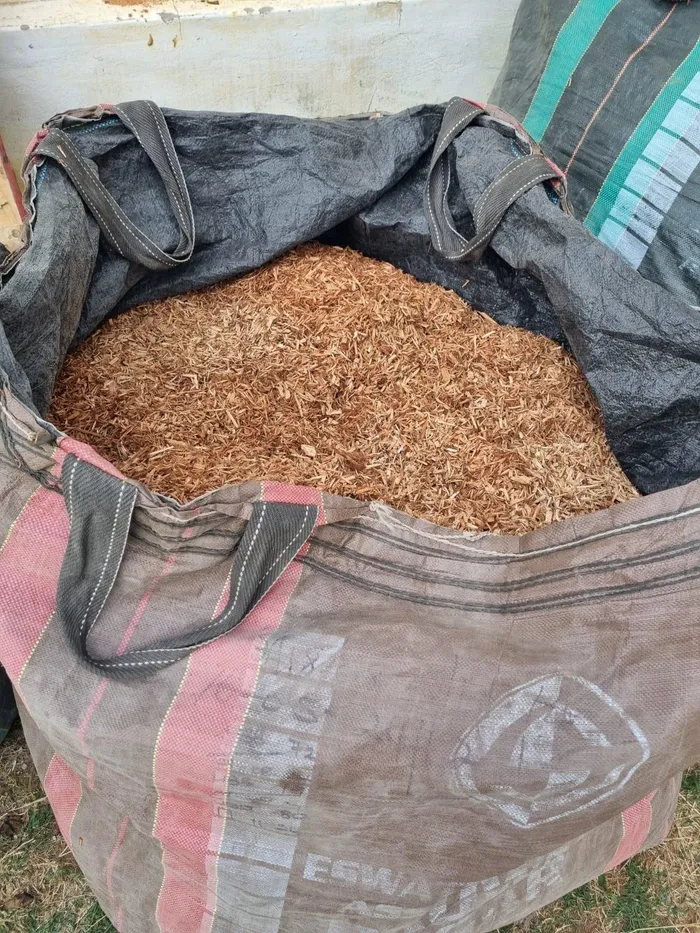
Chipped wood made from invasive alien black wattle trees.
Image: Supplied
The Elandskloof community centre project prototype was co-funded for three years by the WWF Nedbank Green Trust and the Department of Science, Technology and Innovation’s Circular Economy Demonstration Fund, managed by the CSIR.
Called “alien biomass to housing”, it started in April 2024 as a partnership between nonCrete, the non-profit Phuhlisani, the Elandskloof community, and the WWF Nedbank Green Trust.
One-Nil Construction, a broad-based black economic empowerment business, has been central to the build. Headed by Grabeth Nduna, with Peter Mafuwer and Mojalefa Thelingoana , they have been pivotal in creating the unique material mix, design and method.
Nduna says: “We developed a structural mix that is incredibly strong but 55% lighter than conventional concrete. We have something special here and it also creates jobs, which the government has committed to achieve.”
“Making use of invasive wattle biomass for our bricks significantly reduces the amount of stone, sand and cement used in standard concrete bricks,” Lord explains.
The bricks also have a higher degree of fire resistance and superior thermal qualities (they passed official fire, load and thermal testing with flying colours), helping to keep dwellings warm in winter and cool in summer.
Fire-proof bricks are a total game changer in the critical need for fire-resistant building materials. In 2025 nonCrete bricks passed a three-hour, full-scale, fire-resistance rating under a continuous load. The fire test was conducted according to Eurocode requirements by Cape Town-based fire testing laboratory Ignis Testing.
Lord, who was on-site for most of the build explains how they trained five people from the Elandskloof community to make the bricks and made 18 000 bricks over a four-week period, the amount required for the 8m x 8m community centre. He says they decided on a sample build to demonstrate what can be done.
“The vaulted roof system significantly reduces the amount of steel and concrete required and has 75% lower carbon emissions than a conventional concrete flat slab,” explains the Head of the Institute of Technology in Architecture at ETH Zurich, Professor of Architecture Philippe Block. “This is an exceptional design that follows the motto of ‘strength through geometry’. It complies with Eurocode load requirements for multilevel construction in residential, office and other buildings.”
“The methodology has the potential to be duplicated across the country in all areas with invasive alien infestations,” says Poovi Pillay, Executive Head of Nedbank's Social Impact Unit. “It frees up freshwater and replaces conventional, carbon-heavy building materials and practices in a sustainable, environmentally rehabilitative way, including locking the carbon absorbed by the trees into the construction.”
“This form of building creates jobs in situ and helps to restore strategic water source areas,” adds Rodney February, WWF South Africa's Integrated Catchment Coordinator, who is co-managing the Elandskloof project for the WWF Nedbank Green Trust, together with Helen Stuart, WWF's Programme Manager for Partnership Development and Knowledge Sharing.
“The prevalence of alien invasive plants in South Africa's strategic water source areas remains one of the biggest threats to the country's water supply,” says Stuart.
“Our goal is for construction to become restoration; to collaborate with construction companies, cement manufacturers, planners, architects, engineers, municipalities and other government departments. We want to share this technology and create jobs. Our team wants to train people to build their own houses and buildings,” says Lord.
With the community centre completed, members of the Elandskloof Communal Property Association (CPA) are looking to construct their homes in the same way as most community members live in informal dwellings.
“We are very happy with the project and this new way of building,” says Flippie George, CPA Chairperson.
“At first it was strange to us, and we weren't sure if the nonCrete people knew what they were talking about, but when we visited their factory in Cape Town and witnessed how they developed this unique brick and roof system, we realised that we have something very special here. The fact that the community centre was built from the ground up on our farm, with our people trained in the brickmaking technique, is also very exciting and we hope we can build homes this way.”
“We are helping facilitate negotiations with the municipality and the provincial and national departments for the application of the housing subsidies to pursue the larger housing project,” explains Phuhlisani's David Mayson, who has a longstanding relationship with the Elandskloof community and helped them with the land restitution process.
Phulisani is helping the community with an integrated development plan for the farm, including advancing the construction and agricultural side.
As Mayson explains: “The land is currently being used by only a handful of small-scale livestock and vegetable farmers. And they harvest indigenous plants like wild buchu, which grows abundantly here and for which there is market demand. We are also working closely with CapeNature and the South African National Biodiversity Institute to have a portion of the farm proclaimed as a protected environment or nature reserve, as it has critical biodiversity areas and wetlands. Agriculture and other livelihood zones can continue under a protected environment.”
Dr Coralie van Reenen, Research Group Leader of Infrastructure Innovation at the CSIR, says: “The Elandskloof project demonstrates the principles of a circular economy in practice and promotes the uptake of innovation for sustainable human settlements. The circular economy is a key area of research with enormous potential to impact environmental sustainability and resource efficiency, and is particularly relevant in the built environment, which is cited as contributing almost 40% of global greenhouse gas emissions.”
“In my 16 years with WWF, this is one of the most exciting projects I have been part of in terms of its socioeconomic and environmental impact,” says Stuart.
“As a community, we came through a chaotic history and we are past that now and are busy restoring our dignity,” adds George. “One day when our farm is sustainably developed, which we know we can do, we will make our forebears proud as they fought so hard to get Elandskloof back.”