

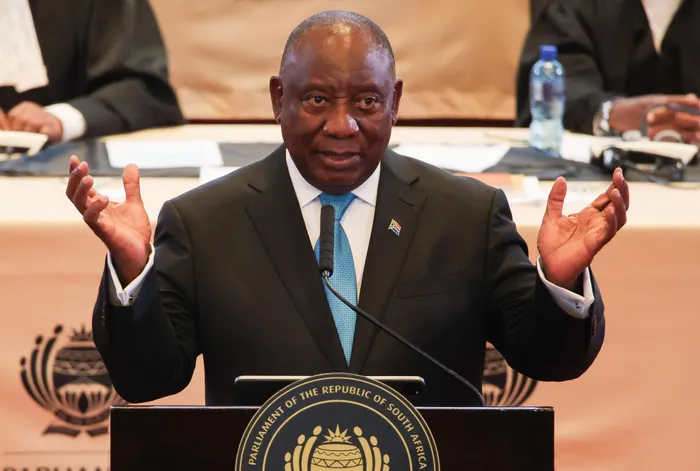
President Cyril Ramaphosa said he placed Minister of Police Senzo Mchunu on special leave so that the allegations made by KwaZulu-Natal Police Commissioner Nhlanhla Mkhwanazi can be properly investigated.
Image: IOL
President Cyril Ramaphosa has reaffirmed his decision not to dismiss suspended Police Minister Senzo Mchunu from Cabinet, saying due process must be followed while serious allegations against him are investigated.
Responding to parliamentary questions from MK Party MP Vusi Shongwe, Ramaphosa said he had placed Mchunu on special leave to allow for a full examination of claims made by KwaZulu-Natal Police Commissioner Nhlanhla Mkhwanazi.
Shongwe told Parliament that serious allegations and supporting evidence presented before an ad hoc committee implicated Mchunu. He questioned whether executive accountability is only triggered after criminal convictions and whether ethical and political standards no longer require decisive action when governance failures are uncovered.
In his response, Ramaphosa emphasised the seriousness of the allegations, noting their potential implications for national security and public safety.
“Following the publication of these allegations, I took the decision to place the Minister of Police on special leave to have the allegations properly ventilated and their veracity determined. I established a Commission of Inquiry into Criminality, Political Interference and Corruption in the Criminal Justice System to investigate the allegations made by General Lieutenant Mkhwanazi.”
He said the commission was actively investigating the matter, adding that his actions were guided by constitutional obligations.
“Executive accountability is sourced from the Constitution. Members of the executive are constitutionally obligated not to act in any way inconsistent with the Constitution. This includes not exposing themselves to any situation involving the risk of conflict between their official responsibilities and private interests or using their position or any information entrusted to them to enrich themselves or improperly benefit any other person.”
Ramaphosa said executive accountability is triggered when constitutional obligations are not met.
“Where Parliament uncovers serious governance failures, it has a constitutional duty and power to ensure that all executive organs of state in the national sphere are accountable to it and to maintain oversight on the exercise of national executive authority.”
He added that his response to the situation was consistent with his oath of office.
“How I choose to fulfil these obligations is subject to the principle of legality. In this case, I have done so by appointing the Acting Minister of Police, putting the minister on special leave, and establishing the Commission of Inquiry,” Ramaphosa said.
Meanwhile, Acting Police Minister Firoz Cachalia said the Crime Intelligence division remained functional despite ongoing challenges.
“The division still executes its mandate in terms of gathering, analysing, and disseminating information to combat crime, particularly organised crime,” he said.
Cachalia was responding to further questions from Shongwe about failures to infiltrate organised crime syndicates, political killings and extortion networks.
He said the division had achieved notable successes, particularly in addressing cash-in-transit crimes in KwaZulu-Natal, Gauteng, Limpopo and Mpumalanga.
“The impact is evident in the crime statistics relating to, among others, cash-in-transit heists, aggravated robbery, recovery of illegal firearms, and dismantling of clandestine laboratories. However, the Crime Intelligence Division continues to face operational challenges, most notably the allegations of corruption, political interference, and information leakage,” he said.
Cachalia added that evidence presented before the Madlanga Commission of Inquiry and the ad hoc committee suggested that some elements within the South African Police Service may be linked to criminal syndicates.