

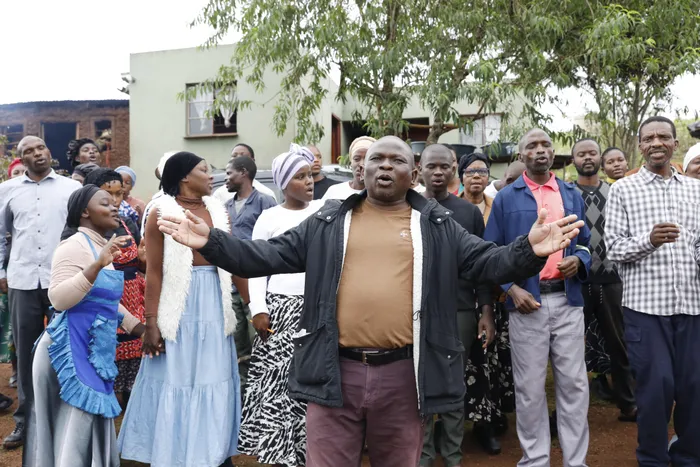
A controversial religious community in KwaMaphumulo, KwaZulu-Natal, has attracted about 100 followers who have abandoned careers, education and, in some cases, medical treatment to pursue a faith-driven lifestyle. Led by Reverend Vusimuzi Sibiya, (in a black jacket) the group says it has found peace and purpose, while raising concern over some of its practices.
Image: DOCTOR NGCOBO Indepedent Newspapers
About 100 people have chosen to leave behind their worldly possessions to become what they describe as "disciples of Jesus" in the rural village of Dabangu in KwaMaphumulo, about 30km north of KwaDukuza.
The group established a secluded settlement, iKhaya Labafundi (loosely translated as "Home of the Disciples"), situated some distance from the surrounding community.
Under this way of life, members have resigned from their jobs, learners and students have withdrawn from their studies, and some self-employed individuals have abandoned their businesses. Some members have also given up mobile phones and embraced celibacy.
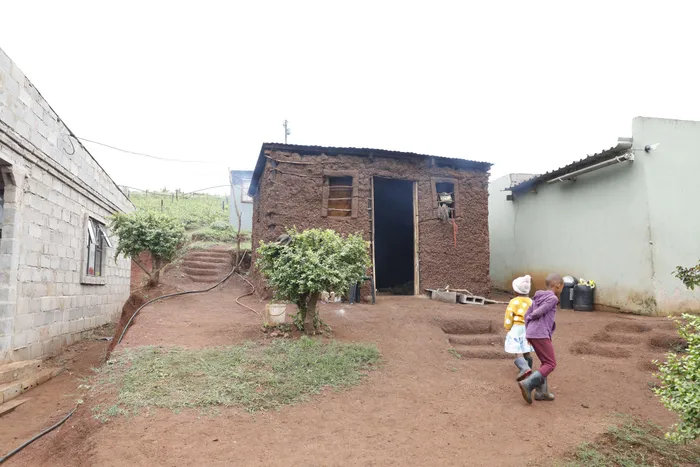
Children of school-going age loiter around at the iKhaya Labafundi faith-based settlement in Dabangu in KwaMaphumulo, northern KwaZulu-Natal, where school and medicine is forbidden.
Image: DOCTOR NGCOBO Independent Newspapers
The community sustains itself by farming crops such as sweet potatoes, mealie meal, avocados, guavas, amadumbe and other produce, alongside raising livestock such as cattle, pigs and chickens. Several dwellings dot the fenced property, which is not easily accessible.
Journalists gained entry only after approval from the group's leader, Reverend Vusimuzi Sibiya.
Inside the settlement, members carried out daily chores, such as washing laundry and dishes and maintaining the grounds. The women wore headwraps, aprons and modest attire of A-line midi skirts and dresses underneath, with a few in pinafore dresses, moving about the expansive property in flat shoes or slippers.
Disciples greet with the uniform phrase: "Thank Jesus, he rules and is King."
The disciples range in age from children to the elderly, and many expressed pride in the life they have chosen.
Sibiya, the founder of iKhaya Labafundi, said he left his former life in pursuit of inner peace and spiritual fulfilment.
"Here, we have people from different backgrounds who left behind various assets to follow Jesus. Some were successful businesspeople who lacked inner peace, but now they have found it," he said.
He added that members come from different parts of the country, many drawn by his teachings, which he shares on social media.
"This is God's nation, led from heaven. Some have given up comfortable jobs, left their families, and abandoned their studies to come here," he said gesturing to some of the disciples who all reacted with a round of applause.
Sibiya maintained that joining the community is voluntary, saying members are guided by faith rather than recruitment.
While talking to journalists inside one of the properties, Sibiya's daughter entered and brought him food.
"This one too, I took her out of Grade 11. She thought she would study and become a doctor, but that did not happen," said Sibiya.
Several members shared personal testimonies about the changes they had made in their lives.
Thandazile Mwelase, from Inanda, north of Durban, said she stopped taking antiretroviral (ARV) treatment in 2024 after starting in 2022, citing her belief in spiritual healing.
"I believe Jesus heals. The word of God says through His suffering we are healed. I have given up everything to follow Him," she said.
Another member, Sibongile Mkhwanazi from Mpumalanga province, said she also discontinued ARV treatment in 2024 after 16 years, expressing similar beliefs.
Ntokozo Mkhize, from Umlazi, south of Durban, said he chose to forgo a place he had secured at the University of Cape Town to study computer engineering in order to join the community.
"I had been accepted and secured accommodation, but I felt called to follow God. I explained my decision at home, and they understood. I am here to learn about Jesus," he said.
He added that he has since given up romantic relationships as part of his commitment to the lifestyle.
A video seen by Independent Media shows some members burning their academic certificates, saying they no longer see value in them.
A 15-year-old girl, seated with her mother, said she had left school because she wanted to follow religious teachings instead.
"I quit school because they do not teach what Jesus taught, and I want to do God's will," she said.
While members describe a sense of peace and purpose, some of the community's practices—particularly decisions regarding education and healthcare—concern the neighbouring community.
Residents in neighbouring communities have raised concerns about children of school-going age who remain at the settlement instead of attending school.
Some community members, speaking on condition of anonymity, described the situation as troubling and said it should be addressed.
"What's even worse is that they openly boast about taking children out of school. Where have you heard of people withdrawing kids from school because of their religious beliefs?" asked one resident, adding that, in their view, the settlement should be shut down.
They also expressed the belief that Sibiya operates without restraint.
According to residents, officials from the Department of Social Development previously intervened. "Social Development workers came and removed Sibiya's children to assist them in continuing with school and living ordinary lives. He was told the children would not be returned, but after a short while, they were brought back," said a community member.
Another nearby resident alleged that all-night sermons are frequently held using loudhailers, sometimes continuing until dawn.
"He never seems to tire, day and night he is preaching," the resident said, adding that many of the followers come from outside KwaMaphumulo rather than the local area.
Professor Salim Abdool Karim, director of CAPRISA - the Centre for the AIDS Programme of Research in South Africa, said it is dangerous for people living with HIV to stop their antiretroviral treatment.
"HIV rebounds when treatment stops reaching high virus levels in the blood. When this happens, patients are running the risk of getting sick with AIDS, developing tuberculosis and other diseases. As importantly, such patients become infectious when they stop treatment. They can start spreading the virus again, putting their partners and community at risk of HIV.
“When AIDS patients are on antiretroviral treatment and for several months after they stop treatment, they feel well. They should not mistake this as being cured. Religious prayers may be able to do many things but they cannot cure HIV,” said Karim.