

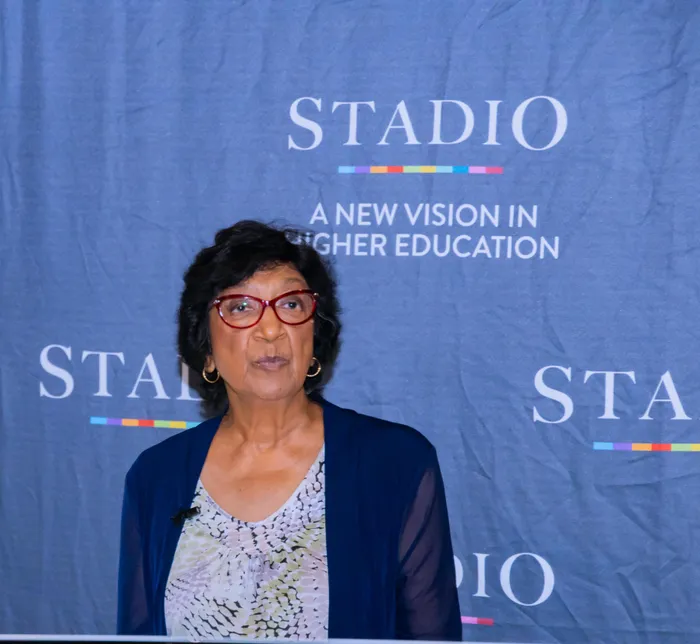
Judge Navi Pillay Pillay addressed students, lecturers and fellow panellists on Gender Based Violence at Stadio Musgrave campus
Image: Supplied
Former International Criminal Court judge and ex-UN High Commissioner for Human Rights Navi Pillay has warned that global efforts to protect women’s and environmental rights, and to combat gender-based violence (GBV), have taken on renewed urgency.
Judge Pillay was speaking at a GBV panel discussion held at the Stadio Musgrave campus, where she addressed students, lecturers and fellow panellists on Gender Based Violence.
The panel included Dr Leah Shibambo, a former deputy national police commissioner who now heads the School of Policing and Law Enforcement at Stadio; Anne Rajcoomar, Project Manager at the South African Depression and Anxiety Group (SADAG); Dr Stan du Plessis, CEO of Stadio and Chief Academic Officer at Stadio, Professor Dhivya Singh. The discussion was facilitated by Sunday Tribune news editor Annie Dorasamy.
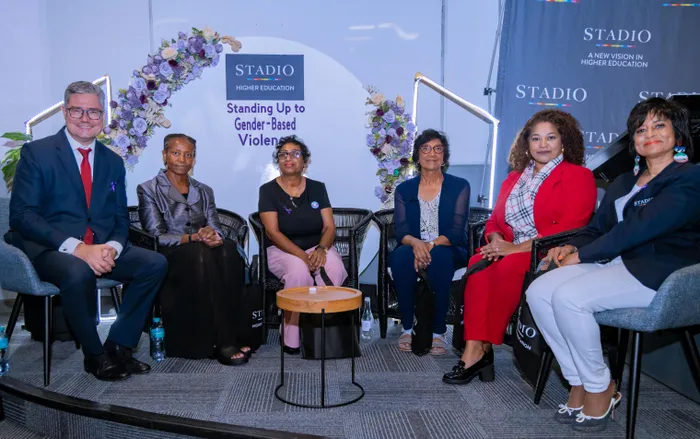
CEO of Stadio Dr Stan du Plessis, Dr Leah Shibambo, a former deputy national police commissioner; Anne Rajcoomar of the South African Depression and Anxiety Group (SADAG); Navi Pillay; Sunday Tribune news editor Annie Dorasamy and Stadio's chief academic officer Professor Dhivya Singh were part of a panel discussion on Gender Based Violence
Image: Supplied
She said nearly one in three women globally have experienced physical or sexual violence at least once in their lifetime, underscoring the scale of the crisis.
Judge Pillay, who has 30 years of experience as a lawyer, was the first woman of colour to serve as a judge in the High Court, as an international judge on the UN Tribunal for Rwanda and the International Criminal Court and as the UN High Commissioner for Human Rights.
"Across the globe, women are the group that is most prone to poverty, violence and conflict and lack political and social-economic rights. GBV is a scourge, not only in South Africa but across the world, across cultures and across rich and poor communities.
"In many countries, including apartheid South Africa, violence against women was not recognised as a crime but treated as a private matter in which the authority of a man to beat his wife and children was allowed," she said.
She noted that historical legal frameworks often prevented state intervention in domestic violence, but activism helped shift this stance.
In 1986 Judge Pillay and the late Professor Anshu Padayachee set up the Advice Desk for the Abused, an NGO that still operates at the University of KwaZulu-Natal.
During that time she and Padayachee approached the chief magistrate in Durban and urged him to authorise magistrates to issue peace orders in domestic violence complaints. This is how peace orders began.
Judge Pillay said the first legislation on providing remedies for gender based violence or family violence was adopted in South Africa in 1992, around which date, other countries such as the UK and US also passed laws against GBV for the first time.
"A provision included in the statutes made rape within marriage a crime."
Judge Pillay referenced key international human rights instruments, including the Universal Declaration of Human Rights, International Covenant on Civil and Political Rights and International Convention on Economic, Social and Cultural Rights as foundational to advancing gender equality.
"It is now 25 years since the adoption of the United Nations Security Council Resolution 1325 on Women, Peace and Security, a landmark commitment to gender equality in conflict prevention and peace building.
"30 years after the Beijing Declaration and Platform for Action, adopted in 1995 at the first UN World Conference on Women achieving gender equality remains essential for sustainable development, economic prosperity and peace. Despite progress, systemic inequalities persist, hindering women's and girls' full participation, leadership and empowerment."
Judge Pillay said despite the solid framework of law, millions of women and LGBTI persons around the world continue to suffer exclusion, discrimination and violence.
"Currently globally, the need to take action to protect women's rights and environmental rights and address GBV have taken on a new urgency.
"As the world faces economic uncertainty, climate crises and deepening inequality, recommitting to gender equality is critical for building a just and sustainable future. The Beijing Declaration and Platform for Action, alongside the Sustainable Development Goals, Convention for Elimination of discrimination against Women (CEDAW) and other international women's rights frameworks, remain crucial guiding instruments," she said.
Drawing on her judicial experience, Judge Pillay highlighted the continued use of sexual violence in conflict. She was part of a landmark 1997 ruling that recognised sexual violence during the Rwandan conflict as genocide.
"That judgement remains one of the most meaningful moments of my career. For centuries women's pain in conflict had been ignored or dismissed. In that courtroom, survivors' voices changed the law.
"Justice, I have always believed, must not only be global, it must also be local. It must reach the person in the village, the women in the camp, the detainee behind bars. Justice is not just about punishing perpetrators, it is about restoring dignity to victims," she said.
Judge Pillay cautioned that progressive laws, including South Africa’s Constitution, are ineffective without implementation.
"Women and girls continue to bear the burden of many of societies greatest challenges. Pervasive traditions and gender stereotypes continue to hold society back from attaining substantive gender equality. Women and girls face systemic discrimination in the enjoyment of all human rights, including lack of meaningful power and participation in decision-making processes despite their vital role in producing food and resources.
She praised civil society activism for safeguarding women’s rights.
"Civil society will never allow a regression of our hard-earned rights."
Responding to a question on men being victims of rape, Rajcoomar said underreporting remains a significant issue.
"At the moment statistics show women are more affected than men. In a society like ours which is very patriarchal by nature we have to be cognisant that people have rights and instead of accepting bad behaviour we need to speak out.
"We need to engage in promoting psychological safety where we have a voice, we can tell others about what we feel. What we often observe from patients and callers is that very often they take it upon themselves to feel the shame and guilt that goes with gender based violence and sometimes they feel they attributed to the situation and we need to get past that," said Rajcoomar.
She explained that, in cases of GBV, what is often observed is the modelling of behaviour—patterns seen in one generation can reappear in the next.
Shibambo said improving police responses requires a better understanding of gender-responsive policing.
"Whether a person identifies as male or lesbian, it doesn't matter, at the time the person has been violated or raped they need the police to respond accordingly. The laws and organisations are there for people to report such crimes. People should not give up if an officer doesn't help," said Shivambo.
Shivambo also highlighted the need for greater awareness among traditional leaders regarding practices such as ukuthwala, where girls are abducted and forced into marriage.
"More education needs to be done with the local chiefs in the rural communities to understand the law," she said.