

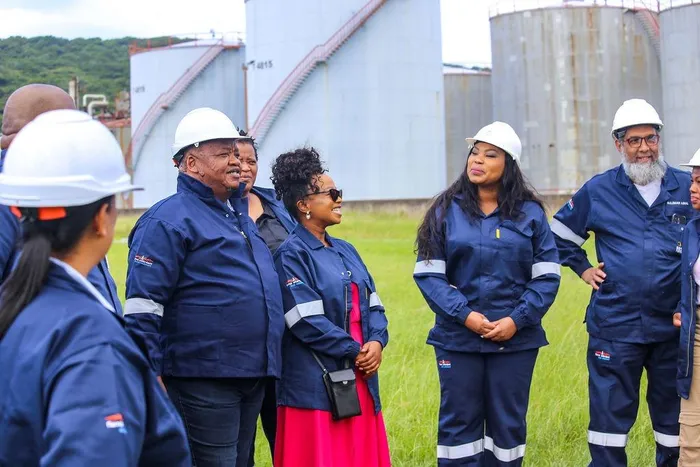
An oversight visit was conducted by eThekwini city manager, Musa Mbhele, and deputy minister of Mineral and Petroleum Resources, Phumzile Mgcina, to the former SAPREF refinery in Prospecton, as the government moves to revive the idle facility and reposition it as a key industrial asset.
Image: eThekwini Municipality
Environmental justice organisations are opposed to government plans to revive the former SAPREF refinery in south Durban, citing longstanding health, environmental and safety concerns.
The pushback follows an oversight visit earlier this week by eThekwini city manager, Musa Mbhele, and deputy minister of Mineral and Petroleum Resources, Phumzile Mgcina, to the former SAPREF refinery in Prospecton, as the government moves to revive the idle facility and reposition it as a key industrial asset.
Located near densely populated communities including Wentworth, Merebank, Bluff, Isipingo, Chatsworth and Umlazi, the refinery has long been a focal point of environmental and public health concerns.
Community groups say residents were not consulted about the sale of the facility or plans for its revival.
For decades Sapref was the largest refinery in South Africa until it permanently shut down in 2022. The defunct refinery was then sold to the Central Energy Fund for R1.
Desmond D'Sa, coordinator of the South Durban Community Environmental Alliance, believes the government has taken on the burden of an old and rusty refinery that has caused huge problems for the citizens living in the surrounding vicinity.
D'Sa said he has been working on the issue of Shell for over 32 years, with regard to the environment, the number of explosions and pipeline leaks.
"This refinery should have never been sold because of the litany of fires and explosions over many years. My belief is that our government has taken on the burden and tax payers will pay for the rest of their life.
"It has not been operational since 2022. This refinery is very dangerous. During Covid they started up the refinery and it blew up. What happens if it blows up again and the infrastructure blows up? Why would you buy a refinery as old and rusty as Engen that is going to cause huge problems for the citizens of Merebank, Wentworth, Bluff, Isipingo, Lamontville. Government has got no money if something happens? This refinery has blown up so many times," he said.
He said they will be demanding a meeting to raise their concerns.
"The community groups were never consulted. We don't think the government should be taking on the burden. Sapref must clean up their mess and contaminated water and soil," he said.
He also questioned the state’s capacity to manage and rehabilitate the facility.
D'Sa said the local government should have never gotten involved because they can't fix infrastructure like pipeline, sanitation, sewerage and water.
"Where will they get billions to put into a oil refinery? Why would they get involved in a refinery that has been blowing up. They don't even have an emergency plan.
"They are talking about getting the refinery up and running in 10 years and creating jobs. In 10 years there might not be crude oil at all. How many jobs will they create? They misleading the public," said D'Sa.
D'Sa cited a history of incidents at the refinery, including a 1988 explosion and recurring pipeline leaks, as well as health impacts in surrounding communities.
"Shell and BP had double standards in SA and in Europe. In Europe there was less emissions and complaints. When Shell pipeline blew up again they brought in their reputational managers from Amsterdam to try and quell the community. They were forced to change the rotten pipeline that was leaking underground into people's swimming pools and into the harbour.
"At schools in Merebank, the rate of asthma was 53% and of that over 50% was chronic asthma. A number of children had cancer in Merebank and the Bluff," said D'Sa.
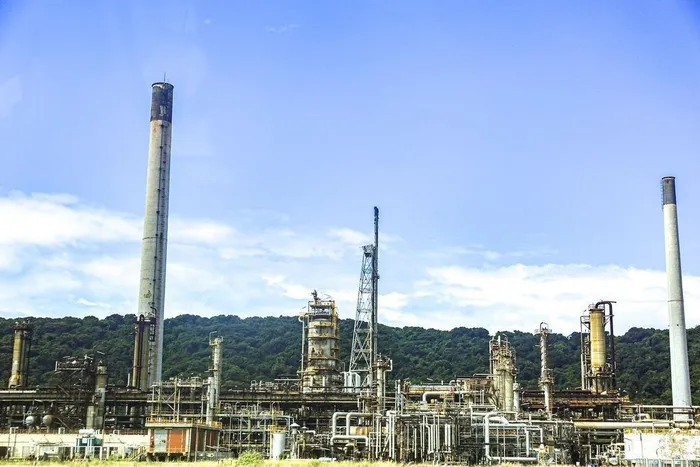
The Sapref refinery in the south of Durban
Image: eThekwini Municipality
Bobby Peek, executive director at Groundwork, questioned where government would be getting the money from to reopen the very old refinery.
"It is past its sell-by date and has been severely neglected by Shell and BP. In a system where we are rapidly moving beyond fossil fuels it's going to cripple the fiscus and it's going to cost the government and taxpayer money. That money could be spent on ensuring energy access for mass transportation for people.
"It's a dead white elephant and it's irresponsible for the government to be speaking about a just transition and opening up an oil refinery that will not be able to be opened up because it's so damaged. Instead they could put that public money to use for mass public transport systems that will get us out of this present crisis," said Peek.
He said Shell and BP should be held accountable for the historical damages.
"The area is a toxic dumpsite now. It needs to be cleaned up in an appropriate and safe manner rather than re-establishing an alternate fossil fuel facilty in those areas.
"Starting up the facility will bring back the historical injustice we have dealt with for many years. It's unfair to the community. What the Minister and president should be doing under the Presidential Climate Commission, which I specifically highlighted at the Commission, that by them not dealing with the oil refineries in south Durban there's no just transition for south Durban," said Peek.
Peek said the matter would be escalated to multiple levels of government, including Parliament.
"There has been no democratic and formal consultation. These decisions around big fossil fuel infrastructure are very often undemocratic and are often challenged in court," said Peek.
According to a statement issued by the City, the facility, now rebranded as the South African National Petroleum Company (SANPC) Refinery, is being repositioned in a coordinated effort between national and local government, as a key driver of industrial renewal.
Strategically located within the petrochemical value chain and adjacent to the Port of Durban’s logistics hub, the refinery is central to the economic vitality of KwaZulu-Natal.
“This is more than a technical inspection; it signals strong alignment between national and local government,” said Mgcina.
Mbhele added: “The SANPC Refinery is a critical asset for both the municipal and national economy. Its revival will ensure that eThekwini remains globally competitive in industrial development.”
According to the statement, the refinery’s return to operation is expected to unlock strategic crude supply opportunities aligned with BRICS partnerships.
"By leveraging South Africa’s membership, the facility aims to secure more reliable and diversified energy sources, contributing to greater fuel price stability. In the context of ongoing global geopolitical uncertainty, this approach supports a more resilient and self-reliant energy framework.
"As South Africa navigates a rapidly evolving energy landscape, the revival of the SANPC Refinery highlights the country’s commitment to sustainable growth, operational excellence, and economic resilience," it further stated.
The project is expected to create approximately 12,500 construction jobs and 2,850 permanent positions, contribute an estimated 1.8% to national GDP, and prioritise local participation through a 65% local content threshold.