

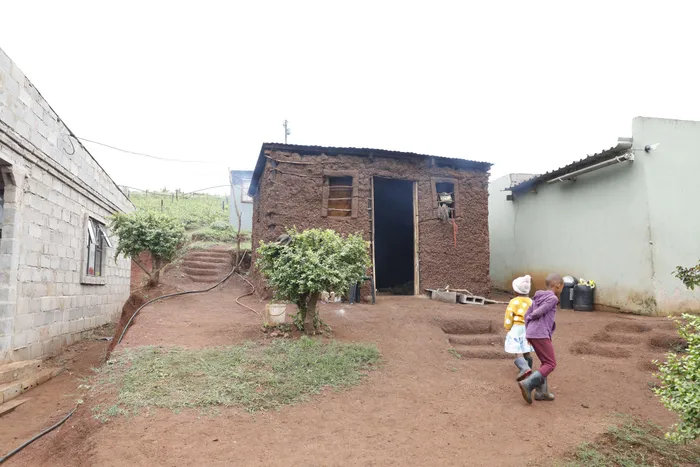
Some of the children who had been loitering without attending school at the religious sect’s smallholding, iKhaya Labafundi bakaJesu (Home of Jesus’ Disciples), in Dabangu village, KwaMaphumulo, were removed this week by officials from the KwaZulu-Natal Department of Social Development following an outcry from various sectors.
Image: DOCTOR NGCOBO Independent Newspapers
The Department of Social Development (DSD) in KwaZulu-Natal has finally intervened in the controversial religious sect in Dabangu village, KwaMaphumulo, which has been in the news for abandoning a conventional lifestyle in favour of subsistence farming and perpetual worship.
The department pounced on the religious sect's smallholding, iKhaya Labafundi bakaJesu (Home of Jesus's Disciples) midweek removing children who had been forced to drop out of school and were met with ululation and jubilation from the nearby community as officials engaged with the sect's leader Reverend Vusumuzi Sibiya, and some of the parents.
The DSD was accompanied by officials from the KZN Department of Health and representatives of the interfaith community, who collectively denounced the sect’s practices, citing its risky advice on antiretroviral (ARV) treatment for HIV-positive members and its interpretation of scripture, respectively.

The KwaZulu-Natal Department of Social Development has intervened in a KwaMaphumulo-based religious sect whose members have abandoned work, studies and family life to pursue a faith-based, communal farming lifestyle. HIV-positive members have reportedly stopped taking antiretroviral treatment, placing their faith in divine healing. The group is led by its founder, Reverend Vusumuzi Sibiya (black jacket).
Image: DOCTOR NGCOBO Independent Newspapers
One of the disciples, Ntokozo Mkhize, a University of Cape Town computer science dropout, confirmed that the children were taken away.
Mkhize said they were not worried, as God would fight for them in the situation they are facing.
"What was happening here was like a movie. Twenty cars arrived here, but we know God will not forsake us," said Mkhize.
Mkhize said those who took the children to relatives did so on the basis of wanting a better life for them.
"According to them, the children should eventually attend school," said Mkhize.
Reverend Sibiya's daughter, Nosipho, said that even though the children were taken away, they are not worried as their God will fight for them.
"We trust in God so much; there is no situation He won't conquer for us," said Nosipho.
Pressure had been mounting on the religious sect after KZN Health MEC Nomagugu Simelane and the Chairperson of the Culture, Religion and Linguistic (CRL) Rights Commission, Thoko Mkhwanazi-Xaluva, both separately denounced it.
Simelane, speaking at a religious gathering in Mzinyathi, north of Durban, over the Easter weekend, went as far as calling for the arrest of anyone encouraging HIV-positive members of the sect to stop taking their ARV treatment.
Mkhwanazi-Xaluva was equally dismissive of the sect's rule banning children from attending school.
Even before their public denunciation of the sect, the nearby community had raised the alarm about Sibiya's group in the area.
Some residents complained about noise from the sect's all-night sermons and singing, with the disturbance worsened by the use of loudhailers.
Residents who spoke on condition of anonymity when the Sunday Tribune first published the story two weeks ago labelled Sibiya as a well-connected individual, citing an incident where social workers attempted to remove children from the sect, only for them to be returned a few days later.
Education in Sibiya's sect is denounced, with the biblical scripture being the only literature embraced among the faithful.
Some members, who now rely on harvested crops such as sweet potatoes, madumbe, mealie meal, guavas, avocados, and meat from their livestock of chicken, cattle and pigs, left comfortable lives as business owners, retail staff, and students.
There is also a husband who abandoned his wife in the Eastern Cape to follow the sect's way of life. The women members shuffle across the yard in flat shoes or slippers, their hair covered in head wraps, with A-line midi and maxi dresses and skirts as their preferred attire, while pinafore dresses remain a popular choice.
Despite having access to electricity, they prefer to cook with three-legged cast iron pots over open fires. Concerns about this secluded religious lifestyle, from nearby community members, the MEC of Health, and the CRL Commission, do not appear to trouble the sect’s followers, who remain steadfast in their belief that God is the answer to every challenge, including livelihood and incurable diseases like HIV.