

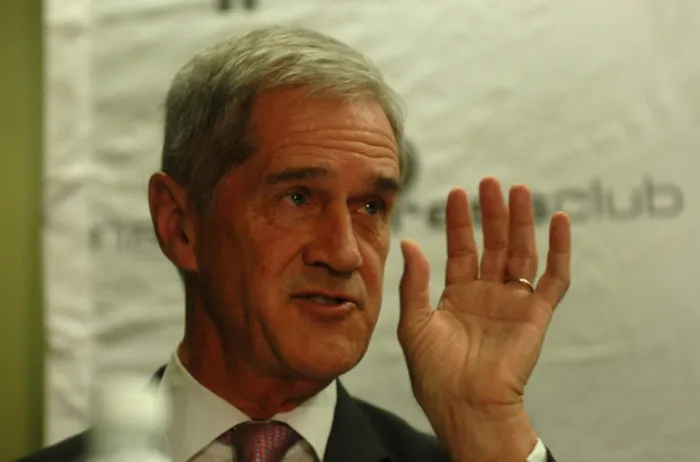
Veteran politician Roelf Meyer has been designated South Africa’s next ambassador to the United States.
Image: Oupa Mokoena / Independent Newspapers
President Cyril Ramaphosa's appointment of veteran politician Roelf Meyer as the country’s ambassador to the United States, has drawn criticism from opposition parties but some analysts view the move as a strategic attempt to ease tensions with Washington.
The appointment comes amid strained relations between Pretoria and Washington.
Meyer will replace the ambassadorial position left open when Ebrahim Rasool was expelled in March last year, following his criticism of US President Donald Trump. US Secretary of State Marco Rubio at the time declared Rasool persona non grata.
Declining to be interviewed, Meyer explained that he is waiting for the accreditation process to conclude and anticipates leaving for the US in roughly three months thereafter.
Political analyst Zakhele Ndlovu said Meyer's appointment would appease the Trump administration.
He said one could make a strong argument that Meyer is the ideal candidate because of the US administration.
"The Trump administration has been very hostile towards the ANC. To have someone outside of the ANC representing SA in the US is something the Trump administration would welcome. South Africa has been punching above its weight in its dealings with the US and I think the ANC has put its interests over those of the country. The US is a powerful country and SA is not a powerful country, but it has been trying to punch above its weight by not allowing itself to be bullied by the US.
"By having someone like Roelf Meyer as the ambassador I think most people would welcome that and it would appease the Trump administration. When one looks at his background, he was one of the chief negotiators. He's got good negotiating skills which should serve the country well," said Ndlovu.
He added that tensions have been exacerbated by US accusations that South Africa was committing genocide.
"To have an Afrikaner representing South Africa speaks volumes about how this claim of genocide cannot be sustained. I think President Ramaphosa was pushed or forced into making this kind of appointment. Why would it take a year to replace Ebrahim Rasool. I think they were trying to figure out who will appeal to the Trump administration.
"Ramaphosa finally came to his senses and appointed someone that would be welcomed by the Trump administration, but I don't think just one individual can play a role in stabilising relations between the two countries. I don't think this will fundamentally change or reset the relations between the two countries," he said.
Ndlovu also pointed to South Africa’s case against Israel at the International Court of Justice as a continuing source of friction.
"Until SA withdraws that case I don't think it would change anything," said Ndlovu.
Political analyst, Dr Lubna Nadvi, said Meyer's appointment has drawn mixed reactions due to his deep involvement in the country's former apartheid regime.
She added that many consider this involvement to effectively compromise his ability to represent South Africa abroad.
"However to others, they consider it appropriate even strategic for him to go to the United States as a white South African who can represent South Africa's business and political interests and be more palatable to the current Trump administration than an ambassador of colour.
"While South Africa should not have to appoint ambassadors based on race or religion, the current United States government has placed South Africa in a specific category. It believes that white citizens (especially Afrikaners) are being discriminated against in the current dispensation and refuses to believe otherwise.
Nadvi said they were also very upset that the South African government took Israel to the ICJ and accused it of genocide.
"Hence, in that context, it might be pragmatic for a white diplomat to be appointed to the post; someone who can rebuild relationships with the United States, which South Africa considers a key strategic trading and political partner.
"It is most unfortunate that the South African government resorted to such measures or even chose to do so, but it can be understood as a realpolitik move, one that is almost Machiavelian in its orchestration. "Only time will tell how effective Meyer will be in the role," Nadvi said.
Opposition parties have strongly criticised Meyer’s appointment.
The Economic Freedom Fighters (EFF) described it as not only politically tone-deaf, but a deliberate insult to the country's democratic struggle.
"Roelf Meyer’s history locates him as a central figure within the apartheid state, having risen through the ranks of the National Party, the political instrument that engineered and enforced racial oppression in South Africa.
"He went on to hold several key positions within the apartheid government, including Deputy Minister of Law and Order and later Minister of Defence. The Department of Law and Order was directly responsible for the police machinery that enforced apartheid laws, crushed political opposition, and maintained a regime built on fear and violence," read a statement.
It further stated that Meyer's involvement in the transition process in the 1990’s cannot be used to sanitise or erase his earlier role in upholding apartheid.
"The EFF firmly rejects the narrative that such an appointment represents “experience” or “stability.” Instead, it reflects a dangerous willingness by the current administration to appease Trump’s white supremacist whims by presenting a figure who is palatable to white power structures," said the EFF.
The MK Party also rejected the appointment by saying Meyer was not an ordinary former politician.
"He was a senior Minister in the apartheid regime and later served as the National Party's chief negotiator during the constitutional negotiations that shaped the political settlement of the early 1990s. He sat across the table from Cyril Ramaphosa as one of the principal architects of that negotiated settlement," said Nhlamulo Ndhlela, MK Party national spokesperson.
Ndhlela said the appointment of Meyer cannot be divorced from the political relationship between him and Ramaphosa.
"This decision reflects not national consensus, but the extension of favour and familiarity between negotiating partners of the past.
"At a time when geopolitical tensions are intensifying and narratives about South Africa are increasingly contested in international forums, our country requires representatives who embody the aspirations of a democratic and sovereign nation, not figures whose political legacy is rooted in managing the transition away from apartheid on terms that preserved elements of the old power structure," said Ndhlela.
Meanwhile, chairperson of the Portfolio Committee on International Relations and Cooperation, Supra Mahumapelo, said they were looking forward confidently and with optimism to Meyer's contribution in taking the relations between the two countries forward.
“The best of all is that South Africa and the United States both believe in dialogue, democratic values and working together to address any challenges,” he said.
Mahumapelo said Meyer previously played a significant role as an international peace mediator in Northern Ireland, where he enhanced trust and facilitated reconciliation between the various political stakeholders in the conflict.