

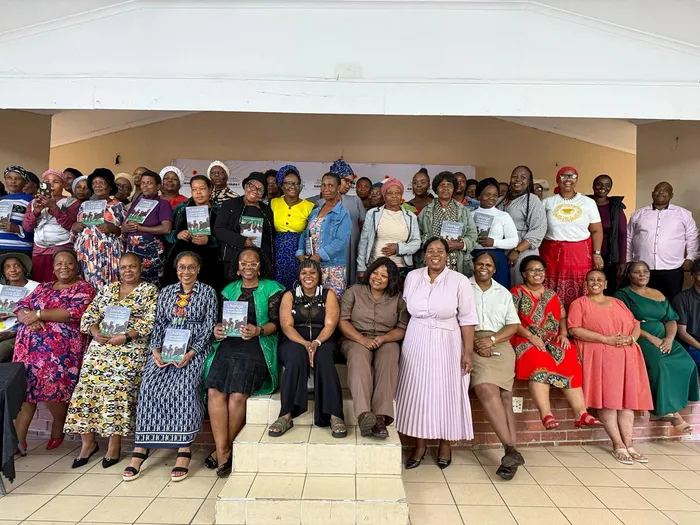
A new book, Ukonga Among Women in Rural Spaces, was launched by the Nelson Mandela Children’s Fund together with the University of Zululand this week. The book details how women in eShowe are build thriving livelihoods.
Image: Supplied
Women in rural KwaZulu-Natal are building sustainable livelihoods, supporting their families, and reshaping their communities through self-help groups, according to a new book launched by the Nelson Mandela Children’s Fund.
Ukonga Among Women in Rural Spaces captures the real-life impact of community-led initiatives in eShowe, where women have created income streams through poultry farming, vegetable cultivation, and small businesses, reducing dependency on state support and strengthening local economies. The book was launched on April 22, 2025.
Developed in partnership with the University of Zululand, the publication combines academic research with lived experience, offering rare, evidence-based insight into how grassroots development can drive long-term change. The project forms part of the Fund’s Sustainable Livelihoods Programme, rooted in Nelson Mandela’s vision of dignity, self-reliance, and collective action.
Ukonga Among Women in Rural Spaces tells the story of how women’s self-help groups in eShowe, within the uMlalazi Local Municipality, have become powerful agents of transformation, driving financial independence, strengthening families, and building resilient communities.
Through partnerships with community facilitators, including the KwaZulu-Natal Christian Council, these groups have:
In many cases, women who previously had no stable income are now contributing directly to household finances, paying school fees, and investing in their futures.
“These groups are proving that when women are given the tools and support to succeed, the impact extends far beyond the individual. It strengthens entire communities,” said Dr Linda Ncube-Nkomo, CEO of the Nelson Mandela Children’s Fund.
What sets Ukonga Among Women in Rural Spaces apart is its combination of personal storytelling and rigorous research.
Led by the University of Zululand, the study documents both the lived experiences of participants and the measurable socioeconomic impact of the programme. The result is a practical, evidence-based model for community-led development, which can inform policy, guide implementation, and be replicated in similar contexts across South Africa and beyond.
A representative, Dr Sma Cele from the University of Zululand, said: “This work bridges the gap between research and reality. It shows how local knowledge and lived experience can inform scalable, evidence-based solutions that respond directly to community needs.”
At the heart of the book are the voices of the women themselves.
Members of the self-help groups describe how collective action enabled them to move from financial insecurity to stability, starting with limited resources, but building sustainable solutions through shared effort and knowledge.
“This book tells the story of how we came together and supported one another,” said a member of one of the self-help groups, mama Winile Dlunge. “We started small, but today we are able to provide for our families and create opportunities for our children. It shows what is possible when women work together.”
Beyond its storytelling, the book offers a clear message to policymakers, development practitioners, and partners: community-led solutions work, and they can be scaled.
By combining grassroots participation with structured support and research, the model demonstrated in eShowe offers a viable pathway for addressing poverty, inequality, and limited access to opportunity in rural areas.
As the Nelson Mandela Children’s Fund continues its work, Ukonga Among Women in Rural Spaces stands as both proof of impact and a call to deepen investment in women-led, community-driven development.