

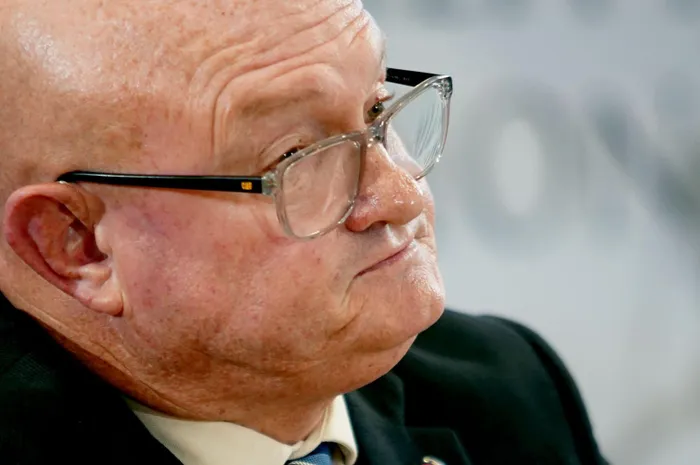
Major-General Hendrick Flynn's testimony at the Madlanga Commission of Inquiry criticises Hawks' handling of cocaine evidence in Port Shepstone in 2021.
Image: Oupa Mokoena/Independent Newspapers
KwaZulu-Natal Hawks head Major-General Lesetja Senona should not have had the key to the "strong room" in Port Shepstone where 541kg of cocaine bricks worth R200 million went missing following a mysterious burglary in June 2021.
Testifying at the Madlanga Commission of Inquiry on Tuesday Major-General Hendrick Flynn, Component Head for Serious Organised Crime at the SAPS Directorate for Priority Crime Investigation (DPCI), stated that after seizing drugs from the Durban depot, the Hawks booked them into the SAP13 at Isipengo police station.
However, the drugs were subsequently booked out due to concerns about insufficient storage space at the facility.
Brigadier Campbell Nyuswa instructed that they be transported to Port Shepstone for storage after consulting with Senona.
He told the commission that Senona was present when the drugs were stored at the Port Shepstone warehouse referred to as a strong room.
He said a proper audit needed to be conducted for the exhibits at the storage facility.
When asked if it was correct for Senona to take possession of the keys given that it was an operational matter, Flynn said that in practice, the SAPS custodian maintains command and control over a SAP13 facility, not the provincial head.
He testified that in instances where the exhibit was left at Isipengo after being booked in, the station commander would have been responsible, and the SAP13 clerk would have ensured it was kept under lock and key.
He said that the moment the DPCI booked the exhibit in and immediately booked it out, they assumed responsibility for it.
He added, however, that the drugs were lawfully removed from the Isipengo police station.
He said ordinarily a key holder would have to satisfy themselves about the exhibits in the warehouse. Flynn said Senona was present when the exhibit was placed in the SAPS13 facility or the vault.
He testified that the SAP13 clerk is the only person allowed to access the vault.
Flynn said that according to the statement and case docket reports regarding the drugs in question Senona later gave Warrant Officer Mpangase the key to access the vault, unseal the exhibits and obtain samples.
The samples were requested by the forensic laboratory science unit, which operates under the SAPS’ detective and forensic unit for analysis.
The commission heard that Senona gave the keys but did not accompany the individuals to ensure they performed their duties correctly.
Flynn criticised the request for samples at that stage, saying they should have been managed at the crime scene.
He told the commission that if Senona had proper control of the key he should have opened that safe himself and not provided the key to anyone under his command to enter that facility because he would "never be able to account for what transpired there in his absence".
He said if he were at that crime scene he would have properly closed the container doors (where drugs were recovered from the port), cordoned off the scene and then requested the Local Criminal Record Centre to arrive. He stressed that preserving evidence at the crime scene is critically important for a successful investigation.
He told the commission that there is substantial progress into the investigation subsequent to his appointment in September 2024.
The commission scrutinised the lack of full-time security at the Port Shepstone storage facility during Senona's recent testimony.
Senona maintained that he took sufficient steps to secure the cocaine, saying he issued an instruction to monitor the facility.
However, conflicting accounts from police officers’ affidavits regarding an instruction to patrol the area showed that one officer expressed unhappiness that the drugs were taken to storage despite the location not being safe.
The officer explained that the Port Shepstone storage had an alarm system, but it was discontinued due to non-payment. A message from the national office confirmed the alarm was removed from the system in December 2020, leaving the facility without active security monitoring.
Flynn's testimony is still under way.
rapula.moatshe@inl.co.za