

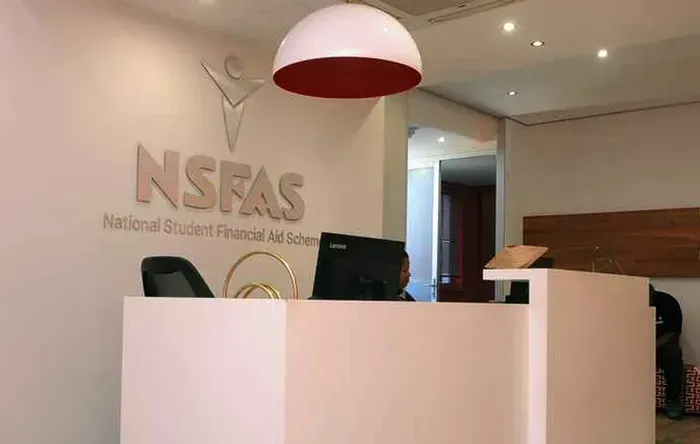
The National Student Financial Aid Scheme, which has been placed under administration, has received a disclaimer of audit opinion for the 2024/25 financial year.
Image: File
The troubled National Student Financial Aid Scheme (NSFAS) has received a disclaimer audit opinion for the 2024/25 financial year from Tsakani Maluleke.
In the report tabled in Parliament this week, Maluleke said she could not express an opinion on the public entity’s financial statements.
“Because of the significance of the matters described in the basis for the disclaimer of opinion section of this auditor’s report, I was unable to obtain sufficient appropriate audit evidence to provide a basis for an audit opinion on these financial statements,” she said.
The audit findings were released only days after NSFAS was placed under administration following the resignation of several board members amid reports of tensions over the appointment of a CEO. The entity is also being investigated by the Special Investigating Unit.
Addressing the disclaimer outcome, Higher Education Minister Buti Manamela acknowledged the difficult path ahead for the organisation.
“The matters raised through the audit process require the entity to implement robust and targeted corrective actions that will drive improvements in accountability, as well as the accurate and reliable recording of information,” Manamela said.
He added that reinforcing the institution’s governance structures would be critical in rebuilding public trust in NSFAS and enabling it to carry out its mandate effectively.
Maluleke said she was unable to determine the extent of the misstatement in bursary expenditure, which was recorded at R45 billion.
According to the report, NSFAS recognised expenditure for students who were incorrectly funded and did not meet the approved eligibility criteria under the NSFAS Act for both the year under review and the previous financial year. This prevented the Auditor-General from securing sufficient evidence relating to bursary expenditure.
The 2023/24 audit was also unable to obtain adequate evidence regarding payments made to students through third-party service providers because of ongoing litigation.
“Consequently, I was unable to determine whether any further adjustments were necessary to the corresponding figure of bursary expenditure – universities and TVET, stated at R34,063 million and R6.213 million, respectively, disclosed in the financial statements.”
Maluleke further stated that sufficient audit evidence could not be obtained for student loans relating to 2024/25 and earlier years.
She attributed many of the financial management failures at NSFAS to weaknesses in leadership and governance structures, including shortcomings within internal audit and the audit committee, which failed to ensure an effective system of internal controls.
“The administrator and executive leadership did not enforce proper oversight over financial management, procurement, and contract administration.
“Persistent audit findings indicate a pattern of disregard for governance responsibilities, with management repeatedly failing to implement corrective actions from prior audits.”
Acting CEO Waseem Carrim said the problems stemmed from longstanding weaknesses in financial reporting, internal controls, and data governance systems.
“NSFAS is implementing enhanced financial management measures, including the introduction of stronger internal controls, improved oversight mechanisms, and more frequent financial reviews and audits.
“In addition, the compliance function will be strengthened to ensure consistent adherence to financial policies, improve transparency, and reinforce accountability across the organisation,” said Carrim.
In her report, Maluleke also found that not all irregular expenditure had been disclosed in the financial statements as required by the Public Finance Management Act (PFMA).
“I was unable to determine the full extent of the irregular expenditure that occurred during the financial year and prior year, as it was impractical to do so,” she said.
NSFAS recorded irregular expenditure amounting to R405 million.
Maluleke further noted that the entity failed to take effective measures to prevent R37.8 million in fruitless and wasteful expenditure.
“The majority of fruitless and wasteful expenditure was due to inadequate laptop asset management. Prepayments were made before services were received, in contravention of Treasury regulation,” she said.
The Auditor-General also found that certain goods and services were procured without obtaining the minimum of three written quotations, as required by Treasury regulations and supply chain management rules.
“Goods and services of a transaction value above R1,000,000 were procured without inviting competitive bids and deviations were approved by the accounting officer, but it was practical to invite competitive bids.”
Carrim outlined several corrective measures aimed at improving NSFAS’s future audit outcomes.
“NSFAS intensified efforts to address governance and control weaknesses identified in prior periods, including those relating to systems, contract management, and consequence management.”