

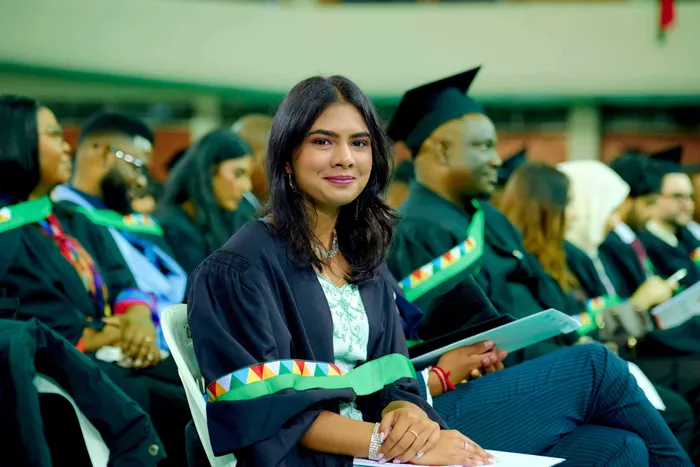
Erin Naidoo master’s research challenged the ocular-centric, or vision-biased, design of built environments. She graduated from the University of KwaZulu Natal on Thursday.
Image: Supplied
Erin Naidoo’s master’s research challenged the ocular-centric, or vision-biased, design of built environments to consider the experiences of visually impaired users, and to expand sighted users’ immersive, fully sensory experiences of public architecture.
Having been fascinated from an early age with design and meaningful building creation, Erin Naidoo spent time watching people and observing how they use and respond to their surroundings.
Naidoo was curious if they were intentionally shaped for different purposes, such as the refuge of a school compared to the vibrancy of a shopping mall. So graduated this week, having done her master's research challenging the the ocular-centric, or vision-biased, design of built environments.
Her study delved into the sensory experiences of public architecture of visually impaired and sighted users.
Coming from Queensburgh, enrolling at the University of KwaZulu-Natal (UKZN) for her undergraduate studies was a given, thanks to its strong architecture programme and the proximity to her home, which eased the transition from school to university. Naidoo went on to complete her honours degree at the University before embarking on a master’s course.
She said the architecture studio and LAN on campus became like a second home and enabled her to bond with peers through long studio hours and shared experiences, a deeply rewarding aspect of her studies.
Naidoo found success in her work, receiving the Garth Moyes Good Fellowship Award in her first year (voted on by her peers), and the Nsika Foundation Scholarship, which supported her studies through to master’s level.
Her passion for architecture is undergirded by her perspective of the discipline as a fusion of people and place.
“Beyond just creating beautiful structures, I am driven by the architect’s unique ability to impact both the environment and the daily experiences of people’s lives positively,” she said.
Her research tackled the emphasis of sight and visual aesthetics in architecture, which can be disorienting for visually impaired users; she investigated how architecture can evolve to embrace design strategies such as touch, sound and scent to create inclusive environments where everyone, regardless of visual ability, can experience and appreciate architecture beyond what is seen.
Her study was titled ‘Exploring Visually-Impaired User Experiences of Public Architecture Towards a Multi-Sensory Community Library in Berea, Durban’.
This approach reframes disability from a “tragedy” into an opportunity for architectural innovation.
“In South Africa, visual impairment is a prevalent disability, yet our public buildings often only meet minimum technical ‘access’ standards and compliance rather than providing a meaningful, enjoyable experience,” said Naidoo.
She sought to advocate for a shift toward Universal Design, in which designing for and considering the most vulnerable results in richer, more legible and more considered environments for everyone. This also promotes social cohesion using public architecture as a tool to challenge and reshape societal perceptions of impairment.
Naidoo was struck by the independence of the visually impaired community, whose mindset, she says, focuses on an alternative way of belonging rather than on disadvantage, and this led her to question whether it is the sighted who are “impaired” by an over-dependence on vision.
She found herself learning from this community in a humbling moment that taught her not to view people with impairments as “subjects” but to treat them as expert consultants on the human experience.
The design component of her research was awarded third place at the Corobrik Regional Student Awards.
Despite beginning her master’s with less industry experience than her classmates, she overcame this “imposter syndrome” by following a rigorous schedule of dedication and by surrounding herself with a strong support group, which fuelled her hard work.
“Stepping out of my comfort zone ultimately allowed me to find my voice and taught me that while architecture demands individual grit, you never truly reach the finish line alone,” said Naidoo.
While conducting research, she worked as a tutor and mentor for undergraduate architecture students, demonstrating strong time management and discipline to balance her workload and strengthen her own learning while assisting others.
Naidoo is now applying her knowledge and skills in a professional setting and once completing her candidacy, she hopes to travel and possibly work abroad, gaining exposure to architecture on a global scale. In the future, she aspires to return to academia and pursue a PhD in architecture.