

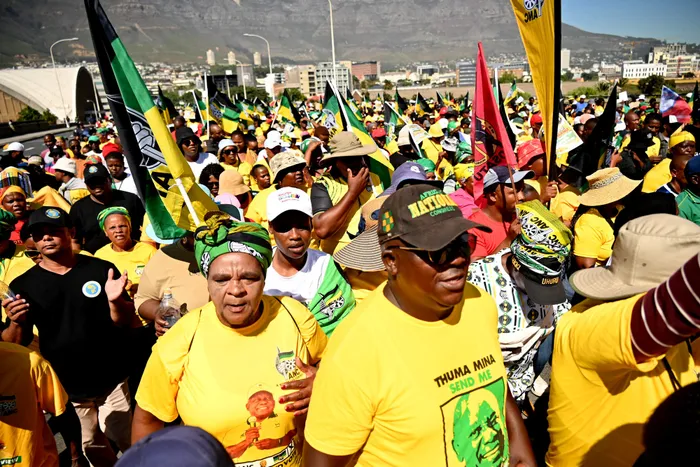
South Africa currently faces a period of uncertainty as the African National Congress (ANC) declines, prompting reflections on the future of the post-1994 settlement. This decline raises significant questions about the fate of the ideals set forth during the country’s transition into democracy, argues political economist Nco Dube.
Image: AYANDA NDAMANE Independent Newspapers
There is a particular kind of silence that settles over a country when a long story reaches its final chapter. It is not the silence of peace, nor the silence of defeat. It is the silence of reckoning. South Africa is entering that silence now as the African National Congress, once the architect of the democratic dawn, continues its slow descent from the centre of national life.
For years, South Africans have asked the same question in taxis, taverns, churches, WhatsApp groups and boardrooms: what happens when the ANC finally falls?
Analyst Siyabonga Hadebe recently sharpened that question, arguing that the ANC’s decline is not merely the collapse of a political party, but the unravelling of the entire post-1994 settlement. The idea of unity, the fragile dream of a rainbow nation, the promise of employment equity and the rise of a Black middle class all became tied to the ANC’s political dominance.
If the ANC falls, does the 1994 project fall with it? Do the freedoms of the Constitution lose their guardians? Do Black South Africans lose hope of becoming first-class citizens in the land of their birth?
These are not academic questions. They are the anxieties of a society standing at the edge of uncertainty.
A movement that cannot learn
The deeper tragedy beneath the ANC’s decline is that the party appears unable to learn from its own failures.
The Arms Deal should have been the warning shot. It introduced South Africans to the language of kickbacks, denials and political protection. It was the first major sign that the liberation movement was becoming seduced by power and money.
Then came Nkandla, a scandal so brazen it felt surreal. A swimming pool became a “fire pool”, while state institutions twisted themselves into knots to defend presidential excess. That was the moment the ANC could have drawn a line and reclaimed its moral authority.
Instead, it defended the indefensible.
Parliament was whipped into submission, the Public Protector was attacked and constitutional accountability became secondary to party loyalty.
One would think the humiliation of Nkandla would force reflection. But then came Phala Phala, another scandal wrapped in secrecy, money and institutional paralysis.
Phala Phala is not Nkandla’s twin. It is its echo.
Again, the ANC faced a choice between principle and protection, between renewal and reflex. Once again, paralysis prevailed.
A movement that cannot learn becomes a movement that cannot change. A movement that cannot change becomes a movement that cannot govern. Eventually, a movement that cannot govern cannot survive.
The real question is no longer whether the ANC will fall. The question is what rises in the vacuum left behind.
Does the 1994 project die with the ANC?
The 1994 democratic project never belonged solely to the ANC. It was a national covenant between generations, built on the promise that South Africa would attempt to create a society where dignity was a birthright, not a privilege.
The ANC became the steward of that promise, but it was never the promise itself.
If the ANC falls, the democratic project does not automatically collapse. But it does lose its most recognisable custodian, forcing South Africans to confront whether the dream can survive without the movement that carried it into power.
The rainbow nation was always more aspiration than reality. It was a national prayer whispered into a deeply wounded society. Over time, inequality deepened, racial tensions simmered and economic exclusion persisted.
The colours of the rainbow began fading.
The ANC’s decline now exposes the fragility of that dream. Yet even fading ideals can be restored if there is enough political courage and moral imagination to rebuild them.
The Constitution remains the anchor
If one institution has endured through corruption scandals, political decay and institutional collapse, it is the Constitution.
The Constitution does not belong to the ANC. It belongs to the people.
It remains the strongest democratic safeguard South Africa possesses, a lighthouse standing against the storms of corruption, inequality and factional politics.
But constitutions do not defend themselves.
They require citizens who understand that rights are not self-sustaining and that democracy survives only when people actively defend it. The Constitution is a promise, but promises mean little without public commitment to enforcing them.
What happens to Black aspiration?
Perhaps the most painful question is what becomes of the aspiration that Black South Africans will one day become fully equal citizens in their own country.
The ANC was meant to be the vehicle carrying that hope. But in many respects, the vehicle stalled.
Still, the aspiration itself is older than the ANC and even older than apartheid. It belongs to generations who endured dispossession yet continued believing in dignity, advancement and justice.
Black aspiration does not die with the ANC. But it may now need new political homes, new economic ideas and new moral leadership.
The greater danger is not the collapse of the ANC. The greater danger would be allowing Black aspiration to collapse with it.
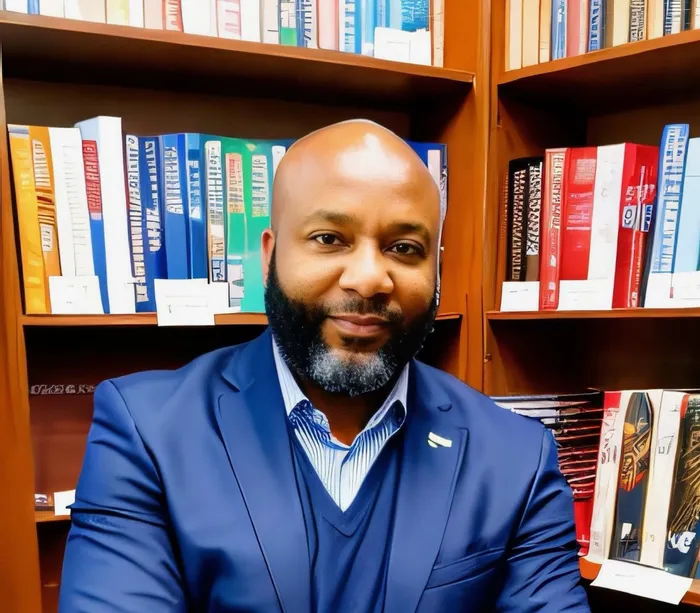
Nco Dube is a political economist, businessperson and social commentator
Image: Supplied
Hope beyond the ANC
Hope is not a feeling. It is discipline. It is the stubborn belief that tomorrow can improve despite the failures of today.
South Africa’s future does not depend on the survival of one political party. It depends on whether citizens can build a new political culture grounded in accountability, competence and ethical leadership.
The ANC’s decline may mark the end of an era, but it is not the end of the South African story.
Hope lies in citizens refusing to become spectators. It lies in communities that continue surviving despite state failure. It lies in civil society, the courts and young people unwilling to inherit a broken country without resistance.
Most importantly, hope lies in the understanding that no party is sacred.
The ANC may fall. But the dream of 1994 does not have to fall with it. That dream can still be reclaimed, renewed and rebuilt.
The future of South Africa will not be decided by whether the ANC survives. It will be decided by whether South Africans still believe deeply enough in the country they once promised themselves.
(Dube is a noted political economist, businessperson and social commentator on Ukhozi FM. His views do not necessarily reflect those of the Sunday Tribune or IOL)
For more from the Sunday Tribune, follow us on Facebook, Instagram and X