

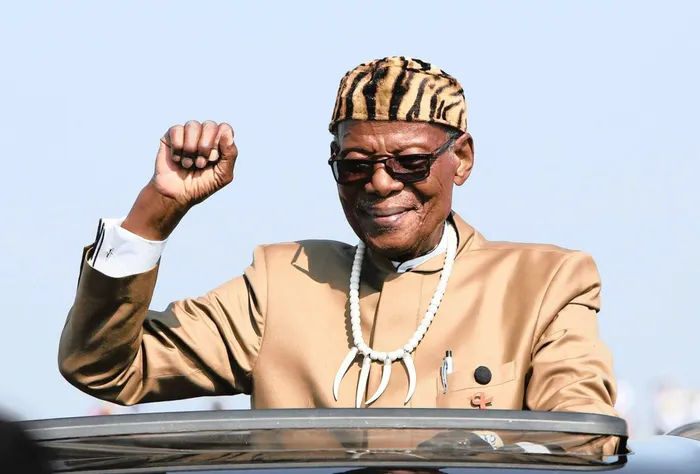
The founder of the Inkatha Freedom Party, Mangosuthu Buthelezi, was the glue that held together competing forces within the party. Since his passing, dissenting voices have grown louder, despite efforts by the party leadership to keep simmering factional battles under wraps.
Image: Independent Newspapers Archives
The growing divisions within the Inkatha Freedom Party (IFP) are beginning to stir fears that one of South Africa’s oldest political parties could be entering its most dangerous period since its formation 51 years ago.
For months, tensions within the party have simmered beneath the surface. But recent events, including leaked voice notes, allegations of intimidation, suspensions of senior members and open factional hostility, suggest the cracks may now be too deep to conceal.
Political history in South Africa offers many warnings about what happens when dominant parties become consumed by internal warfare. The IFP itself has travelled this road before. The ANC has travelled it too.
The question now being quietly asked in political circles across KwaZulu-Natal is whether the IFP can survive the storm gathering inside its own ranks.
Lessons from the ANC’s decline
South Africa’s political landscape is littered with examples of parties weakened by internal conflict.
The ANC’s decline did not happen overnight. It began with factions competing for control of the movement and eventually spiralled into splinter parties, leadership wars and electoral decline.
The turning point came at the ANC’s 2007 elective conference in Polokwane, where supporters of former president Jacob Zuma defeated those aligned to then-president Thabo Mbeki.
The aftermath reshaped South African politics.
Disgruntled ANC leaders broke away to form the Congress of the People (COPE), which went on to secure more than a million votes and 30 seats in Parliament in the 2009 elections. Although COPE later collapsed under the weight of internal leadership battles, the damage to the ANC had already begun.
The fractures continued.
Former ANC Youth League president Julius Malema was expelled from the ANC in 2012 and later formed the Economic Freedom Fighters (EFF), a party that rapidly became a powerful force in national politics.
Years later, Zuma himself would become the ANC’s biggest internal rebellion when he publicly announced that he would not vote for the ANC. His uMkhonto weSizwe Party (MKP) surprised many in the 2024 elections, contributing significantly to the ANC losing KwaZulu-Natal and Gauteng.
The ANC’s experience has become a cautionary tale for every political movement attempting to manage internal rivalries while holding onto power.
The IFP’s own painful history
The IFP knows the cost of political fragmentation better than most.
When former IFP national chairperson Zanele kaMagwaza-Msibi broke away to form the National Freedom Party (NFP), the consequences were devastating for the party.
In the 2011 local government elections, the IFP suffered major electoral losses and was left controlling only two municipalities.
That political wound has never been fully forgotten within the party.
For years, however, the late IFP founder Mangosuthu Buthelezi managed to keep internal tensions under control. Even where disagreements existed, Buthelezi’s authority and stature often prevented disputes from exploding publicly.
But since his retirement from active leadership in 2019 and subsequent passing, the political glue that held the organisation together appears to be weakening.
Voice notes expose growing divisions
Recent leaked recordings have exposed the extent of the tensions now gripping the party.
One widely circulated voice note allegedly features KwaZulu-Natal Legislature member and IFP Youth Brigade chairperson Mncedisi Maphisa speaking to party member Lindi Ndlovu.
In the recording, Ndlovu allegedly expresses anger over being sidelined during branch inauguration processes and refuses to wear a T-shirt bearing the face of IFP president Velenkosini Hlabisa.
She also allegedly claims that members aligned to her faction were blocked from attending branch inaugurations after stones were placed on roads leading to venues.
Maphisa allegedly responds by urging members of his faction not to allow themselves to be used by opposing groups. The recording further contains inflammatory remarks directed at rival members within the party.
The fallout was immediate.
Both Maphisa and Ndlovu were suspended and are expected to face internal disciplinary proceedings.
But the controversy did not end there.
Another leaked recording, allegedly linked to Newcastle Municipality Speaker Thengi Zulu, surfaced shortly afterwards. In that audio clip, a person believed to be Zulu is allegedly heard discussing plans to undermine rival factions during branch inaugurations.
Together, the recordings have reinforced perceptions that internal divisions within the IFP are escalating into open factional warfare.
The battle for the post-Buthelezi IFP
At the centre of the divisions is a growing struggle over the future direction and leadership of the party.
Within IFP structures, two dominant factions are increasingly being discussed openly.
One faction, known as Abusekho Ubunzima (AU), loosely translated as “No More Hardship”, is believed to support Hlabisa’s leadership.
The other grouping, Konke Kuhamba Kahle (KKK), meaning “Everything is Going Well”, is reportedly pushing for changes in the party leadership and is linked to provincial chairperson Thami Ntuli, even though there has not been any proof of that.
None of the leaders have publicly acknowledged or rejected the existence of the AU and the KKK.
Although senior party leaders have attempted to downplay the tensions, warnings from within the organisation suggest deep concern about the possible consequences.
IFP deputy president Mzamo Buthelezi recently issued one of the strongest public warnings yet about the growing divisions.
Speaking at an event in Nquthu, Inkosi Buthelezi cautioned party members against allowing factional battles to destroy the organisation.
“This thing of us fighting each other will hurt us a lot. As an organisation we are not ready to deal with the consequences of what we are starting,” he warned.
“In other words, this thing of us fighting each other will completely destroy us. We will wake up tomorrow without these seats we have.”
Power, positions and political survival
Political analyst Zakhele Ndlovu from the University of KwaZulu-Natal said the tensions within the IFP are not surprising given the party’s growing access to political power.
“The Prince (Buthelezi) was the one who held the party together. He was the glue,” Ndlovu said.
He noted that Buthelezi’s authority allowed the party to contain internal disputes for decades, but that balancing force no longer exists.
Ndlovu believes another major source of conflict is access to government positions and political influence.
“The IFP is now in municipalities, in the KwaZulu-Natal government and in national government. Positions will be contested because everyone wants bread. There are people unhappy because they did not get positions,” he said.
The IFP’s resurgence in recent years brought renewed political relevance and influence, particularly in KwaZulu-Natal. But with political power has come intensified competition within the organisation itself.
These internal divisions manifest precisely when the party is maximising its public visibility and reclaiming substantial support, most notably within the rural electorate, as evidenced by its recent by-election victories.
For more from the Sunday Tribune, follow us on Facebook, Instagram and X
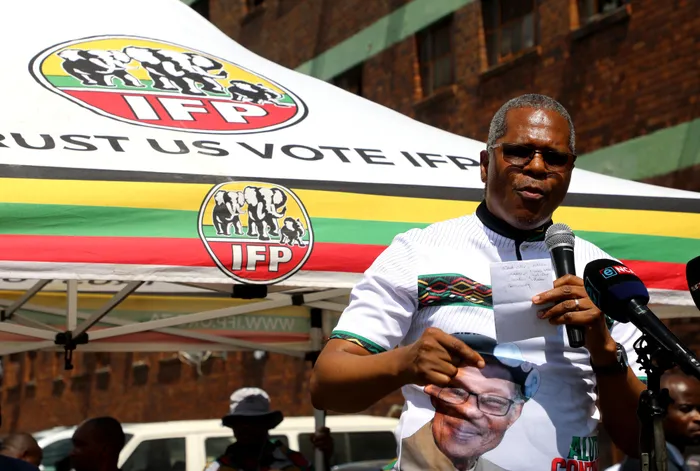
IFP President Velenkosini Hlabisa has issued a stern warning to party members fuelling divisions over campaign T-shirts bearing either his image or that of the late IFP founder, Mangosuthu Buthelezi, ahead of the local government elections.
Image: Independent Newspapers Archives