

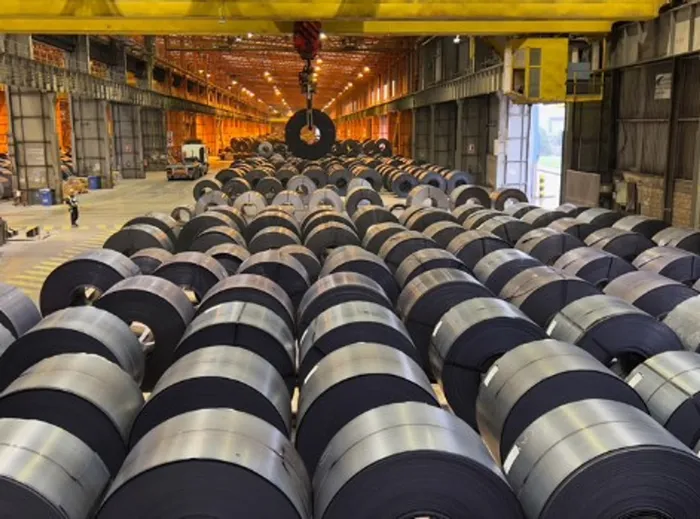
Global oversupply drives cheap steel imports, threatening SA’s industry.
Image: File
South Africa’s steel industry is facing mounting pressure as a flood of cheap imported steel undercuts local manufacturers, threatens thousands of jobs and accelerates the decline of one of the country’s most strategic industrial sectors.
This warning comes from Ayabonga Cawe, chief commissioner of the International Trade Administration Commission of South Africa (ITAC), who defended newly gazetted tariff adjustments and safeguard measures aimed at protecting domestic steel producers from growing global overcapacity and unfair competition.
Speaking this week following the publication of revised import duties on a range of steel products, Cawe said the local industry had reached what many stakeholders described as an “emergency situation”.
According to Cawe, imported steel products are cheaper largely because the world is producing far more steel than global demand can absorb.
He said countries such as China, India and Turkey have massively expanded steelmaking capacity through the construction of new smelters, furnaces and industrial plants over the past two decades. However, demand for steel has not grown at the same pace.
“I think there are two things that make steel products cheap. The first is that in the last 20 years, you have seen massive expansion by the way of the implementation of new smelters, kilns, and so on in many parts of the world. Whether you're talking about Turkey, India, China, or certain other parts of Asia, or even here on the continent, you have not had a similar expansion in the extent of demand as revealed by the distribution of purchasing power,” Cawe said.
“So you've had a massive pile-up of capacity on the supply side, massive inventory. But actually there hasn't been a corresponding rise in the demand for steel. There hasn't been as much infrastructure built, hasn't been as much residential and household renovation. All of the things that determine demand have not moved in a direction that follows the massive pile-up of machinery and capital kit to make steel that has been seen.”
Cawe added that this has also happened alongside the key countries that used to consume a lot of steel putting up more barriers, such as in the European Union.
And because steel plants are costly and energy-intensive to shut down and restart, producers often continue operating even when demand weakens.
Cawe said this creates large inventories that must be exported into global markets, frequently at extremely low prices.
“A steel plant is not something you can switch on and off. You end up having to take on a lot of inventory. And that inventory, if it can’t be absorbed in your own country, you have to export,” he said.
South Africa has become increasingly vulnerable to these global pressures as cheap imports gain market share locally.
Cawe said imported steel is entering the country at prices below the cost at which local producers can manufacture comparable products.
“We are seeing massive price injury in the form of cheap steel products landing in South Africa below even a comparable cost of production and some margin,” he said.
The country’s steel value chain includes major producers such as ArcelorMittal South Africa, Columbus Stainless, Scaw Metals Group, SA Metal Group and Cape Gate.
Some of these companies had requested tariff increases of as much as 65.55% on certain imported steel products. However, the International Trade Administration Commission recommended more moderate increases, raising duties to the maximum levels permitted under World Trade Organization rules.
The ITAC said the measures are necessary to counter import surges, price undercutting and duty circumvention that are damaging the domestic industry.
The consequences for South Africa’s steel sector have already been severe, with several smelters being mothballed.
Cawe said local steel production has fallen dramatically from more than nine million tons in the mid-2000s to less than half that level today while employment has also collapsed.
“In the third quarter of 2009, you had over 50,000 people working in the basic iron and steel sector. You have, now at the end of 2025, less than half that number [with] 23,000 workers in the basic iron and steel sector. That's just on jobs alone,” Cawe said.
“If you take production around just prior to the global crisis 2007-2008, we were producing in South Africa over 9 million tons of steel. We produce now just over 400 tons of steel.”
The situation has been worsened by rising protectionism in major economies. Countries and regions including the European Union have introduced safeguard measures and higher tariffs to shield their own steel industries from low-cost imports, redirecting excess steel exports into more open markets such as South Africa.
“So that just places it in perspective that were we to do nothing, or were we to think that all markets and products like steel are frictionless, perfectly information driven, and perfectly competitive markets, without all manner of input cost support and trade and prohibitive and restrictive trade measures, that would not square up to the evidence of what we see in the global markets,” Cawe said.
“And we have to respond. And part of responding is to not just lament the situation that you have. It's to actively respond with the tools you have at your disposal. You assess whether those tools are impactful. And with the passage of time you review those. And on reviewing them, you make the corresponding decision. You can't afford inertia or indecision or no response.”