

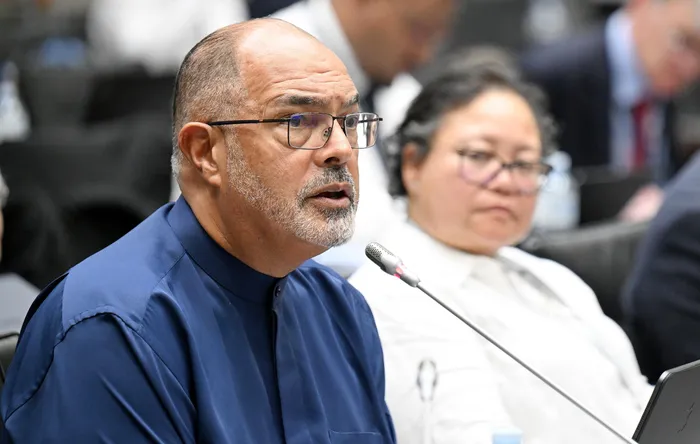
Outgoing SARS Commissioner Edward Kieswetter at the joint meeting where Finance and Appropriations parliamentary committees were briefed on the 2026 Budget.
Image: Phando Jikelo / Parliament of RSA
The South African Revenue Service (SARS) was praised on Friday for the remarkable collection of revenue that led to withdrawal of the R20 billion in tax increases provisionally included in the May 2025 Budget.
However, this success has amplified calls from political leaders for greater funding and resource allocation to enable SARS to sustain and enhance its revenue-collection capabilities in the upcoming financial year.
During a joint meeting of the Finance and Appropriations committees, attended by Finance Minister Enoch Godongwana and representatives from the National Treasury, ActionSA MP Alan Beesley expressed gratitude to the Treasury for providing additional funds to SARS in the past year.
“We still believe SARS is underfunded. We can’t have SARS underfunded. They have shown they can do better and I think it is an important issue that gets addressed, and that it gets addressed quite soon,” said Beesley.
Echoing these sentiments, EFF MP Sinawo Thambo praised SARS for its revenue generation, highlighting the relief the country felt from avoiding potential VAT increases and the ensuing turmoil that might have followed.
“We commend SARS for the revenue generated. It is something that should be encouraged. Let's capacitate SARS as far as possible because a lot of revenue that is generated is going to invest in service delivery objectives and imperatives as well,” said Thambo.
He also lauded Godongwana for responding to calls to adjust income tax thresholds in line with inflation.
However, ANC MP Nonceba Gcaleka-Mazibuko raised critical questions regarding the decision to withdraw the planned tax increase, suggesting it should have been directed towards pro-poor spending amid persistent economic challenges.
She further queried the safeguards in place to ensure that tax concessions for small, medium, and micro enterprises (SMMEs) would lead to tangible employment and productive investments.
ACDP Chief Whip Steve Swart added his voice to the chorus of appreciation, acknowledging the positive direction of the country’s finances due to enhanced tax collection.
“We do note the improvements in tax collection given the additional resources. There is more to be done given the debt book of R2.5 billion of undisputed debt,” Swart said.
He reiterated the necessity for additional funding and resources to clamp down on illicit trade, particularly concerning tobacco and alcohol. He called for a more integrated approach among state organs, arguing that current efforts are insufficient.
MK Party parliamentary leader Desmond van Rooyen critiqued the budget as a mere compliance exercise, arguing that it failed to address the fundamental issues plaguing the country.
He expressed disappointment at the disregard for their concerns regarding the regressive fuel levy, urging for practical integration among entities operating at the country’s ports of entry.
“We welcome the modernisation trajectory within SARS. This process should not be driven as an isolated programme,” said Van Rooyen.
He said entities operating in the ports of entry needed to work in an integrated manner.
“It should not be on paper. We must see it happening practically,” said Van Rooyen.
In a more sobering reflection, EFF MP Omphile Maotwe highlighted that the projected economic growth of 1.6% for the new financial year is insufficient.
“If we can’t grow the economy by at least 3%, it won’t assist us in curbing unemployment, poverty, and inequality, otherwise we will be seized with long-term economic damage,” Maotwe warned.
Outgoing SARS Commissioner Edward Kieswetter acknowledged the vital funding received last year, indicating that it would be instrumental in building the agency's capacity.
He reaffirmed the need for an integrated approach to tackle illicit trade, especially following SARS’s recent successes in addressing complex syndicate crimes.
However, Kieswetter cautioned that SARS remains structurally underfunded and still faces a staggering R500 billion tax gap, consisting of R200 billion in VAT and R120 billion in personal income tax, among others
“We need 250 to 1,000 forensic investigators and analysts to deal with syndicate crime. We need enforcement officers in excise area to go to the spaza shops. We need a lot of technical skills, accelerate technology and data science to improve our structural capacity to administer the laws,” said Kieswetter.
mayibongwe.maqhina@inl.co.za