

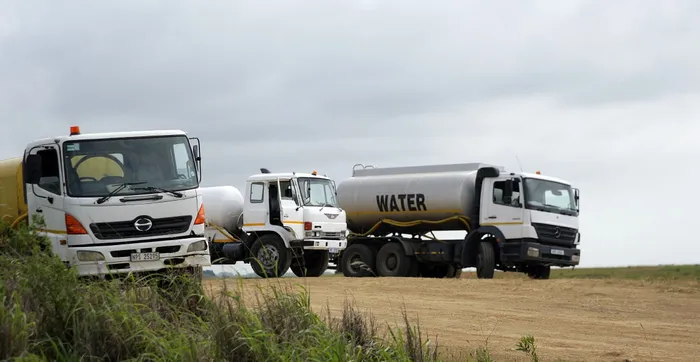
Paul Mashatile says insourcing tanker services and empowering municipalities will help reduce reliance on private water tanker operators.
Image: Bongani Mbatha / African News Agency (ANA)
Deputy President Paul Mashatile has announced that municipalities will begin procuring their own water tankers as part of a broader government intervention aimed at curbing the influence of private water tanker operators, often referred to as the “water tanker mafia,” while improving state control over water distribution and service delivery.
Responding to oral questions in the National Assembly, Mashatile said the government has already instructed the Minister of Water and Sanitation, Pemmy Majodina, to intervene in affected areas and work with provincial and municipal leadership to resolve ongoing water challenges.
He explained that engagements were held with Gauteng Premier Panyaza Lesufi and the Executive Mayor of the City of Johannesburg, Dada Morero, along with officials, to address the crisis and strengthen coordination.
He said the ministerial team was deployed following directives from the President to assess conditions on the ground and support municipalities in implementing solutions.
Mashatile noted that he personally visited Johannesburg to monitor progress and ensure that both immediate interventions and long-term infrastructure plans are being carried out.
In addressing infrastructure development, Mashatile pointed to ongoing projects intended to improve water capacity and reliability.
He said that in certain areas, including Carlswald, a large-scale reservoir construction is underway, stating that “they are already building a 20-million or mega million water reservoir, which once completed next year, will have the capacity to give reliable water in that area for another 20 years.”
He further added that private sector participation is also contributing, noting that “the private sector in the same area is building a 10-million one, which will add this to 30 million.”
Mashatile emphasised that these developments form part of broader efforts to expand storage and distribution capacity, alongside other interventions such as improved management of rainfall capture and water resources.
He said these initiatives are already being implemented to strengthen supply resilience in affected regions.
In other provinces, Mashatile indicated that similar interventions are being extended beyond Gauteng, including in Limpopo, where water access challenges persist.
He explained that in some areas, the issue is not the availability of water in dams but rather the inability to deliver it to communities due to reticulation constraints and geographical dispersion.
Mashatile said that in such cases, the government is encouraging the use of groundwater through municipal drilling initiatives to supplement supply and improve access, particularly in rural areas where infrastructure is more difficult to implement.
A central part of his response focused on the government’s strategy to address the dominance of private water tanker operators.
He stated that municipalities will be empowered to take control of tanker services through insourcing, including the procurement of trucks, in order to reduce dependence on external providers.
“We have said to them, we want to empower them to deal with the water tanker mafia. What government is going to do is to buy the trucks so we'll insource and make sure that it is the government that has the capacity to supply,'' he said.
Mashatile also raised concerns about revenue management within municipalities, using Johannesburg as an example.
He said that while municipal water entities generate significant income, sometimes amounting to tens of billions of rand, this revenue is not always adequately reinvested into maintaining and upgrading water infrastructure.
He explained that “Joburg Water would bring in about maybe R60 billion or more of revenue, and then it becomes a good revenue base for the city to do other things.”
''We are saying a sizeable chunk of revenue from water must go to water infrastructure and maintenance of water infrastructure.''
However, he stressed that a substantial portion of such revenue should be allocated back to water services, adding that if a municipality generates large sums from water, “they should be able to allocate close to R45 billion directly to water, rather than allocate R1 billion out of the R20.”
He said government has now taken a decision to ensure that revenue derived from water is ring-fenced and prioritised for infrastructure and maintenance, arguing that this approach will strengthen sustainability and improve service delivery over time.
hope.ntanzi@iol.co.za
IOL Politics