

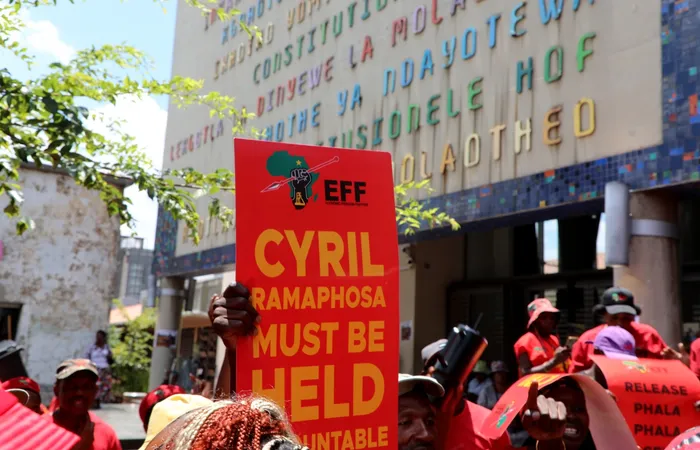
EFF members are set to picket outside the Constitutional Court as part of the party's monthly campaign to put pressure on the court to deliver judgment on the Phala Phala case.
Image: Timothy Bernard / Independent Newspapers
The EFF will take its push for accountability to the steps of the Constitutional Court of South Africa on Wednesday, calling for the release of the long-awaited judgment in the controversial Phala Phala scandal.
In a fresh escalation, the party’s Gauteng leadership has announced a picket at Constitutional Hill in Braamfontein, accusing the apex court of an unjustified delay in a case it says cuts to the core of transparency and the rule of law.
Gauteng provincial chairperson Nkululeko Dunga said the judgment has been withheld for more than a year and five months, raising serious concerns about accountability within the judiciary.
“The EFF remains unwavering in its commitment to transparency, accountability, and the defence of the rule of law,” Dunga said, calling for the immediate release of the ruling.
The demonstration is set for 10am outside the Constitutional Court precinct, where party members and supporters are expected to gather.
The protest follows a letter from EFF leader Julius Malema to Chief Justice Mandisa Maya, in which he demanded clarity on what the party described as an “unacceptable delay”. Malema warned that the prolonged wait risks eroding public confidence in the judiciary and weakening constitutional accountability at the highest levels of government.
At the centre of the dispute is the case Economic Freedom Fighters v Speaker of the National Assembly and Others, which deals with how Parliament handled the Phala Phala matter involving President Cyril Ramaphosa.
The case has become one of the most closely watched constitutional matters in recent years, given its implications for executive accountability and parliamentary oversight.
The Phala Phala saga, linked to allegations at Ramaphosa’s private farm, has remained in the political spotlight since it first emerged. It has raised persistent questions around executive conduct, foreign currency dealings, and the handling of related investigations.
Although parliamentary and legal processes have attempted to address the issue, the absence of a Constitutional Court ruling has left a gap that opposition parties argue is damaging public trust in key institutions.
The matter was heard in November that year, but more than 12 months later, judgment is still pending.
“This matter has now become one of the most delayed judgments in the modern history of the Constitutional Court,” Malema wrote.
He noted that more than 480 days have passed since the hearing, far exceeding the judiciary’s own guideline that judgments should be delivered within three months, unless exceptional circumstances apply.
karabo.ngoepe@inl.co.za