

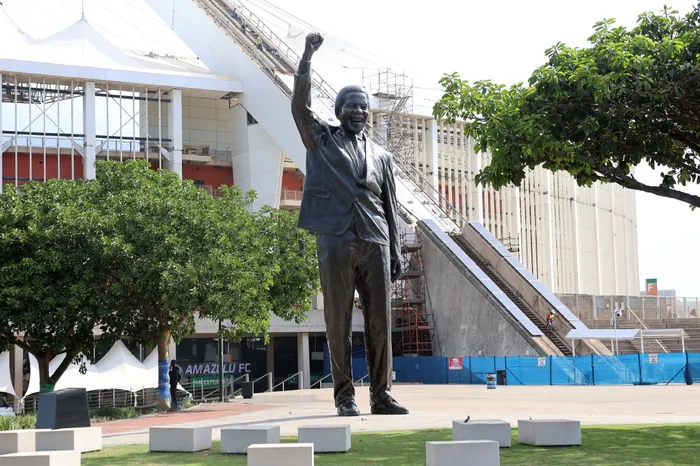
The statues of Nelson Mandela and Oliver Tambo, symbols of heritage, have sparked controversy over their R22 million cost amid pressing service delivery issues in eThekwini.
Image: Tumi Pakkies/ Independent Newspapers
The Department of Cooperative Governance and Traditional Affairs (Cogta) lacks the authority to unilaterally investigate or overturn eThekwini Municipality’s 2018 council resolution on the R22 million expenditure for the statues of former President Nelson Mandela and former ANC president Oliver Tambo, according to Minister Velenkosini Hlabisa, unless evidence of non-compliance with statutory frameworks is provided.
The municipality, defending the spending, maintains that the project was part of a heritage strategy, involved lawful public participation, and did not compromise essential services, thus arguing against any need for consequence management regarding the expenditure or decision-making process.
Hlabisa was responding to questions posed by the MK Party’s Adil Nchabeleng, following a public and political outcry that the municipality spent R22m on two statues while it battles with water shortages, sewage spills, collapsing infrastructure, pothole-ridden roads and a worsening housing backlog.
Nchabeleng wanted to know if the minister would investigate the expenditure as a possible gross misplacement of priorities by the municipality, and how spending millions on symbolic monuments is justified when eThekwini communities lack basic constitutional services.
He also asked if there were proper public consultation and cost-benefit analysis conducted (who approved the expenditure, or what consequence management will follow if public funds were diverted towards political symbolism instead of urgent service-delivery needs).
Hlabisa, providing background and legal and policy framework, explained that under the constitutional scheme, municipalities have executive authority over local governance and spending decisions through democratically adopted council resolutions, subject to statutory frameworks such as the Municipal Systems Act, the Municipal Finance Management Act (MFMA), and the Integrated Development Planning (IDP) processes.
“The department does not approve, authorise or veto specific municipal capital projects, but monitors compliance with applicable legislation and supports municipalities within the cooperative governance framework,” Hlabisa said.
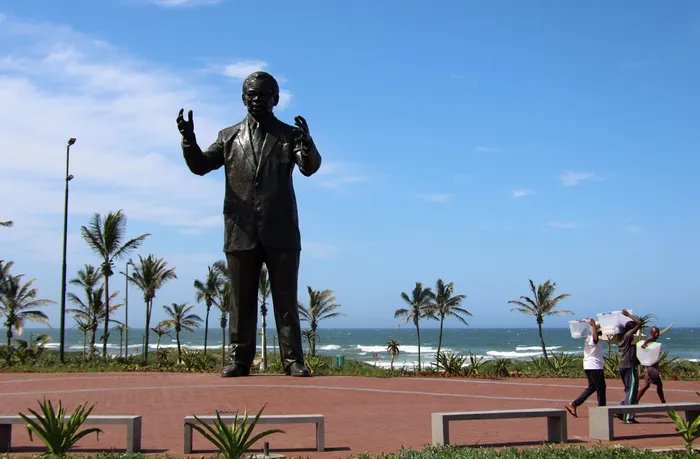
The eThekwini Municipality’s decision to allocate R22 million for statues raises questions about priorities in local governance amidst community needs.
Image: Tumi Pakkies/ Independent Newspapers
He said the municipality advised that the expenditure related to the statues emerged from a duly adopted council resolution of January 31, 2018, which approved the commissioning of the monuments. The decision was made through a lawful and democratic process, with the majority of councillors voting in favour.
“Given the constitutional and legislative framework governing municipal autonomy, the department does not have the authority to unilaterally overturn or investigate a lawful council decision unless evidence suggests non‑compliance with the MFMA, supply‑chain prescripts, or other applicable legislation. No such evidence has been presented to the department at this stage,” Hlabisa said.
He also explained that according to the municipality, the statues are part of a broader heritage and social cohesion strategy aimed at reshaping the city’s symbolic landscape, preserving historical memory, and enhancing cultural tourism.
Additionally, the municipality said the expenditure did not divert funding from essential service delivery programmes, which continue to receive the majority of municipal budget allocations.
Furthermore, the municipality indicated that it remains fully committed to fulfilling its constitutional service delivery obligations concerning water, sanitation, electricity, roads, and human settlements, through the IDP, budget, and Service Delivery and Budget Implementation Plan (SDBIP), all of which are monitored and independently audited.
The minister also shared that the municipality advised that municipal decision-making is governed by established statutory public participation processes embedded in the IDP and budget cycles, and that the commissioning of the statutes occurred within the municipality’s broader public consultation and budget approval framework.
“Regarding consequences management, the municipality has indicated that the project complied with applicable procurement and governance rules and that expenditure was authorised by a lawful council resolution. As such, no diversion of funds or irregular decision‑making has been identified that would warrant consequence management under the MFMA or related legislation,” Hlabisa said.
thobeka.ngema@inl.co.za