

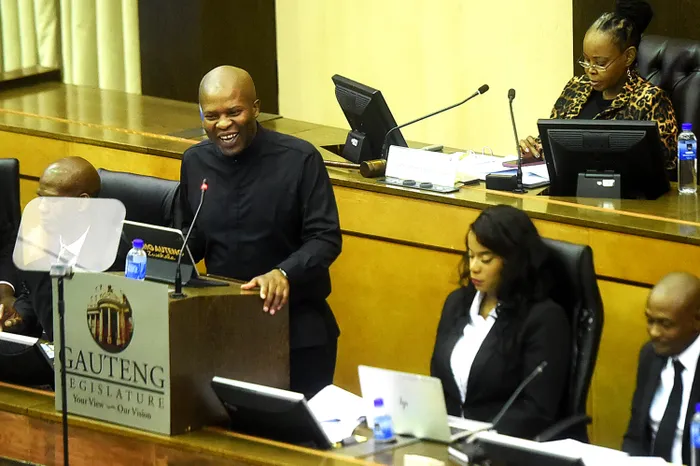
Political parties in the Gauteng Legislature have reacted to the budget tabled by MEC for Finance, Lebogang Maile, on Tuesday.
Image: Itumeleng English / Independent Newspapers
The budget presented by Gauteng MEC for Finance and Economic Development, Lebogang Maile, has sparked strong reactions from various political parties, highlighting the province's ongoing struggles with infrastructure and unemployment.
During Tuesday's address, Maile outlined a comprehensive budget allocation of over R500 billion over the next three years, aimed at rebuilding confidence in provincial governance.
For the 2026/27 financial year, Maile allocated R179.2 billion to the provincial budget. The allocation focuses on strengthening frontline services, accelerating infrastructure development, and maintaining fiscal discipline.
At the heart of the criticism is the R36.4 billion earmarked for infrastructure development, which has been denounced by the DA and BuildOneSA (BOSA) as inadequate to combat the province's pressing infrastructure challenges.
Areas such as Westbury, Coronationville, Melville, Parktown, Kensington, and Midrand have experienced prolonged water shortages, exacerbating public frustration.
DA shadow MEC for finance in the province, Ruhan Robinson, articulated this fact, saying Tuesday's budget speech by the MEC focuses on the wrong priorities.
According to Robinson, it excluded the urgent need to address the collapsing infrastructure, which has resulted in a water, electricity, and pothole crisis, adding that the maintenance needs of the province have been severely neglected for several years.
"The budget for the new financial year covers about 2% of the maintenance needs. This is in stark contrast to the National Treasury norm, which is 8%. The R4.6 billion for the e-toll debt could have been used for infrastructure maintenance. Our water, electricity, roads, and school infrastructure are on the brink of collapsing," Robinson stated.
BOSA's Roger Solomons indicated that the budget’s core spending priorities are cause for concern, as only R1.8 billion is allocated to economic development, while R5.5 billion goes to human settlements and R5.6 billion to social development.
On the jobs front, Solomons stated: "Not enough of the budget is being directed to job-creating and job-supporting initiatives. Approximately 2.5 million Gauteng residents are unemployed, representing around 33% of the workforce. During the final quarter of 2025 alone, the province lost 54,000 jobs. If Gauteng is meant to be the economic heartbeat of South Africa, then the country today resembles a patient in ICU on a respirator."
On a positive note, Rise Mzansi's Vuyiswa Ramokgopa welcomed the budget, including the additional R63.9 million allocated to the Gauteng Department of Agriculture to combat and contain Foot-and-Mouth Disease (FMD).
"In addition to combating the FMD outbreak, programmes that support urban agriculture, smallholder production, and the development of local food systems remain important. Many households in Gauteng continue to struggle with the cost of food. Strengthening local food production can play a role in improving access to affordable and nutritious food," said Ramokgopa.
Maile also revealed ongoing discussions with other political parties, including the EFF and the uMkhonto weSizwe Party, to secure broader support for the budget. This comes as the EFF, with about 11 seats in the legislature, recently vowed not to support the budget following a fallout with the ANC.
siyabonga.sithole@inl.co.za