

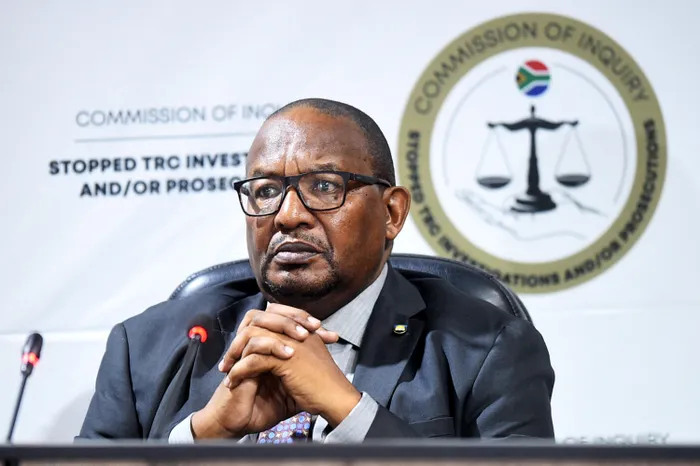
Former NPA head Vusi Pikoli appeared before the TRC Cases Inquiry, where he accused the late former police commissioner, Jackie Selebi, of alleged interference.
Image: Itumeleng English / Independent Newspapers
Former National Director of Public Prosecutions (NDPP) Advocate Vusi Pikoli has candidly acknowledged that it was a blunder to label the subcommittee of the Directors-General Forum as an "Amnesty Task Team".
This declaration came during his testimony before the Truth and Reconciliation Commission (TRC), which is investigating accusations of political interference in prosecutions dating back to the apartheid era. The inquiry is presided over by retired Constitutional Court Justice Sisi Khampepe.
During his appearance before the commission on Thursday, Pikoli revealed that the TRC had already concluded its amnesty process, rendering the terminology of the subcommittee not only misleading but fundamentally flawed.
"I acknowledge that it was a mistake to use the term 'Amnesty Task Team'," Pikoli stated.
He stressed the seriousness of this wording, especially considering South Africa’s delicate transitional justice environment.
However, Pikoli said he firmly believed that the establishment of the forum was the correct instrument to achieve some of the policy directions arising from President Thabo Mbeki's 2003 announcement to Parliament.
In April 2003, in his address to Parliament, Mbeki noted the importance of ensuring justice continued to prevail for apartheid-era crimes, adding that there would be no general or blanket amnesty on these crimes. He authorised the NPA to continue to prosecute for justice to be served.
"I fully agree with what the president said in 2003, and I was fully committed to driving that process. The work of the DG's Forum was to give effect to that policy position... The Directors-General Forum and the Amnesty Task Team were never meant to usurp prosecutorial powers from the NPA, and it never did," he told the commission.
Commissioner Andrea Gabriel SC also raised her own concern with Pikoli that the report of the Directors General Forum and the Amnesty Task Team subcommittee appeared not to prioritise justice for the victims of apartheid-era crimes.
Pikoli indicated that Mbeki had wanted apartheid-era crimes to receive maximum attention through the forum, stating:" The president wanted, and he stated that there is still some outstanding work. This is even though he accepted the report of the TRC. His view was that not all matters relating to the TRC were concluded, and now that the TRC was no longer there, the government could find ways to ensure that outstanding matters were still followed up."
Pikoli's evidence was preceded by that of his precursor, former NPA head, Bulelani Ngcuka, who was asked to reflect on a secret memorandum from Pikoli to the then Justice minister Bridgitte Mabandla, where the former complained of political interference by the Directors-General Forum.
On Wednesday, Ngcuka told the commission that Pikoli should have allowed himself to be bound by the law on whether or not to prosecute TRC cases. However, he indicated that it was not for him to judge.
"The law is clear. You make the decision. You prosecute. You don’t ask for advice from other people. That would have been my view. So I don’t know what caused my colleague to make that decision. But at the end of the day, he should have been the one to say no," Ngcuka had said.
Pikoli also accused the late former police commissioner, Jackie Selebi, of interference, saying: "There was an obscene obsession by the National Police Commissioner Jackie Selebi to remove Adv Anton Ackerman from the TRC cases."
The inquiry resumes on Friday morning, with Pikoli set to continue his testimony.
siyabonga.sithole@inl.co.za