

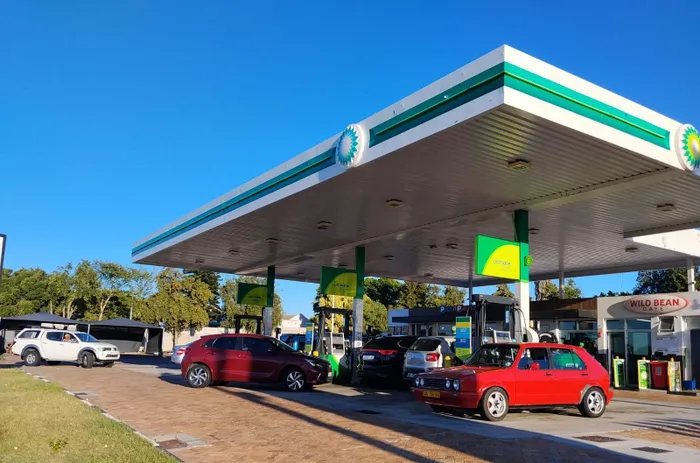
The BP in Link Road, Parklands has already seen people filling up their tanks ahead of the fuel increase on Wednesday, April 1.
Image: Robin-Lee Francke / IOL
As South Africans dread the highest fuel price hike that the nation has ever seen, there has been panic buying and pure pandemonium at filling stations across the country.
Motorists have also been capped on how much fuel they can put into their vehicles.
An IOL journalist based in the north-western suburbs of Johannesburg said several filling stations, including the BP in Boskruin and the Shell in Randpark Ridge, were closed as they had run out of fuel by 6pm on Monday night.
“One filling station that did have fuel was the Total filling station in Northwold, where only regulars were being allowed to refill a maximum of 30 litres of fuel.
“Petrol attendants said they were expecting more fuel on Tuesday, while there was uncertainty at the closed filling stations, with petrol attendants only indicating they do not know when fuel stocks would be refilled,” the journalist said.
Social media users also took to platforms to complain that they were barred from filling up for more than R150 at a time, with some filling stations banning the use of jerry cans.
In KwaZulu-Natal (KZN), the 45th Engen Woolworths Food Convenience along King Cetshwayo Highway in Sherwood, Durban, notified motorists on their Facebook page on March 28 that only one (EFT) swipe would be made available.
“With the increase in demand for fuel, it has put pressure on our holding supply. Deliveries out of depot are delayed by hours; it is a wait-and-see game for the fuel truck to arrive.”
To maintain pumping fuel at 45th Engen, we need to have a maximum fill-up amount when our tanks are low. Therefore, at times you could see signs go up to restrict litres per vehicle; once the delivery is in, restrictions will be removed.
“If you do fill and return shortly again, unless cash, your swipe could decline for two swipes. To keep business flowing, we need to put these steps in place. Please do not be angry with the attendant, as he is just following instructions. In no way are we keeping volume to have a money gain on price increase, never have and never will. Thank you for understanding with us as this matter is out of our control. [sic]”
Another motorist from Cape Town, Shaquile Fortuin, who has a diesel vehicle, said this price hike has set him back tremendously.
“This increase has a big financial impact on us. Fuel was already high, and now it’s going up even more. It kills a person’s pockets. We will now need to cut down on groceries or other things in life to cover these extra costs. It’s not like our salaries are being increased. I literally had to buy a jerry can to buy in diesel to have enough money for the month. This increase is going to have a bad result on households,” Fortuin said.
On Tuesday, March 31, the Tshwane mayoral committee member for roads and transport, Councillor Tlangi Mogale, said commuters making use of the Tshwane Bus Service (TBS) had to be informed of the current fuel supply challenges it is experiencing, which are significantly affecting normal bus operations.
Mogale said the bus service operates 155 daily shifts across its three depots, namely:
“At present, all three TBS depot filling stations have run out of fuel. This situation has had a major impact on operations, resulting in a reduced number of buses in service and the disruption of scheduled trips. From yesterday (Monday), only 65 of the planned 155 shifts were able to operate, using the limited fuel that remained,” Mogale said.
She said there was a strong likelihood that bus services would operate by Tuesday afternoon should fuel supplies be restored in time.
Commuters have been urged to make alternative arrangements should the problem persist.
Month-end data from the Central Energy Fund is pointing to petrol price increases of between R5.31 for 93 Unleaded and R5.82 for 95 Unleaded. Diesel looks set to increase by between R10.13 in the case of 500ppm and R10.27 for the cleaner 50ppm. However, government announced on Tuesday that it is providing a temporary tax break to the tune of R3.
robin.francke@iol.co.za
IOL