

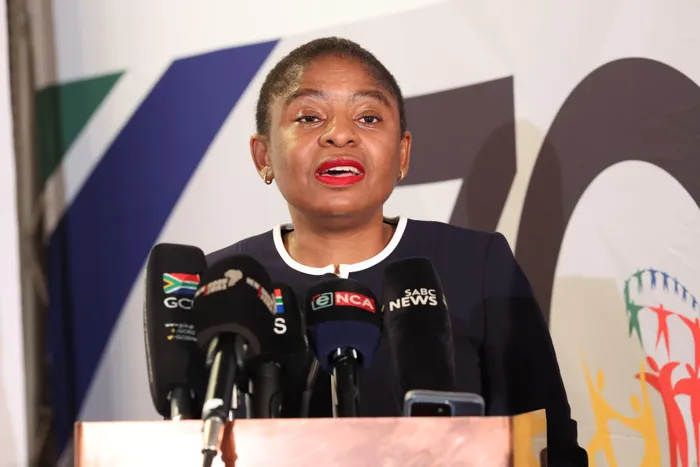
Khumbudzo Ntshavheni delivers the Budget Vote 14 debate in Parliament, where she revealed that foreign-born nationals are twice as likely to be employed as locally born South Africans, according to Statistics South Africa data.
Image: GCIS
Minister in the Presidency Khumbudzo Ntshavheni says foreign-born people in South Africa are more likely to be employed than locally born citizens, as the government intensifies efforts to clamp down on undocumented immigration and tighten labour law enforcement.
Delivering the Stats SA Vote 14 2026/2027 Budget Debate speech on Wednesday, Ntshavheni cited new data from Statistics South Africa showing a stark employment gap between South Africans and foreign nationals.
“The unemployment rate for foreign-born persons as of 2022 was 18,2%, and that of locally born persons was 34%,” Ntshavheni said.
“The unemployment rate of foreign-born persons is almost half compared to that of locally born persons.”
She added that Stats SA’s migration module found that “the absorption rate of foreign-born persons was 64% and that of locally born persons was 37,7%, meaning that foreign-born persons were twice as likely to be employed in South Africa than locally born persons.”
The minister made the remarks against the backdrop of rising anti-foreign national sentiment across the country, where undocumented migrants are often accused of taking jobs from South Africans and contributing to crime.
Ntshavheni acknowledged growing public frustration, saying the employment figures were being released “when the country is experiencing an increase in anti-foreign nationals’ sentiments”.
She said Cabinet had already instructed the Department of Employment and Labour to intensify workplace inspections in sectors considered vulnerable to the hiring of undocumented foreign nationals, including hospitality, agriculture, trucking and construction.
“Cabinet further directed municipalities to ensure the enforcement of municipal by-laws, with priority on trading by-laws,” she said.
“South Africans must also play their part by refraining from sub-leasing their business licenses.”
Ntshavheni also revealed that government was moving ahead with reforms contained in the revised White Paper on Immigration, which includes provisions aimed at reserving certain sectors and trades for South Africans and recognised refugees.
The proposed changes include introducing a “first country of safety principle”, relocating refugee reception centres closer to border areas and empowering departments to “designate certain trades, professions, and businesses only for South Africans and refugees”.
Her remarks came as Stats SA reported worsening unemployment figures in its latest Quarterly Labour Force Survey.
“Stats SA released Quarter 1 Quarterly Labour Force Survey for 2026 that indicated a decrease in employment by 345 000 to 16.8 million in the first quarter compared to 17.1 million in the previous quarter,” Ntshavheni said.
She rejected suggestions that the rise in unemployment was merely due to an increase in first-time job seekers entering the labour market.
“The argument of an increase in unemployment due to first quarter trends of increased labour market entrants does not hold as the country experienced a decline in the number of employed persons,” she said.
Despite government highlighting a planned R1 trillion infrastructure investment programme and more than R1.5 trillion in investment pledges secured through the South African Investment Conference, Ntshavheni conceded that unemployment remains a major challenge driving inequality and poverty.
She stressed that official statistics were critical for shaping government policy and combating misinformation.
“Official statistics replace speculation with facts and rhetoric with reality,” Ntshavheni said.
“We call on South Africans to allow facts to guide our national discourse. Let us choose evidence over noise, facts over fiction, and data over doubt.”
IOL News