

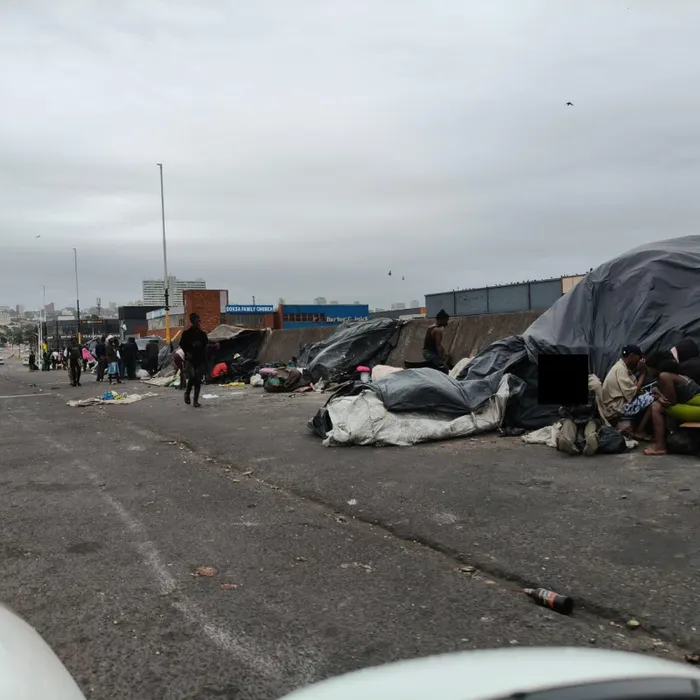
Vagrants and drug addicts have re-occupied the pavement under the M4 southern freeway in Durban
Image: Supplied
Vagrants and drug addicts continue to play a cat and mouse game with the eThekwini municipality after re-occupying the pavement under the M4 freeway, Che Guevara Road.
More than a hundred vagrants and addicts have used plastic bin bags and wood to create makeshift shelters on the pavement, which is at the entrance to the Durban CBD from the southern freeway. Municipal teams had cleared the area on Friday, but motorists and businesses stated that the vagrants returned once the police and clean-up teams left.
Councillor Andre Beetge, a DA member of the eThekwini executive committee, welcomed the municipality’s long-overdue intervention and apparent acknowledgement of the relief it would bring to businesses, residents, and visitors alike. He, however, was concerned that the city had no immediate plan to remove them. What is required, Beetge said, was a sustainable, dignified and city-wide approach.
“It is difficult to ignore the lingering questions. Why did decisive action only come after the festive season, and more importantly, what is the long-term plan as people were all back again by Sunday morning?”
“When we first exposed the scale of the problem and began applying pressure for the City to both acknowledge it and act meaningfully, the establishment of the Sakhithemba facility for the homeless in Lower Illovo, south of Amanzimtoti, was presented as a near-panacea — the so-called promised land,” Beetge said.
Looking broadly, Beetge suggested that the municipality should be actively identifying suitable land for occupation — including the formalisation of existing informal settlements — where areas can be properly demarcated into parcels, infrastructure installed, and basic services delivered.
“Buildings donated to the city by the provincial government could be renovated into suitable housing. Likewise, the expropriation of slum turned and abandoned buildings, as this would restore dignity to vulnerable communities while simultaneously reducing health risks, sanitation challenges and crime-related pressures faced by surrounding areas,” Beetge stated.
He said the challenge is not new, and that the city employs an entire department tasked with finding solutions and managing challenges associated with the homeless.
“The time for smoke and mirrors has come to an end; the ratepayers are entitled to demand a meaningful return on that investment,” he added.
Doran Subiah, chairperson of the Umbilo Business Association (UBA), said the illegal dumping sites will re-emerge, and the unlawful structures will be rebuilt if the root causes are not addressed. Subiah stated that the UBA requires the municipality to match businesses' commitment to cleaning the area with a transparent, long-term plan for Umbilo that includes regular maintenance schedules, infrastructure investment, and a dedicated safety and cleanliness partnership.
In October 2025, the municipality held a workshop to assess current by-law capabilities to deal with offences committed by homeless people on Durban’s streets.
This was part of the municipality’s inner city rejuvenation programme and homeless interventions.
The municipality, in previous media statements, stated that it was aware that the homeless community comprises individuals who are suffering from an addiction, unemployed foreign nationals, undocumented individuals, and hard sleepers who have lost their residences.
The municipality also announced that Phase 1 of the Sakhithemba Shelter in Illovo, south of Durban, is expected to have a maximum occupancy capacity of 800 at completion. The shelter would be managed by a non-governmental organisation (NGO).
Currently, the municipality has two safe sleeping spaces in Greyville and North Beach. The municipality also has a Harm Reduction Centre at Bellhaven Memorial Hall in Greyville to offer drug management programmes.
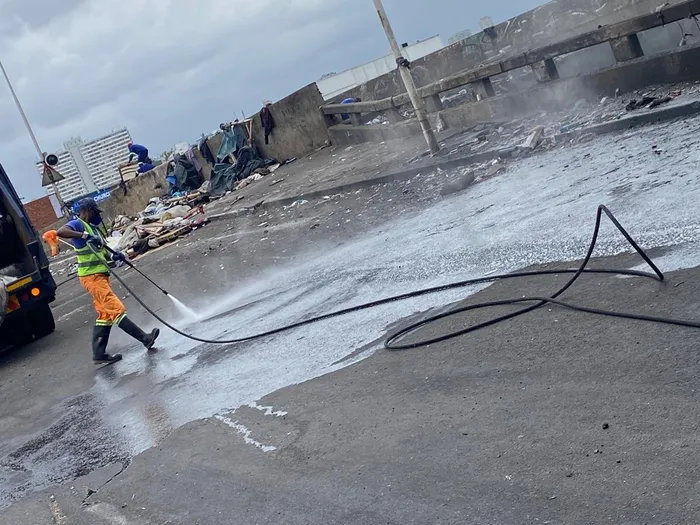
Following a clean-up operation on Moore Road, vagrants and drug addicts have re-occupied the pavement under the M4 freeway in Durban.
Image: eThekwini Municipality
With regard to the homelessness interventions and programmes, the city previously stated that it has pathways out of homelessness. The programme includes skills development and training, ID document support programme, job opportunities, drug rehabilitation and treatment, and reunification with families.
The development of the Homelessness Policy through internal consultative processes commenced in November 2022. A draft policy is now due for external consultation and will be shared through the municipal website for comments.
zainul.dawood@inl.co.za