

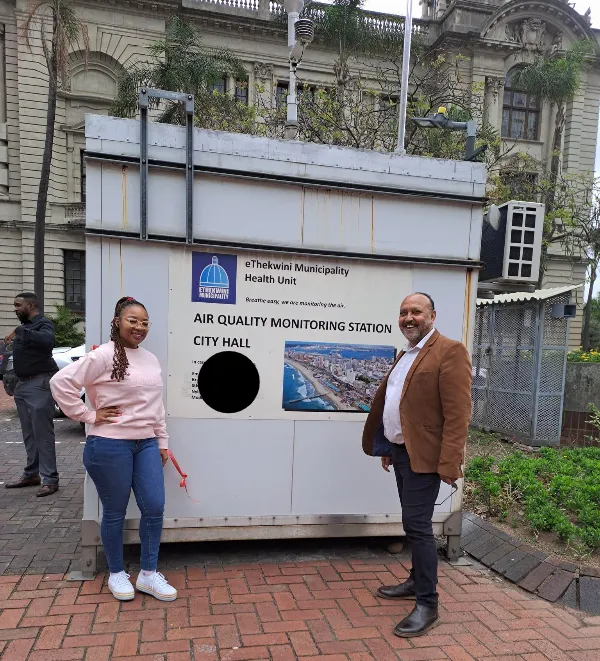
The air quality monitoring station outside the Durban City Hall. Pictured, right, is former municipal official Eric Apelgren.
Image: Eric Apelgren
The eThekwini Municipality is urging residents to become more informed about monitoring air quality, as part of efforts to improve public health and environmental awareness across communities.
Speaking on the programme eThekwini Matters, host Zimbili Mazibuko highlighted the importance of understanding the Air Quality Index and how pollution levels are managed, noting that many residents remain unaware of how to interpret air quality data or respond to potential health risks.
Mazibuko explained that air quality plays a crucial role in public health and environmental well-being. Phathutshedzo Raphalalani, the senior manager for pollution control in the municipality, explained that they are trying their level best to provide details on the state of air quality in communities.
He said warnings about air pollution are categorised according to colour codes with purple indicating poor quality and green the best quality. Raphalalani said monthly reports are submitted to the South African Air Quality Information System (SAAQIS).
Raphalalani said teams work rapidly to trace those contributing to air pollution in communities and the environment. He said some parts of eThekwini are highly industrial, including the South Durban basin. The municipality makes use of bylaws to monitor emissions from vehicles and trucks.
“Most of the sources of emissions are from traffic but the impact associated with that, in terms of compliance, is not taken into consideration. The issue of respiratory problems will then emanate when we see and monitor stats from our clinics. If stats increase, it tells us that air quality needs to be investigated and looked into, as well as how we monitor our compliance and law enforcement,” he explained.
Raphalalani said that the Atmospheric Emission Licence was one of the tools the municipality used to monitor industrial sectors.
“In 2023, the municipality managed to penalise a facility R8 million for non-compliance. This shows that, as the city, we leave no room for non-compliance when it comes to air quality management. This is done to safeguard our communities and the health of people,” he said.
He explained that air quality awareness programmes are conducted in communities, including inviting schools to the Durban City Hall.
“We educate children on the impact of air pollution on communities. We will expand our programmes in this regard so that instead of focusing only on pupils, we will go to the communities themselves to begin interacting with senior citizens and residents,” Raphalalani said.
Raphalalani said that eThekwini has created an air quality museum for educational purposes.
zainul.dawood@inl.co.za