The tyranny of party loyalty: how SA's politics is held hostage
Party Factionalism

Nco Dube a political economist, businessman, and social commentator.
Image: Supplied
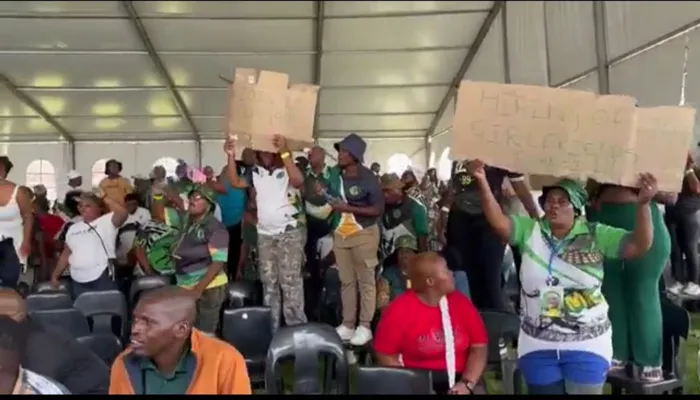
HOLDING placards and singing “Wenzeni uZuma?” (What has (President Jacob) Zuma done, uMkhonto weSizwe (MK) Party members attempted to interrupt President Cyril Ramaphosa’s Imbizo in Mpumalanga on Thursday. Intra-party factionalism and party loyalty is wrecking South Africa's democracy, argues the writer | Video/Screenshot
Image: Supplied
Nco Dube
There is a peculiar malaise gnawing at the heart of South African democracy. It is not the overt corruption or the brazen incompetence that so often dominate headlines, but something more insidious, something that quietly undermines the very foundations of our political system.
This malaise is the cult of political party loyalty. In a country still wrestling with the ghosts of its past and the uncertainties of its future, blind allegiance to political parties and the toxic factionalism it breeds have become obstacles to genuine progress, independent thought, and the placing of the nation above narrow interests.
In this piece, I attempt to interrogate the negative impact of party loyalty and intra-party factionalism in South African politics. I explore how these phenomena suffocate independent thinking, erode impartiality among commentators and political actors, and ultimately betray the public interest. I attempt to offer a critical, unapologetic assessment, one that refuses to tiptoe around uncomfortable truths.
The Anatomy of Party Loyalty in South Africa
Party loyalty in South Africa is not merely a matter of preference or ideological alignment. It is a deeply entrenched, almost tribal phenomenon. For many, political identity is inherited, not chosen. The African National Congress (ANC), the Democratic Alliance (DA), the Economic Freedom Fighters (EFF), the Inkatha Freedom Party (IFP), the uMkhonto weSizwe Party (MKP) and other parties have cultivated bases that often view dissent as treason and critical engagement as betrayal.
This loyalty is reinforced by a history of struggle and liberation, particularly in the case of the ANC. For many South Africans, to question the ANC is to question the legitimacy of the very freedom they enjoy. But this sentiment is not unique to the ANC. Across the political spectrum, parties have weaponised loyalty, turning supporters into foot soldiers and critics into enemies.
At first glance, loyalty may seem virtuous. A sign of commitment and stability. But in the South African context, it has become a double-edged sword. The cost is measured in the stifling of independent thought, the erosion of accountability, and the prioritisation of party interests over the national good.
Intra-Party Factionalism: The Enemy Within
If party loyalty is the glue that binds, intra-party factionalism is the rot that festers beneath the surface. Nowhere is this more evident than within the ANC, where factional battles have become a permanent feature of the political landscape. But the DA, MKP, IFP and EFF are not immune; they too have seen their share of internal rifts and purges.
Factionalism thrives where loyalty is prized above principle. It is the inevitable result of a system that rewards sycophancy and punishes dissent. Intra-party factions form around personalities, patronage networks, and competing ambitions, rather than genuine ideological differences. The result is a politics of survival, not service. A contest for power, not principle.
The consequences for governance are dire. Cabinet reshuffles, policy paralysis, and endless infighting are the order of the day. Decisions are made not on the basis of what is best for the country, but what is expedient for the dominant faction. The public becomes collateral damage in a never-ending game of thrones.
Perhaps the most tragic casualty of party loyalty and factionalism is independent thought. In a healthy democracy, political actors and commentators should be able to engage critically with issues, challenge orthodoxy, and hold power to account. In South Africa, such independence is rare.
Party structures are designed to suppress dissent. Whips enforce discipline, and those who step out of line face ostracisation, demotion, or expulsion. The message is clear: toe the line or pay the price. This culture of conformity extends beyond politicians to the media and civil society. Commentators who criticise their “own” party are branded sell-outs; those who criticise others are dismissed as partisans.
The Role of the Media
The media, which should serve as a bulwark against abuse of power, is itself not immune. Many commentators, analysts, and journalists are openly aligned with political parties or factions. Their analysis is often coloured by loyalty, leading to selective outrage and a reluctance to hold their own side to account. The result is a public discourse that is polarised, predictable, and impoverished.
Impartiality is the lifeblood of credible analysis and effective governance. Yet in South Africa, it is in short supply. Commentators, political players, and supporters alike are trapped in echo chambers, where loyalty trumps logic and partisanship overrides principle.
Social media has amplified the echo chamber phenomenon. Platforms like Twitter and Facebook have become battlegrounds for party loyalists, where nuance is sacrificed on the altar of outrage. Algorithms reward conformity and punish complexity. The result is a toxic feedback loop, where only the loudest, most extreme voices are heard.
Those who dare to be impartial, who criticise their own party or praise the opposition, are often vilified. They are accused of betrayal, subjected to harassment, and excluded from important conversations. This creates a chilling effect, discouraging others from speaking out and reinforcing the culture of conformity.
Putting the Country and the Public First: A Lost Ideal
The ultimate tragedy of party loyalty and factionalism is that they prevent political actors from putting the country and the public first. Decisions are made to protect party interests, secure positions, and settle scores, not to serve the people.
Public service has become a means to an end, not an end in itself. The language of “the people” is invoked at every turn, but rarely honoured in practice. Policies are crafted to win votes, not solve problems. Appointments are made to reward loyalty, not competence. The result is a state that is often unresponsive, inefficient, and corrupt.
The public, for its part, is not blameless. Many voters continue to support parties out of habit, fear, or misplaced loyalty. They accept mediocrity and corruption as the price of belonging. In doing so, they perpetuate the very system that fails them.
The Way Forward: Reclaiming Independent Thought and National Interest
South Africa stands at a crossroads. The challenges we face like unemployment, inequality, corruption, and social unrest, are too great to be solved by party loyalists and factional warriors. What is needed is a new politics: one that values independent thought, impartiality, and the national interest above all else.
We must create space for critical engagement within parties and society at large. Political actors should be encouraged to challenge orthodoxy and question leadership without fear of reprisal. Parties must become forums for debate, not echo chambers for loyalty.
Party structures must be reformed to reward merit, not mediocrity. Internal democracy should be strengthened, and mechanisms for accountability put in place. Factionalism must be confronted head-on, with clear consequences for those who undermine unity and purpose.
The media and civil society have a vital role to play in holding power to account. Journalists and commentators must strive for impartiality, even when it is unpopular. They must resist the temptation to become cheerleaders for one side or another, and instead serve the public interest.
Ultimately, the public must take responsibility for the choices it makes. Voters must be educated to think critically, challenge party narratives, and demand better from their leaders. Blind loyalty must give way to informed citizenship.
Conclusion: The Courage to Choose Country Over Party
The time has come for South Africans to reclaim their democracy from the tyranny of party loyalty and factionalism. This will not be easy. The forces of conformity are powerful, and the incentives for loyalty are strong. But the stakes are too high to accept the status quo.
We must have the courage to put the country and the public first. To demand independent thought, impartiality, and genuine service from those who claim to lead us. Only then can we build a politics worthy of our people, and a future worthy of our hopes.
Let us remember: parties are vehicles, not destinations. They exist to serve the people, not the other way around. When party loyalty becomes an obstacle to progress, it is not loyalty at all, but betrayal. The time for euphemism and equivocation is over. South Africa deserves better and it is up to all of us to demand it.
(Dube is a political economist, businessman, and social commentator on Ukhozi FM. His views don't necessarily reflect those of the Sunday Tribune or IOL)