

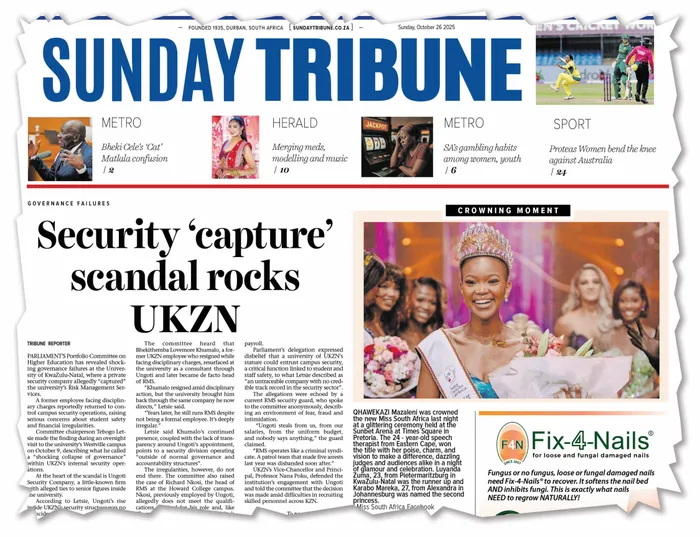
The letter writers are responding to this article carried on October 26. So far, the Parliament’s Higher Education and Training Portfolio Committee has received a report in which the University of KwaZulu-Natal (UKZN) has explained why it appointed a security company owned by its former employee, without publicly advertising the contract. The report is still to be debated in the National Assembly.
Image: Rowan Abrahams/IOL Graphics
I acknowledge the University of KwaZulu-Natal’s (UKZN) published response to my letter of 10 November 2025, which raised concerns about governance integrity within a public higher education institution.
As my letter made clear, my intention has never been to litigate personal matters in the media. My purpose is, and remains, to affirm the principles of transparency, accountability, and ethical governance that must undergird public universities in a constitutional democracy.
UKZN’s reply situates my letter within the narrow parameters of an employer–employee dispute before the Commission for Conciliation, Mediation and Arbitration (CCMA). This framing is incorrect. The issues I raised concern the integrity of doctoral examination processes, the protection of a vulnerable student, and the proper stewardship of public resources. These are governance matters of national importance, not private labour issues.
Public universities are accountable to the public. It is therefore appropriate, indeed necessary, to address UKZN’s statement and clarify the governance concerns that have been placed before the public record.
UKZN’s Position on Public Engagement vs. CCMA Processes
In its published statement, UKZN expresses “regret” that I elected to write publicly while a CCMA process is ongoing. This position rests on several incorrect assumptions.
The issues raised are governance concerns, not labour grievances
UKZN’s response conflates two distinct matters:
The latter cannot be adjudicated by the CCMA; nor can they be contained within its procedural boundaries. Governance concerns belong in the public domain, and in oversight structures such as Parliament, Council, and the national higher education system.
Public universities are accountable to the public, not only to tribunals
UKZN is a public entity funded by taxpayers. Its decisions, processes, and adherence to governance norms fall squarely within the purview of public oversight and scrutiny.
The CCMA does not adjudicate:
These are matters of national governance relevance.
Freedom of expression on public governance cannot be restricted
The Constitution protects the right to engage publicly on issues affecting society, including the governance of public institutions. No institution possesses the authority to limit the platforms or channels through which such engagement occurs. UKZN’s suggestion that concerns should be confined to the CCMA is therefore inappropriate in law and contrary to basic democratic norms.
What UKZN’s framing reveals about governance culture
The attempt to contain governance issues within a labour process reflects a troubling governance ideology, characterised by:
These tendencies mirror patterns noted in the Parliamentary Portfolio Committee’s ongoing inquiry into governance failures at UKZN.
A Forensic Analysis of UKZN’s Media Statement
While asserting that it cannot comment on a matter before the CCMA, UKZN proceeds to make substantive, public claims about the “factual basis” of my concerns. This contradiction undermines the credibility of the response.
Bare denials without evidence
UKZN labels my concerns “factually incorrect” yet provides no facts, no counter-evidence, and no policy grounds to substantiate this assertion. A bare denial does not amount to a refutation.
The suggestion that no evidence was provided is incorrect
My letter referenced matters that are already documented within:
These materials exist within the institution’s own files. UKZN’s omission of this context misrepresents the factual position.
Claiming non-use of whistleblowing channels misstates the law
The Protected Disclosures Act defines protected disclosure by content, not channel. A staff member need not invoke a specific administrative pathway for a disclosure to be protected. Moreover, all concerns were raised internally through established reporting lines well before the dismissal process commenced.
Threatening post-CCMA legal action is inconsistent with principles of public accountability
UKZN states that it “reserves its rights” and will consider legal options after the CCMA process. Such statements risk being perceived as attempts to deter public engagement on governance matters. The Constitutional Court has held consistently that dialogue on matters of public interest must remain free from threats of institutional retaliation.
UKZN’s commitment to transparency is not demonstrated in its statement
While affirming a commitment to “lawful governance”, the published response does not address:
These omissions leave the core concerns untouched.
Governance Breaches: A High-Level Summary
The governance concerns raised in my initial letter fall into three interconnected categories.
These issues are documented and form part of the public interest.
PhD examination integrity
Among the concerns are:
These matters undermine doctoral degree integrity.
Financial governance (R16 million postgraduate bursary fund)
Questions requiring transparent answers include:
Abuse of authority and maladministration
Concerns include:
These point to systemic rather than individual governance failures.
Critical Governance Questions Requiring UKZN’s Clarification
The doctoral examination
The R16 million bursary fund
The plagiarism allegations
Transparent answers are necessary to restore public trust.
Alignment with Parliamentary Oversight
The concerns I raised are consistent with patterns under examination by the Parliamentary Portfolio Committee on Higher Education.
While each case differs in detail, the broader concerns are similar:
It is in the national interest that these matters be confronted openly.
Conclusion
My letter to the public was grounded in a commitment to governance integrity, student protection, and ethical leadership within a public university. UKZN’s media statement does not address the substantive governance issues raised. Instead, it seeks to situate them within a labour dispute, thereby avoiding the broader questions of institutional integrity that remain unanswered.
The CCMA will address its part of the matter. The public, Parliament, and the higher education sector must address the rest.
My hope remains not to harm UKZN, but to contribute to restoring public confidence in the governance of a vital national institution. I remain committed to truth, integrity, and the strengthening of ethical governance in higher education.
Professor Pholoho Morojele is a former Dean of Research: University of KwaZulu-Natal.