

The Sunday Tribune stands by its story, asserting that the University of KwaZulu-Natal's Vice-Chancellor's response was defensive and undermined accountability.
Image: Rowan Abraham / Graphic Artist
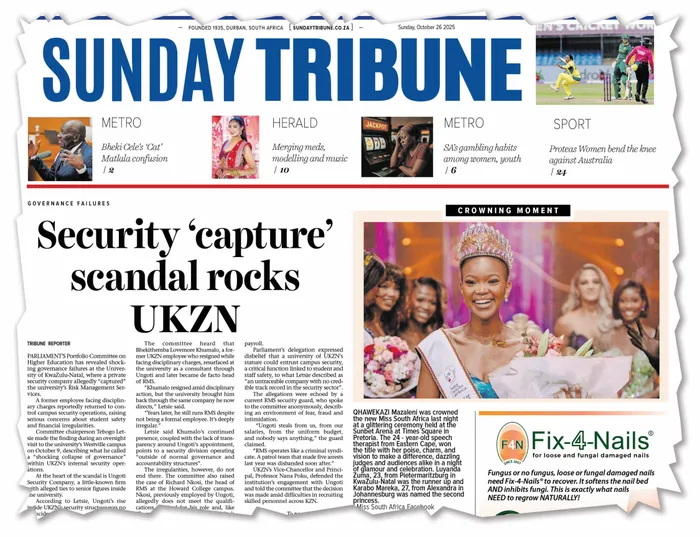
WHEN Parliament’s portfolio committee on higher education visited the University of KwaZulu-Natal (UKZN) on October 9, 2025, it raised serious concerns about governance and, in particular, the institution’s contract with Ungoti Security.
As a newspaper, we reported on the committee’s findings, as is our duty, and published on October 26, 2025. That work drew on official parliamentary proceedings, written responses from the committee chairperson, Tebogo Letsie, and the university itself, as well as weeks of corroboration into concerns raised by multiple individuals regarding Ungoti’s role on campus.
Yet instead of engaging constructively with the issues raised, UKZN’s Vice-Chancellor, Prof Nana Poku, chose an entirely different approach. In an extraordinary move, he circulated a scathing statement to students, staff and alumni accusing this newspaper, and specifically our news editor, of unethical journalism. He went as far as to claim that the story was driven by malice and that parliamentary proceedings had been deliberately misrepresented.
These allegations are false. Our news editor, Annie Dorasamy, did not author the story in question. Her involvement was limited to ensuring all relevant parties were given a fair opportunity to respond. Both UKZN and the committee chairperson provided comprehensive answers. Ungoti Security didn't answer calls or emails.
The committee raised concerns about Ungoti since its director is a former employee of the institution who allegedly left under a cloud. It is therefore troubling that instead of challenging any specific fact in our reporting, the vice-chancellor chose to launch a personal attack. His insistence that the use of the word “shocking” constitutes misrepresentation is, at best, a stretch; at worst, it is an attempt to divert attention from legitimate public interest questions about the university’s governance and procurement practices.
This newspaper stands by its story. Accountability in higher education requires transparency. When public institutions respond to scrutiny with hostility rather than clarity, it erodes trust and undermines the very principles of oversight and good governance. That UKZN has seen fit to issue multiple letters in response to a single article suggests not an excess of factual error, but an excess of defensiveness.
Journalists cannot become targets for officials who are uncomfortable with oversight. That the vice chancellor chose to single out a senior female member of our editorial team, for a story she did not write, raises serious questions about whether she would have been treated similarly were she not a woman. Reputation is every journalist's currency, and to impugn our news editor's with falsehoods, like the vice chancellor has done, is deeply unfortunate.
We respect the right of any institution to correct inaccuracies. We will always provide space for a right of reply. But we will not retreat from reporting on matters of public interest. UKZN remains accountable to parliament, its stakeholders, and the public. This newspaper will continue to uphold the principles of integrity and scrutiny, because accountability, however uncomfortable for some, is the lifeblood of a healthy democracy.