

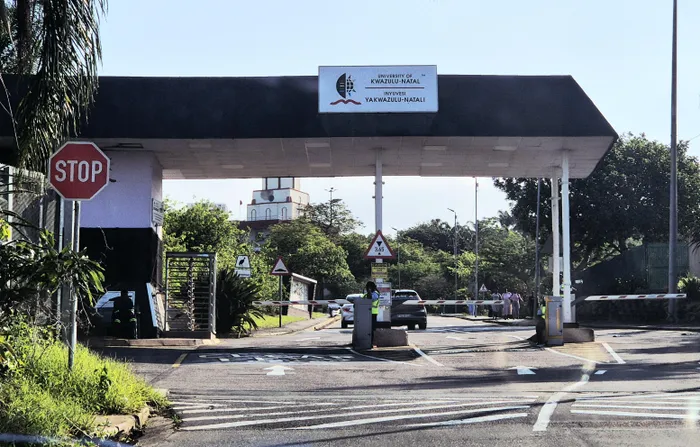
The writer is responding to a letter by Paulus Zulu, Emeritus Professor at the University of KwaZulu-Natal.
Image: Sibonelo Ngcobo / Independent Newspapers
IN LAST week’s edition of the Sunday Tribune, Professor Thabo Zulu published a response to my letter on governance integrity at the University of KwaZulu-Natal (UKZN). His letter, while framed as an academic intervention, does not engage any of the substantive issues I raised. Instead, it relies on generalised assertions, mischaracterisations of my position, and a restatement of institutional ideals as though they were evidence of institutional practice.
Given the seriousness of the matter, a clear and evidence-based clarification is required.
Misrepresentation of My Original Concerns: Professor Zulu begins by expressing “deep disappointment” and accusing me of “sensationalising isolated events.” Yet he does not cite a single sentence from my original letter to substantiate this allegation. A claim of misrepresentation requires demonstrating how the alleged distortion occurred.
His letter offers none.
My commentary did not depend on emotion, nor did it rely on selective memory. It listed specific, documented governance breaches, including procedural deviations in examination processes, failures of oversight, irregular security governance arrangements, and concerns already noted publicly by the Parliamentary Portfolio Committee.
These examples were not isolated, nor were they sensational; they were factual.
Assertions Without Supporting Evidence: Professor Zulu’s repeated claim that my concerns are “unfounded” is not accompanied by any engagement with the evidence I referenced. He disputes my conclusions without addressing the factual basis that informed them. It is therefore necessary to restate a basic principle of academic and governance discourse.
Assertions do not overrule evidence. They must be substantiated.
The Fallacy That the Existence of Procedures Equals Compliance: Professor Zulu notes that UKZN has established procedures for managing examination irregularities and governance matters. That is correct. However, the issue I raised was not about the existence of procedures, but about whether these procedures were faithfully followed. To insist that an institution cannot be compromised simply because it has policies is a fundamental governance fallacy. Organisations may possess exemplary policies yet fail to implement them consistently.
Capture, interference, and procedural deviation occur precisely when formal structures exist but are selectively applied or strategically ignored.
Professor Zulu offers no evidence that due process was upheld in the matters I highlighted; he simply states that procedures exist. That conflation is misleading.
Factual Inaccuracy Concerning UKZN’s Due Process Record: Professor Zulu’s assertion that the university has “repeatedly and consistently followed due process in all matters” is contradicted by several independent sources, including internal reports, documented complaints, examination irregularities, and evidence before the CCMA.
Additionally, the Parliamentary Portfolio Committee on Higher Education has publicly flagged systemic governance concerns at UKZN. I do not speak for the Committee, nor do I claim to substantiate the evidence before it. However, the existence of the Committee’s concerns demonstrates that the governance issues I raised are not isolated or imagined.
A single demonstrable breach disproves a claim of universal compliance. Multiple breaches expose a pattern.
Public Accountability in a Public Institution: Professor Zulu questions why I raised these concerns publicly rather than confining them to internal university channels. He overlooks three critical points:
First, UKZN is a publicly funded institution. Matters of governance integrity are therefore matters of public interest. Second, my commentary explicitly distinguished between the ongoing CCMA labour process and the broader governance issues affecting a national institution. Third, internal channels were compromised or ineffective in addressing the governance breaches I encountered. When institutional processes cannot guarantee impartiality or transparency, public disclosure becomes necessary.
Collapsing Governance Breaches into “Differences in Academic Interpretation”: Professor Zulu suggests that the issues raised amount to nothing more than “differences in academic interpretation.” This is inaccurate and diminishes the gravity of the concerns. Examination irregularities, Senate procedural deviations, failures in risk governance structures, and the Parliamentary Committee’s concerns are not matters of opinion.
They are matters of record, procedure, and national oversight.
What Is at Stake: This debate is not about personalities or institutional pride. It is about the standards to which public universities must be held. When governance structures fail, when procedures are selectively applied, or when whistleblowers are ignored or sidelined, the integrity of the institution is weakened. To raise concerns about such practices is not to tarnish a university’s reputation; it is to protect it.
Conclusion: Professor Zulu’s letter does not rebut the governance issues I raised. It does not engage the evidence, address the specific concerns, or offer factual counterpoints. Instead, it rests on sweeping assertions and appeals to institutional idealism.
Public institutions are strengthened by transparency, not silence. They are upheld by truth, not denial. And they are protected not by defending systems from scrutiny, but by ensuring that all systems stand up to scrutiny.
Professor Pholoho Morojele