
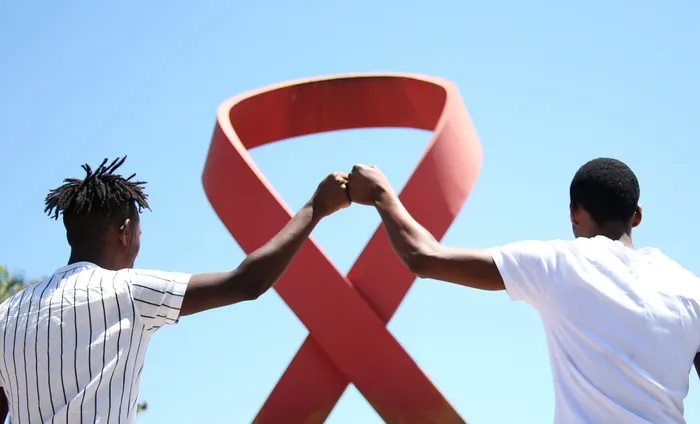
AS new prevention technologies emerge, like the injectable lenacapavir, a new revolutionary HIV prevention tool which has the potential of reducing new infections, can South Africa fulfil the promise of ending AIDS by 2030? asks the writer.
Image: TUMI PAKKIES Independent Newspapers
When the late Mbongeni Ngema released his hauntingly emotional song Ingculaza, he captured the anguish of a nation that had just triumphed against the brutality of apartheid, only to be confronted by a new, silent, and devastating war: HIV/AIDS.
In his lament, Madlokovu (Ngema clan name) reminded us that freedom had been won from a ruthless regime, but another enemy that was less visible, more insidious, was claiming lives in every township, village, and city. The song was not just art; it was a cry of pain, a mirror held up to a society grappling with loss, stigma, and fear.
That lament still echoes today. South Africa’s HIV/AIDS story is one of pain, resilience, and unfinished struggle. From the devastation of the 1980s and 1990s, through the world’s largest treatment programme today, to the promise of prevention jabs and a future free of AIDS, the journey is deeply human. It is about mothers who feared passing the virus to their children, young people navigating stigma, and communities demanding dignity. This op‑ed traces the past, present, and future of HIV/AIDS in South Africa, reminding us that statistics only matter if they translate into lives saved and hope restored.
The first cases of AIDS in South Africa were reported in 1983. By the early 1990s, prevalence among pregnant women was climbing, and the epidemic was spreading rapidly. But denial and political paralysis defined the early years. The apartheid government treated HIV as a marginal issue. Later, under democratic rule, denialism at the highest levels delayed action.
By the early 2000s, the crisis was catastrophic. Hospitals overflowed with patients dying of opportunistic infections. Funerals became weekly rituals in townships and rural villages. Families were torn apart, children orphaned, and communities devastated.
Statistics tell part of the story: by 2004, AIDS‑related deaths peaked at 280,000 in a single year. But behind those numbers were mothers who buried their children, young men who wasted away in hospital wards, and grandmothers who suddenly became primary caregivers to orphaned grandchildren.
Civil society rose in defiance. The Treatment Action Campaign (TAC) fought relentlessly for access to antiretroviral therapy (ARVs). Activists marched, litigated, and demanded dignity. Their struggle was not abstract. It was about saving lives.
Today, South Africa has the largest HIV/AIDS programme in the world. More than 6 million people are on ARVs. Transmission from mother to child has been reduced to less than 2%. AIDS‑related deaths have fallen by more than 80% since the peak.
These are extraordinary achievements. They mean that millions of South Africans who would have died are alive. They mean that HIV is no longer a death sentence, but a chronic condition that can be managed.
Yet the present is not without pain. In 2024, 170,000 people were newly infected. Women and girls accounted for nearly 60% of those infections. Stigma remains pervasive. Many still fear disclosure, rejection, or violence.
Daily life is shaped by HIV in countless ways. A young woman in KwaZulu‑Natal may take her ARVs every morning before school, hiding the pills from classmates. A miner in Rustenburg may skip treatment because he fears losing his job if colleagues discover his status. A grandmother in Limpopo may walk kilometres to a clinic to collect medication for herself and her orphaned grandchildren.

Nco Dube, a political economist, businessman and social commentator
Image: Supplied
These are not just statistics, they are lived realities.
The future holds promise. South Africa is preparing to roll out six‑monthly HIV prevention injections (lenacapavir) by 2027. These jabs, almost 100% effective, could revolutionise prevention, especially for young women who remain most vulnerable.
UNAIDS has set the goal of ending AIDS as a public health threat by 2030. South Africa is central to that vision. Bold initiatives like “Close The Gap” aim to put an additional 1.1 million people on treatment. New technologies, from viral load monitoring to digital adherence tools, are strengthening the response.
But the future is also fragile. Funding cuts from international donors threaten progress. Complacency is dangerous. If prevention stalls, if treatment falters, if stigma persists, the epidemic could resurge.
The warning is clear: all the progress means nothing if it does not translate into tangible benefits that change lives. A declaration of “ending AIDS” will be hollow if young women continue to be infected, if men avoid clinics out of fear, if communities remain burdened by stigma.
Numbers can numb us. Millions infected, millions treated, thousands dead. But HIV/AIDS is not about numbers. It is about people.
It is about the mother in Soweto who once feared passing the virus to her child, but now celebrates her daughter’s graduation because prevention worked. It is about the young man in Umlazi who once faced rejection from his family, but now finds acceptance in a support group. It is about the nurse in Mthatha who has watched patients die, but also watched them rise again with ARVs.
It is about resilience. Communities have carried this epidemic with courage. Activists have fought for justice. Families have endured unimaginable loss. And yet, hope persists.
South Africa’s HIV/AIDS journey is a testament to human resilience and the power of collective action. From denial and devastation, to the world’s largest treatment programme, to the promise of prevention jabs, the story is extraordinary.
But it is unfinished. The epidemic continues to shape lives. Stigma continues to wound. Funding continues to falter. And complacency threatens progress.
The triumph of South Africa’s HIV/AIDS programme must be defended against indifference. It must be deepened, expanded, and delivered. Only then will the promise of ending AIDS by 2030 be real.
World AIDS Day is not just a commemoration, it is a call to action. It is a reminder that behind every statistic is a human being. And it is a demand that we honour their lives not with words, but with action.
(Dube is a noted political economist, businessperson, and social commentator on Ukhozi FM. His views don't necessarily reflect those of the Sunday Tribune or IOL. For further reading and perspectives, visit: http://www.ncodube.blog)