

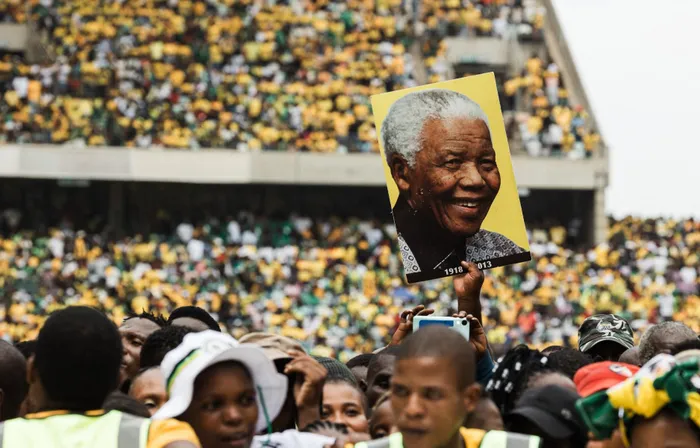
African National Congress (ANC) supporters holds a poster of former President Nelson Mandela during the party's election manifesto launch at the Moses Mabhida Stadium in Durban on February 24, 2024. When it suits them, ANC leaders invoke Mandela’s name but fail to emulate him, says the writer.
Image: AFP
Prof. Bheki Mngomezulu
The date of December 5, 2013, was deeply ingrained in my brain. It was a very cold and snowy day in Sweden, where I was attending a workshop, when I received the devastating news about Nelson Mandela’s passing.
Given his international stature, various television stations covered this breaking news repeatedly. An important chapter in the life of the ANC and South Africa had ended. Mandela joined his comrades, including Chief Albert Luthuli, Chris Hani, Dr. Langalibalele Mafukuzela Dube, Oliver Tambo, and many others. From that day, South Africa was never going to be the same.
This year 2025 marks 12 years since Mandela’s passing. As South Africa celebrates this 12th anniversary, it is the opportune time to reflect on how the country has progressed or regressed under the ANC since that fateful day.
We must establish what we have done with the gains that were made under Mandela’s leadership. Importantly, the ANC as an organisation must use this opportunity to do self-introspection by asking itself very pertinent questions that would help it assess its performance and project its political future. Ten of these questions are listed below.
To what extent has the current ANC leadership succeeded in keeping the gains made by Mandela and his contemporaries? To what extent has the party protected its public image since Mandela’s passing? Why has the ANC’s support waned in each election, especially since the 2019 general election? What role has factionalism played in the ANC’s misfortunes? Can the ANC still claim the label of being the ‘leader of society’ as it has been known for many years?
Does the ANC still put people first, or are leaders obsessed with political greed and power mongering? Does comradeship still exist in the ANC, or do comrades stab one another in the back for political expediency? Has the current leadership succeeded in steering the ship in the right direction – both in the context of the party and the country? As the number of political parties has proliferated exponentially, does the current leadership have what it takes to prevail under these circumstances? Lastly, has the ANC learnt from its previous mistakes?
These questions are important for two reasons. Firstly, when it suits them, ANC leaders invoke Mandela’s name and even quote him on public platforms, but fail to emulate him. Secondly, the ANC is facing an existential crisis. This is evidenced in its poor support base, the level of debates on various pertinent issues, lack of consistency when implementing party policies and resolutions, covering things up to protect certain individuals even at the expense of the party and the country, and refusing to embrace constructive criticism from within and outside the party.
In a nutshell, the ANC has failed to mirror Mandela. When Chris Hani was assassinated on April 10, 1993, it was Mandela who prevented a civil war and bloodbath. Soon after the news broke out about Hani’s assassination, Mandela addressed the nation, calling for calm. He assumed the role of a father figure as the leader of the ANC even before he assumed the presidency on May 10, 1994. Through his leadership dexterity, a civil war was averted.
By contrast, when unrest broke out in KwaZulu-Natal and Gauteng in July 2021, President Ramaphosa poured petrol on the flames, thereby causing an inferno by wrongly labelling this incident as ‘ethnic mobilisation’, which was a simplistic and ill-informed characterisation. It took a few of us to challenge this notion – risking our lives in the process as we received threatening calls and messages. Eventually, sanity prevailed when the President conceded that this was not ethnic mobilisation but a more serious issue. Mandela would have handled this situation differently.
When the Phala Phala saga surfaced involving the theft of questionable US dollars from President Ramaphosa’s farm, the ANC’s ethical behaviour was tested. It was clear that this incident was difficult to defend. Ramaphosa did the right thing and penned his resignation letter as the President of the country.
Instead of the ANC applauding Ramaphosa for showing leadership and for putting the country and the ANC first, it opted for a wrong and unjustifiable decision. The party told Ramaphosa to rescind his resignation.
It reminded him that it had enough numbers in parliament to ensure that there would be no two-thirds majority should opposition parties invoke Section 89 of the constitution to remove the president. Indeed, Ramaphosa complied. While this saved him in the short term, it tarnished his image. Moreover, the incident seriously damaged the ANC’s public image. Once again, the ANC failed Mandela.
A Section 89 independent panel was appointed to investigate the Phala Phala matter. It was led by Retired Chief Justice Sandile Ngcobo, who was assisted by Justice Thokozile Masipa and Advocate Mahlape Sello. On November 20, 2022, the panel presented Volume 1 of the report. When the report was presented in parliament, the ANC once again used its numbers to reject it. This decision was not premised on rationality and objectivity. On the contrary, it was driven by political expediency and short-term gains. Again, the party failed Mandela.
ANC support has waned since Mandela’s passing. After obtaining 62.15 percent in 2014 (down from 65.90 percent obtained in 2009, from 2019, the ANC has made history in the wrong way. In 2019, for the first time, the ANC went below 60 percent, obtaining 57.50 percent. As if this was not enough, in 2024, the worst record was set when the party went below 50 percent, only managing 40.18 percent. Unless something drastic happens, in 2029, the ANC could go down even further.
Addressing the rumour that some in the ANC want Ramaphosa to resign, Snuki Zikalala shocked many of us. He averred that such would be tantamount to a coup, treason, and would cause instability. Ironically, the same was not said when Mbeki and Zuma were recalled.
In short, the ANC has squandered Mandela’s legacy as evidenced in its public image, unity, ethical behaviour, proximity to the people, and performance at the polls.
* Prof. Bheki Mngomezulu is Director of the Centre for the Advancement of Non-Racialism and Democracy at Nelson Mandela University.
** The views expressed do not necessarily reflect the views of IOL, Independent Media or The African.