

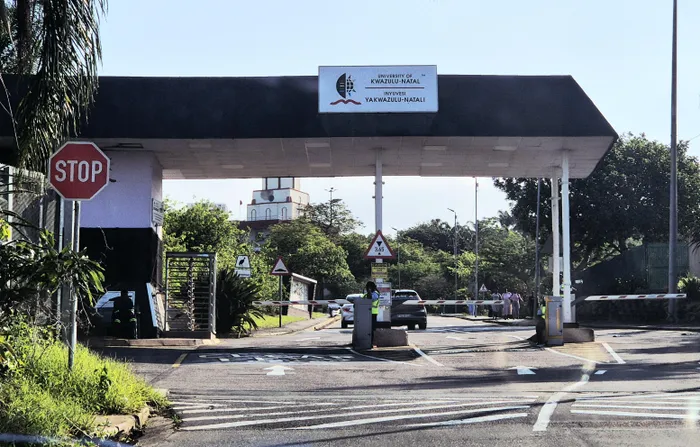
The University of KwaZulu-Natal recently came under the spotlight of the Parliamentary Portfolio Committee on Higher Education for alleged governance failures.
Image: Sibonelo Ngcobo / Independent Newspapers
I appreciate the concerns raised in the recent letter, “Clarification on academic integrity: addressing confusion in UKZN discourse” (Sunday Tribune, December 7, 2025), which responded to ongoing public dialogue on university governance.
It is important, however, to ensure that public discussion remains anchored on verifiable facts rather than assumptions.
My original letter (October 16) stated two central points:
These are matters on public record and are now confirmed by independent oversight, not personal allegation, nor conjecture.
Therefore, the claim that my narrative lacks evidence overlooks the fact that the evidence has since been established by Parliament itself. The timing of my dismissal relative to the concerns I raised remains a legitimate basis for scrutiny.
I acknowledge that UKZN, like all institutions, has established procedures for examinations, ethics, and governance. My argument, however, has always been that: The mere existence of procedures does not guarantee their application. It is precisely where processes fail, or are selectively applied, that governance integrity requires principled intervention.
Public discourse on academic governance is not an attack on an institution’s reputation. Quite the opposite, it is a duty of care to protect the very academic values that universities exist to uphold:
These are constitutional imperatives in higher education, not personal grievances.
I have no desire to impugn individuals nor to sensationalise matters of institutional significance. My concerns are, and have always been, focused on due process and academic integrity.
As these issues continue to unfold, I welcome a factual and respectful discourse rooted in documentation, oversight findings, and the principles that safeguard the academy in South Africa.
Accountability is not confusion. It is clarity in service of the public good.
Professor Pholoho Morojele
Executive Dean, Faculty of Arts and Design
Durban University of Technology
(Former Dean of Research, UKZN)