

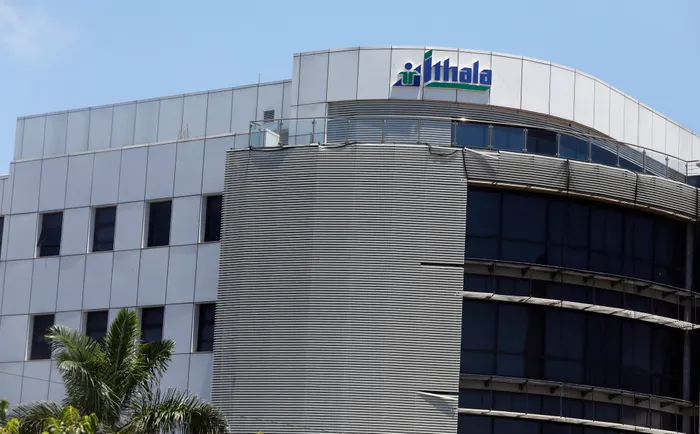
AS excitement grows over FNB's guarantee for Ithala Bank depositors to access their funds, just in time for Christmas, following an almost year-long limbo, the writer uncovers the true founding timeline of South Africa's Ithala Bank, challenging the widespread misconception that it was established by Inkosi Mangosuthu Buthelezi in the 1950s. Discover the actual evolution from the Bantu Investment Corporation to today's financial institution against the backdrop of South Africa's complex political history.
Image: DOCTOR NGCOBO Independent Newspapers
In the absence of truth, lies often flourish. Ponder Ithala Bank, which is regularly in the news and dominates contemporary conversations these days.
Word has it that the state-owned Ithala Bank was founded by the late Inkosi Mangosuthu Buthelezi in the 1950s. That is a gross blue lie.
The genesis of Ithala Bank SOC is around about 1983 or 1984. Unfortunately the bank's own website is also peddling this lie of the 1950s.
Below is the brief evolution of Ithala Group as a Finance Development Institution (FDI), just like your Industrial Development Corporation (IDC), National Empowerment Fund (NEF) of Sydney Maree fame and scandal and other FDIs like the Development Bank of Southern Africa (DBSA) and Business Partners, formerly known as Small Business Development Corporation (SBDC).
All the aforementioned FDIs are statutory bodies founded by the pre- and post-1994 governments.
Ithala could not have been founded by Inkosi Buthelezi in the 1950s, as he had not even ascended to the Chief Minister position of the then-Bantustan homeland of the KwaZulu Government.
Probably people mistake the founding of the now defunct Bantu Investment Corporation, commonly known as BIC, which was founded in 1959.
BIC was created to financially prop up the 10 ethnic-based Bantustan homelands, viz. Transkei, Bophuthatswana, Ciskei, Venda, Gazankulu, Lebowa, KwaZulu, KwaNdebele, Qwaqwa and KwaNgwane.
Transkei was the first to take the so-called nominal independence from Pretoria on October 26, 1976, selling the birthright of so many, and mostly those who back UDM these days are clamouring for those good old days of this Bantustan founded by the Matanzima siblings, Kaiser and George.
They were followed by Bophuthatswana of Lucas Mangope, Venda of Patrick Mphephu of "Mangope did it, Kaizer Daliwonga Matanzima did it. Why can't I did it" fame, and lastly Ciskei of Lennox Sebe.
The remaining six became what were called self-governing territories with the hope that eventually they would also take the Pretoria-style independence.
Remember the bile mouthed by that Polish killer of SACP secretary-general Chris Hani about blacks having rights in their homelands?
So, the KwaZulu Government Homeland Bantustan started as what was called the Zululand Territorial Authority (ZTA) from 1970 to 1972 for amaZulu, and Inkosi Buthelezi was elected the Chief Councillor of the ZTA, later Chief Minister.
So BIC then propped up the Bantustan and created cheap labour industrial estates in eZakheni outside the white-controlled town of Ladysmith and Sithebe outside the white-controlled town of Mandeni, and the same with the townships of eZakheni and Mpumalanga outside the white-controlled Hammarsdale, Madadeni and Osizweni in Newcastle, and Gamalakhe Township outside the Natal towns of Port Shepstone and Margate.
The same with the creation of eSikhawini, now eSikhaleni Township, to supply labour to the port city of Richards Bay and the town of eMpangeni. These were called border industries.
Those who grew up in Bophuthatswana would recall Mogwase; those who grew up in Ciskei would recall Dimbaza, where Ohlssons Lager Brewery had a beer factory. In Gazankulu there was Letaba, where Busaf had a bus body-building factory. You had Nkowankowa and Nzelele Townships for both vaTsonga and baPedi outside the white town of Tzaneen.
So, in a nutshell, all these ten Bantustans had their own BICs (remember the KZ Transport orange buses, Transkei Road Transport Corporation buses, Gazankulu (Ximoko) buses, Lebowa Transport, the present NW Transport, etc.).
These evolved into "Development Corporations", which were known as KwaZulu Development Corporation (KDC), later changed into KwaZulu Finance and Investment Corporation (KFC).
In the Eastern Cape they have ECDC; Limpopo has LDC.
For years Pretoria had its man, Dr Marius Spies, as the statue guarding that BIC funds were not looted. It had a training facility, KwaZulu Training Trust (KTT), in Mariannhill (remember it being looted in July 2021).
So in 1984, KFC changed its name to Ithala, deriving its name from the isiZulu definition that it is a place of preserving or storing something.
So through the Ithala FDI there was an offshoot of the present troubled Ithala Bank SOC, and that was in 1984, not in the 1950s as it is now claimed.
The Bank came into being to also finance bonded homes in what is the present Ingonyama Trust Board land under Amakhosi, as most finance lending institutions, such as ABSA, FNB, Nedbank and Standard Bank, could not finance mortgages in areas where there is no title deed for the land.
Yes, it is the legacy and Inkosi Buthelezi's dream, but he did not form it in the 1950s, as the Nationalist Party of DF Malan that consolidated apartheid came into being in 1948.
(Baloyi is a former journalist who has worked for many publications in various roles. He has also worked as a government communications specialist. He writes in his personal capacity. His views don't necessarily reflect those of the Sunday Tribune or IOL)