

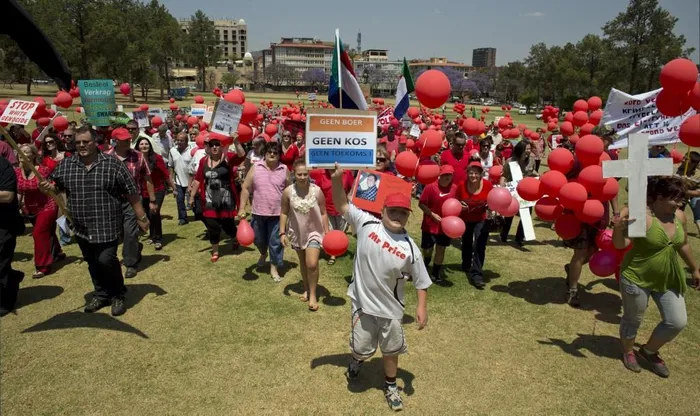
Disgruntled right-wing white South Africans displaying the apartheid-era flag at a protest held in Pretoria on October 10, 2013. One thing that should be noted is that for reconciliation to be a reality, all racial groups must not only state their willingness to reconcile. Instead, they must actively work towards reconciliation, says the writer.
Image: AFP
Prof. Bheki Mngomezulu
On December 16, 2025, the country will celebrate 30 years of Reconciliation Day. Until 1995, this day was known as Dingane’s Day or Day of the Vow. King Dingane, who planned the killing of Boers in 1938 after luring them into his kraal, died on January 29, 1840.
The Boers made a vow to God that if they were to win against Dingane, they would build a church to thank God. Their wish came true at the Battle of Blood River. It was for these reasons that the day had two names – one acknowledging King Dingane, the other acknowledging the Boers.
The current labelling of this day as “Reconciliation Day” was meant to heal the old wounds and build a post-apartheid nation. The extent to which we have been able to reconcile as a nation remains the subject of debate.
In simple terms, reconciliation refers to the process of restoring relations to the former state after they have been disturbed in one way or another. It is essential for peace to prevail. Nelson Mandela described reconciliation as “working together to correct the legacy of past injustice.”
But reconciliation is not an event; it is a process that goes through various stages. It does not only mean forgetting the past injustices but working hard to correct them so that they do not happen again. Corroborating this view, Mandela argued that “true reconciliation does not consist in merely forgetting the past.”
Reconciliation is achieved under certain conditions, one of which is telling the truth. In this regard, Mandela argued that “if there is to be reconciliation, first there must be the truth.” Implicit in this submission is that if the truth does not come out, reconciliation is not possible.
It was the same understanding that informed the operations of the Truth and Reconciliation Commission (TRC), which was chaired by Bishop Desmond Tutu with Dr Alex Boraine as his Deputy Chairperson. For anyone to be pardoned, such a person was expected to tell the truth about what happened under apartheid.
In addressing the critical question of how far South Africa has gone in embracing and achieving elusive reconciliation, it is important to trace the discussion historically by reflecting on what some of South Africa’s leaders said about race relations in South Africa.
One of these leaders was Robert Mangaliso Sobukwe, who was one of the founding members of the Pan Africanist Congress (PAC), which split from the ANC in 1959. His approach to human relations was a form of radical reconciliation through shared humanity so that people could put their racial and other differences aside and build one South Africa.
He argued that there was one race, the human race. Sobukwe once stated that “I wish to make it clear again that we are anti-nobody. We are pro-Africa. We breathe, we dream, we live in Africa because Africa and humanity are inseparable.
Another key figure was Steve Biko, founder of the Black Consciousness Movement (BCM), who once said that “the blacks are tired of standing at the touchlines to witness a game that they should be playing. They want to do things for themselves and all by themselves.”
What Biko agitated for was racial harmony, where black people could be accorded the status they deserved but which had been taken away from them by their white counterparts. Unless this was done, there would be no reconciliation. The truth had to prevail.
Flowing from these arguments, South Africans must ask themselves if, after thirty years since this “Reconciliation Day” was formalised, reconciliation among different races has occurred.
One thing that should be noted is that for reconciliation to be a reality, all racial groups must not only state their willingness to reconcile. Instead, they must actively work towards reconciliation.
Sadly, what has been happening in South Africa is that those who were the victims of apartheid have bent backwards to accommodate their erstwhile oppressors – the white people. In return, some whites continue to refer to black people as baboons, gun them down and argue that they mistook them for monkeys, kill and feed them to crocodiles, shoot them down for allegedly trespassing in their farms, place one of a black person in a coffin alive as was the case in Mpumalanga – arguing that it was simply a threat, or having a white businessman who owns a accomodation outlet in KwaZulu-Natal boldly telling the media that he does not serve black people in his business. The list goes on.
A recent example is the group of 49 Afrikaners who accepted President Donald Trump’s call that all the Afrikaners who want to escape what he called “Afrikaner genocide” should relocate to America. If Trump was playing a political game to punish South Africa for taking Israel to the International Court of Justice (ICJ), the action by the 49 Afrikaners negates reconciliation.
While this emigration may have benefitted the 49 Afrikaners in the short term, it was a blow to reconciliation. It is indeed commendable that some Afrikaners distanced themselves from the deceptive narrative propagated by Trump and a few Afrikaners. But such action opened old wounds that were beginning to heal.
The remaining Afrikaners must now publicly denounce their 49 compatriots to keep the reconciliation dream alive. Sadly, some of the other racial groups could be sceptical about all Afrikaners and stop trusting them, whether they are part of the genocide propaganda or not.
One of the reasons why reconciliation has not been achieved in South Africa is that during the transition period, black people (including Indians and coloureds) were quick to pardon their white counterparts before they could sincerely and genuinely apologise for the atrocities they committed during apartheid. In other words, the truth did not come out. Therefore, reconciliation could not be achieved.
To answer the question posed earlier, South Africa has not achieved reconciliation. Unless we tell the truth, unless Afrikaners desist from colluding with Trump about ‘genocide’, reconciliation will remain a far-fetched dream!
* Prof. Bheki Mngomezulu is Director of the Centre for the Advancement of Non-Racialism and Democracy at Nelson Mandela University.
** The views expressed do not necessarily reflect the views of IOL, Independent Media or The African.