
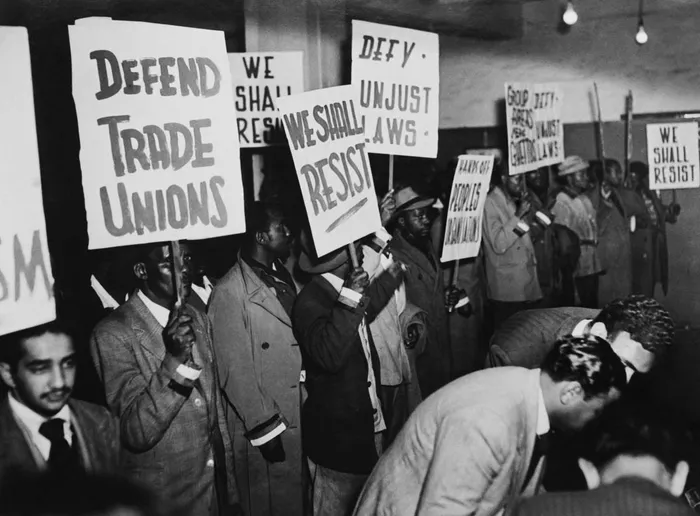
Supporters of the ANC protest against apartheid laws in Johannesburg on August 12, 1952. The protest was part of nationwide defiance campaign and culminated in the historic Congress of the People and the adoption of the Freedom Charter in Kliptown on June 26, 1955.
Image: AFP
Siva Naidoo
South Africa today is a nation under strain—tested by corruption, deepening inequality, and social decay. Yet, across the country, and particularly in Tongaat and along the North Coast, I have witnessed something enduring and powerful: ordinary people rising in extraordinary ways.
Whether confronting floods, tornadoes, drug lords, or injustice, our communities have repeatedly demonstrated courage and resilience. This spirit is the heartbeat of the Freedom Charter—a beacon that continues to guide us.
I was born and grew up in Tongaat. By the late 1970s, I was a young activist actively involved in civic and welfare movements. For us, the Freedom Charter was far more than a political document—it was a lodestar. Adopted in Kliptown in 1955, it boldly proclaimed that *South Africa belongs to all who live in it*. It promised equal rights, housing, work, security, peace, and dignity for all. To young activists of my generation, it was audacious, hopeful, and profoundly necessary.
Decades later, the reality we confront is sobering. Poverty, unemployment, and inequality remain stubbornly high. Corruption and mismanagement have eroded public trust. Basic services falter. Communities on the North Coast continue to endure chronic water shortages. Roads crumble, shadow economies flourish, and violence, gender-based abuse, and substance addiction are all too common.
Siva Naidoo
Image: Supplied
Yet, even in the face of these challenges, I remain hopeful. South Africans are resilient. Time and again, we rise when tested. I have seen this spirit on the North Coast during moments of great trial: the July 2021 unrest, when ordinary citizens stood together to protect their communities; the devastating floods in KwaZulu-Natal; the Tongaat tornado, which destroyed homes but not courage; and grassroots mobilisation against drug lords through the Tongaat Anti-Drug Forum. These experiences affirm that the values of the Freedom Charter—solidarity, courage, and community—are still alive.
The Charter’s relevance today is profound. It calls for active citizenship. Justice, equality, and accountability are not delivered by the state alone; they are achieved through organised, persistent action. Change does not come passively.
It requires mobilisation, vigilance, and courage. As Madiba reminded us, power lies in the hands of the people. We defeated apartheid because we acted. That same spirit can confront corruption, social decay, and inequality today.
Unity is essential. Our nation is fractured by ideological, racial, and social divides. The Freedom Charter reminds us that we are one people and one nation. Our strength lies not in our differences, but in our shared purpose. Only through unity can we tackle the corruption, poverty, and social ills that undermine our democracy.
As an activist and practitioner of Ubuntu and Human Values, I believe the path forward must be grounded in dignity, respect, and empathy. Ubuntu teaches us to recognise the inherent worth of every human being and to act in ways that place the community above self-interest. A society guided by these principles can confront poverty, unemployment, and inequality with both courage and compassion.
The failures of governance are evident. The promise of the so-called “money racial project” has been compromised by greed, mismanagement, and ethical collapse.
Yet the Freedom Charter reminds us that we cannot wait passively for salvation. Citizens must reclaim their agency—organising communities, monitoring leadership, and insisting on justice. The power to change our nation lies with us.
The moral clarity of the Freedom Charter is timeless: housing for all, work for all, education and opportunity for all, peace and security for all. These are not abstract ideals; they are urgent imperatives. The way forward is clear—invest in human potential, restore integrity in leadership, and cultivate a culture of service and accountability.
I have seen communities on the North Coast respond to crisis with courage and organisation. They mobilised against drug lords, coordinated relief for flood victims, and rebuilt after devastation. Even in despair, citizens acted to protect and uplift one another. This is the living spirit of the Freedom Charter.
Organise. Mobilise. Speak truth to power. Hold leaders accountable. Build from the ground up. Change begins with us.
To the youth of South Africa: activism is not a relic of the past. The Freedom Charter remains a call to action. Every citizen is a custodian of democracy. Every voice matters. Every act of courage strengthens the moral fabric of our nation.
South Africa belongs to all who live in it. The Freedom Charter reminds us that it always has—and that it always must. Its promises are not mere words; they are a blueprint for justice, dignity, and equality. The struggle continues, but the torch lit in 1955 still burns. Let us lift it with courage, unity, and faith in our people, and build a South Africa worthy of its citizens.
* Siva Naidoo is a 1970s activist, formerly from Tongaat. He is an Ubuntu and Human Values practitioner.
** The views expressed do not necessarily reflect the views of IOL, Independent Media or The African.