

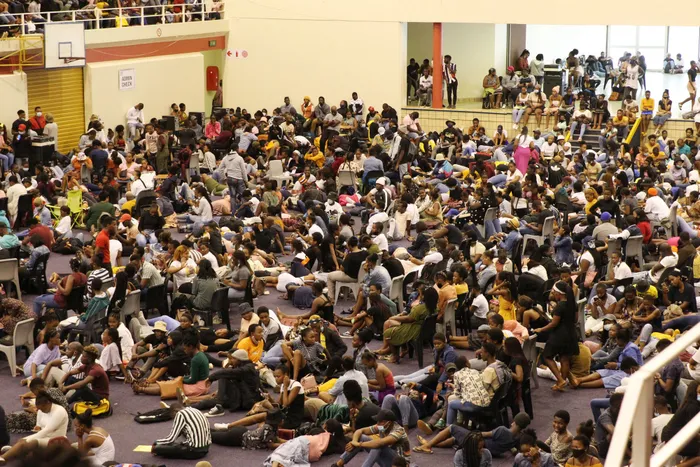
Public universities are under unprecedented operational stress. Rising numbers of tertiary study-qualifying matriculants, along with limited academic staffing and funding, have pushed the system beyond its limits.
Image: Doctor Ngcobo/Independent Newspapers (Archives)
SOUTH Africa’s 2025 matric results tell a story of progress and pressure. A record number of learners achieved Bachelor's passes this year, rising by 8,700 candidates from 2025. This means 345,000 learners are eligible to enter the country’s higher education system for degree study.
However, over a third will be turned away, not because they lack ability or ambition, but because the system lacks space, even with larger institutions. The University of the Witwatersrand and UCT have each received 86,000 and 98,844 applications, but only have capacities for 6,000 and 4,500 students, respectively. Stellenbosch University shows the same, with 90,027 applicants for 6,005 places.
In absolute numbers, the number of students qualifying for tertiary education from the matric class of 2025 exceeds 700,000. This includes the Bachelor’s passes (345,000), as well as diploma passes of 28% (over 250,000 learners) and 13.5% (over 130,000 learners), Higher Certificate passes. However, South African public universities can accommodate approximately 230,000 first-year students.
Public universities are under unprecedented operational stress. Rising numbers of tertiary study-qualifying matriculants, along with limited academic staffing and funding, have pushed the system beyond its limits. This pressure is compounded by persistent funding deficiencies and an ever-increasing financial burden, with an unsustainable NSFAS funding model that consumes an ever-bigger slice of the Department of Higher Education and Training university budget.
As this gap between demand and opportunity widens, an urgent question emerges: how do we create credible, scalable pathways into higher education, and ultimately the economy, before we lose the potential of an entire generation?
While the situation is deeply challenging, online and blended education have become a critical strategy for widening access to South African higher education. By reducing geographical and infrastructural barriers, digital and distance education offer hope to students who are turned away from traditional campus-based programmes while including working adults and youth in rural, underserved areas.
This flexibility fosters a sense of opportunity by enabling historically marginalised populations to gain the qualifications needed for skilled jobs. It supports lifelong learning in an economy increasingly valuing adaptability and technological literacy.
However, the country’s uneven digital access, with difficulties in internet access and connectivity, affects equitable participation. This demands targeted investment in digital infrastructure to ensure online education delivers its promise of universal access.
Private higher education institutions are playing an increasingly important role in easing the mismatch between demand for tertiary education and the public sector’s limited capacity to absorb all eligible students.
South Africa’s National Development Plan (NDP) targets 1.62 million students in higher education by 2030, yet public universities alone cannot meet this demand without a significant expansion in system capacity. Private institutions complement public provision, offering additional, accredited places to students who might otherwise be excluded.
The private higher education sector enrols over 300,000 students across more than 120 registered private institutions, demonstrating its considerable contribution to national participation rates and to the system’s resilience.
One of the private sector’s key strengths lies in its ability to scale responsibly. Many private providers operate multiple campuses, employ blended and distance-learning models, and adapt quickly to shifting demands, keeping pace with the evolving workplace.
Large tertiary education groups such as ADvTECH’s IIE Rosebank College, Waterfall School of Business and STADIO Holdings have expanded significantly in recent years, investing in new campuses and distance-learning platforms that now serve tens of thousands of students nationwide.
These models demonstrate how system capacity can be expanded beyond the limits of the public sector while maintaining governance, quality assurance and accountability.
These approaches are designed to make tertiary education more attainable and to enable students to balance work, study, and life commitments, broadening access while maintaining high academic standards.
Maintaining high quality and standardisation across the higher education system is crucial for building trust among students and employers. In South Africa, quality assurance and accreditation through the Council on Higher Education and related statutory bodies ensure that private higher education providers meet the same national academic benchmarks as their public counterparts.
Graduates from private institutions hold recognised, comparable, and aligned qualifications with the national qualifications framework, supporting their mobility and credibility in the labour market.
Accommodating academically eligible students has implications far beyond the education sector. While South Africa’s unemployment challenge is complex and shaped by broader economic factors, evidence consistently shows that higher levels of educational attainment improve employment prospects over a lifetime.
Graduates, on average, fare better in the labour market than those without post-school qualifications. Expanding access to tertiary education, therefore, remains central to long-term economic inclusion, skills development and productivity growth, even as structural reforms in the labour market continue.
There is a growing consensus across the sector that South Africa needs a more diverse, collaborative post-school education system to meet national development goals. Universities South Africa (USAf) and sector stakeholders have increasingly emphasised the importance of partnerships between public and private providers, a more explicit and more precise articulation of pathways, and shared responsibility for quality assurance and financing to ensure that the higher education system is equitable, resilient, and responsive to the needs of students and the economy.
In a country where youth unemployment remains one of the defining challenges of our time, expanding credible access to higher education is not only an educational imperative, but also an economic and social one.
Dr Linda Meyer is the former COO of Universities South Africa and current managing director of the IIE Rosebank College. The views expressed do not necessarily reflect those of the Sunday Tribune or IOL.