
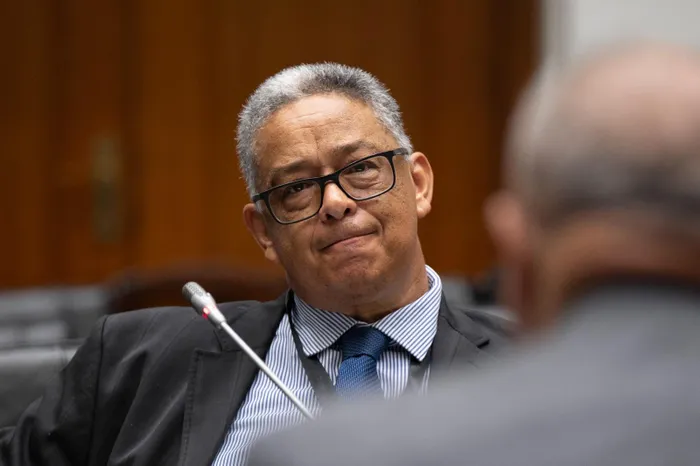
Former Independent Police Investigative Directorate head Robert McBride testified before Ad Hoc Committee investigating corruption, political interference, and criminal infiltration in South Africa’s criminal justice system. McBride embodies South Africa's complicated relationship with its liberation fighters. The writer explores how McBride's refusal to be a 'convenient hero' reveals our nation's selective memory and unresolved trauma.
Image: ARMAND HOUGH Independent Newspapers
South Africa has always had a complicated relationship with its struggle heroes. We celebrate them in song, in murals, in the sepia-toned nostalgia of public holidays, yet we recoil when they appear before us in the flesh. Flawed, human, unvarnished.
Few figures embody this contradiction more sharply than Robert McBride. He is not a likeable man, and perhaps he has never tried to be. He is arrogant, flippant, dismissive, and often abrasive. He is also a politician’s worst nightmare: independent-minded, unpredictable, and utterly unwilling to toe any party line.
But beneath the rough edges lies a truth that many in the ANC’s struggle-credential class quietly resent, McBride is the real thing. A genuine combatant. A man who went to war, carried out missions, faced the gallows, and lived to tell the tale.
In a country where struggle credentials have become political currency that is sometimes inflated, sometimes forged, often selectively remembered, McBride’s are inconveniently authentic. And that authenticity has made him both a symbol and a target.
A Life Lived Under Surveillance
For more than three decades, McBride’s life has been lived under a microscope. Not the gentle, curious gaze of a society seeking understanding, but the harsh, punitive scrutiny of those who never forgave him for his role in the armed struggle. Every misstep, every scandal, every lapse in judgement has been amplified, dissected, and weaponised. His mistakes have been treated not as human failings but as evidence of inherent criminality, an old apartheid narrative repackaged for a democratic era.
This is not to say McBride is a saint. He is not. But the intensity of the scrutiny he has faced is wildly disproportionate to his actual misdemeanours. Many ANC deployees have done far worse. Some have looted, some have lied, some have presided over institutional decay and yet they glide through public life with barely a fraction of the condemnation McBride attracts.
The difference is that McBride’s sins are never allowed to fade. They are kept alive by a coalition of interests that are political, racial, institutional and who find utility in keeping him perpetually on trial.
The Making of a Combatant
To understand the hostility toward McBride, one must return to the beginning. Born into a coloured family in Wentworth, Durban, McBride grew up in a community brutalised by apartheid’s spatial and economic engineering.
He joined Umkhonto we Sizwe (MK) not as a careerist or a political opportunist but as a young man convinced that armed resistance was the only moral response to an immoral system.
On June 14, 1986, a 23-year-old McBride led the operation that would define his life: the bombing of Why Not Restaurant and Magoo’s Bar on the Durban beachfront. The target, according to MK intelligence, was a gathering place for security branch operatives. The explosion killed three civilians and injured many others. It was a tragedy, and McBride has never denied the consequences. But it was also an act of war. One carried out in the context of a state that routinely bombed, tortured, assassinated, and disappeared Black South Africans with impunity.
The apartheid state wasted no time in making an example of him. He was arrested, tried, and sentenced to death. On death row, he lived with the daily possibility of execution. The noose was not a metaphor; it was a physical reality, a shadow that hung over him for years. His reprieve came only with the political negotiations that paved the way for democracy. In 1992, he was released as a political prisoner.
This is the part of McBride’s story that many prefer to forget. It is easier to caricature him as a reckless bomber than to acknowledge the full context of the war he fought. It is easier to condemn him than to confront the uncomfortable truth that the liberation struggle was not a polite debate but a violent confrontation between an illegitimate state and those who resisted it.
The Burden of Being a Real Hero
In the post-apartheid era, McBride’s struggle credentials have been both his armour and his curse. They opened doors for him, to diplomacy, to policing, to oversight institutions but they also made him a threat. Unlike many who claim the mantle of struggle hero, McBride does not defer to political power. He does not flatter, he does not grovel, and he does not pretend to respect those he considers intellectually or morally compromised.
This independence has made him enemies across the political spectrum.
White interest groups such as AfriForum and political parties like the DA have long treated him with disdain. Their hostility is unsurprising; McBride represents a chapter of history they would rather rewrite. For them, he is a symbol of the ANC’s armed resistance, a reminder that apartheid was not a benign administrative error but a violent, oppressive system that provoked violent, justified resistance.
What is more revealing is the disdain he now receives from within the ANC and the MK Party. When he appeared before the Parliamentary Ad-Hoc Committee on the Mkhwanazi matter, the hostility from ANC and MKP MPs was palpable. It was not the measured scepticism of oversight; it was personal, visceral, almost envious.
Why? Perhaps they too have internalised the 30 years of bad press that has dogged McBride. Or perhaps it is something more sinister: the discomfort of politicians who possess inflated or inherited struggle credentials confronting a man whose heroism is not performative but lived. McBride’s authenticity exposes their embellishments.
A Country That Can't Let Go
South Africa’s inability to let go of McBride’s past says more about the country than it does about him. We are a nation still wrestling with the moral ambiguities of our liberation struggle. We want heroes who are pure, unblemished, saintly. But real heroes are messy. They make impossible choices in impossible times. They carry the weight of history in their bones.
McBride is a reminder that the struggle was not a storybook. It was a war. And wars produce complicated people.
The refusal of certain sections of society to move past the Magoo’s bombing is not about justice; it is about narrative control. It is about refusing to acknowledge that apartheid created the conditions for violence. It is about refusing to accept that liberation movements, like all movements, were made up of human beings who made difficult, sometimes tragic decisions.
The Political Economy of Memory
McBride’s story is also a story about power. Who gets to define history, who gets to be forgiven, who gets to be condemned. In South Africa, forgiveness has always been unevenly distributed. Perpetrators of apartheid-era atrocities were granted amnesty, reintegrated into society, and in many cases rewarded with pensions and promotions. Black combatants, on the other hand, were expected to apologise, to shrink themselves, to carry their guilt publicly.
McBride refused to shrink. And that refusal has cost him.
His life illustrates how the political economy of memory operates: those who challenge dominant narratives are punished, while those who conform are rehabilitated. McBride’s greatest crime, in the eyes of his detractors, is not the bombing. It is his refusal to be ashamed of having fought.
A Mirror We Avoid
Robert McBride is not easy to defend. He is abrasive, confrontational, and often his own worst enemy. But he is also a mirror. One that forces South Africa to confront its selective memory, its unresolved trauma, and its discomfort with the messy realities of liberation.
He is a reminder that struggle heroes are not mythical beings but human beings. That the past cannot be sanitised to make the present more comfortable. That the truth of our history is not found in the polished speeches of politicians but in the lives of those who risked everything.
McBride’s story is not just his own. It is South Africa’s story. Complicated, painful, heroic, flawed. And until we learn to hold all these truths at once, we will continue to punish those who remind us of who we were, and who we still are.
(Dube is a noted political economist, businessperson, and social commentator on Ukhozi FM. His views do not necessarily reflect those of the Sunday Tribune or IOL. This is an edited version. For the full version visit: www.sundaytribune.co.za or www.ncodube.blog)
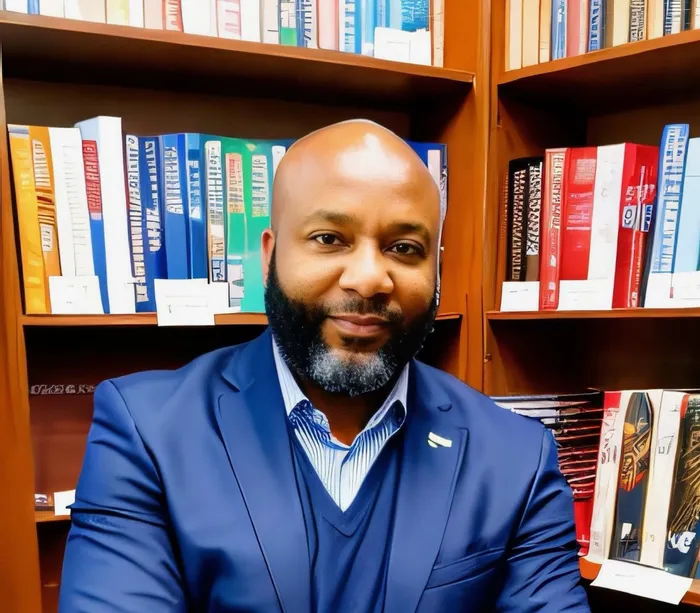
Nco Dube, a political economist, businessman and social commentator
Image: Supplied