
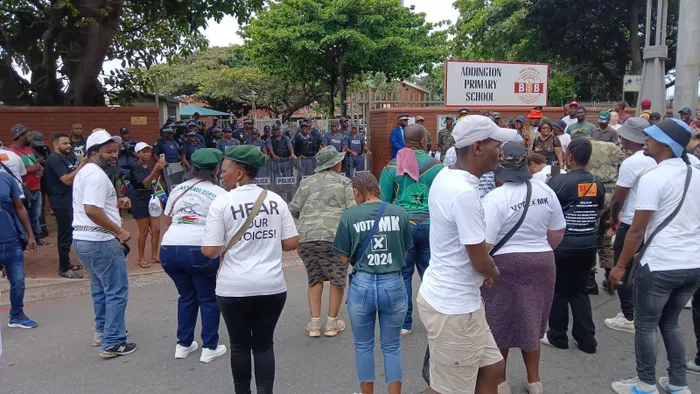
Parents and organisations like Operation Dudula and March and March outside Addington Primary School in Durban in a protest related to an alleged disproportionate placement of children of foreign nationals over South African learners at the schoool. The writer argues that most news reports about the school reveal lack of verification and how lazy journalism threatens not just media integrity but social cohesion itself.
Image: DOCTOR NGCOBO Independent Newspapers
South African journalism will not die from censorship. It will not die from political interference. It will die from something far more shameful: laziness. It is being slowly executed by reporters who no longer report with discipline or intellectual courage, by newsrooms that trade verification for virality, and by editors who surrender their constitutional duty in exchange for clicks, outrage, and manufactured controversy.
The Addington Primary School saga in Durban is not merely a disgrace. It is a forensic exhibition of how far journalism has fallen. It is proof that the profession has abandoned verification, discarded rigour, and replaced investigation with ideological theatre. What unfolded in this case was not reporting. It was propaganda by proxy. South Africans were deliberately whipped into a frenzy by activists and opportunists alleging that Addington Primary School was refusing admission to South African children to prioritise undocumented foreign nationals. The accusation was designed to inflame. It was crafted to provoke. It was engineered to trigger fear, anger, and resentment. And the media swallowed it whole.
Prominent radio stations parroted the claims. Newspapers printed them. Television channels broadcast them. Social media amplified them. Not one newsroom paused to demand enrolment records. Not one editor insisted on official data from the Department of Education.
The Addington Case Study
Not a single journalist asked the most basic questions that define the profession: What are the facts? Who can confirm them? What do the official records show? Even when journalists line up parents who perpetuate a claim, they miss the critical opportunity to verify it, despite having all the material and evidence before them. This was not a failure of access. It was a failure of courage. The facts, in truth, demolish the narrative entirely. After spending years hopping between newsrooms, covering everything from investigative to politics to the general chaos of daily news, I learned one thing: nothing beats the thrill of getting your facts right… and nothing hurts more than an editor finding a hole in the story and sending you back to verify that 200-year-old quote from someone who’s probably retired.
Addington Primary School has an enrolment of 1 582 learners. Of those, 580 are foreign nationals, all of whom are fully documented. Only twelve South African learners are undocumented, and five undocumented foreign nationals, less than one percent of the school population. Yet the country was led to believe that South African children were being displaced to make room for “illegal foreigners.” This is not misinformation. It is institutional negligence. Even more damning is what journalists did not bother to establish. Did anyone verify the legal status of the parents? Did anyone investigate whether these children were born of two foreign national parents or one South African parent and one foreign national? Did anyone ask how many of these learners were born in South Africa and have never known any other country? And if so, where exactly are these children meant to go? Which border must they cross when they were born here? Which country must they return to when they speak our languages, attend our schools, and live in our communities?
Constitutional Implications
These are not philosophical questions. They are constitutional questions. Section 29 of the Constitution of the Republic of South Africa is unequivocal: “Everyone has the right to a basic education.” Not citizens, not undocumented persons, not permanent residents, everyone. The Constitution does not qualify this right. It does not insert an immigration clause. It does not subordinate education to nationality. It affirms education as a foundational human right, inseparable from dignity, equality, and freedom. And yet, journalists, custodians of constitutional literacy, chose ignorance. They allowed mob rhetoric to replace legal reality. They allowed political opportunism to override constitutional principle. They allowed fear to silence fact. This is not merely poor journalism. This is the death of the noble craft. Consider the irony: some of the most powerful and intellectually formidable editors in the country, men and women who worked under relentless pressure to confront apartheid with nothing but their pens and courage, are now presiding over newsrooms where fear of social media backlash outweighs the pursuit of truth.
What we observed in the Addington Primary School saga is treacherous journalism. It undermines social cohesion. It legitimises xenophobia. It turns schools into battlegrounds and children into political weapons. Let us be clear: no responsible South African supports undocumented migration. No citizen condones criminal syndicates, traffickers, and cartels who exploit porous borders and prey on our communities. These are legitimate national security concerns. And precisely because the issue is serious, it must not be polluted by lies. Patriotism does not require deception. Sovereignty does not require hysteria. And border security does not require propaganda.
What makes the Addington Primary School outrage even more grotesque is the selective amnesia that accompanied it. There was a time when parents did not even want to send their children to that school; enrolment was so low that closure was a real possibility. Today, when the school is full, functioning, and academically stable, it is suddenly presented as a fortress captured by foreigners. This is not an analysis. It is fiction. And fiction has no place in journalism.
The Role of Editors
It is shocking that, in many cases today, the media does not merely report controversy but aligns itself with those who manufacture it. Activists who focus on specific issues understand how to manipulate journalists into aligning with their agenda. They exploit the growing laziness in journalism, where reporters no longer ask critical questions or interrogate narratives properly. As a result, activists are often elevated to the status of unquestioned authorities. While the issues they raise may be legitimate, journalists frequently fail to recognise that they are being used as instruments to advance a particular agenda.
Editors must constantly remind journalists in daily diary meetings that being handed a microphone and standing in front of a TV camera does not make one a celebrity. If fame is what you are chasing, you are in the wrong profession. Journalism's purpose is to hold everyone accountable, seek truth in every situation, and report with integrity. Journalists must not jump on bandwagons, exploit emotions for headlines, or accuse people or organisations without facts. Once a journalist takes sides, they stop being a reporter and become the story.
When journalists abandon their craft, society is left defenceless. A review of Addington coverage reveals stories riddled with holes, missing data, unverified claims, anonymous sources, and emotional soundbites masquerading as evidence. There is no statistical grounding. No demographic analysis. No constitutional framing. Where were the education officials? The school governing body records? The enrolment registers? Immigration compliance reports? Absent. All of it.
Instead, we were served theatre. Journalism is not propaganda. Journalism is not a popularity contest. It exists to interrogate power, not amplify it. It exists to verify claims, not circulate them. It exists to expose manipulation, not become its instrument. A newsroom that does not ask questions is not a newsroom, it is a public relations agency for whoever shouts the loudest.
The danger of lazy newsrooms
Editors must reassert authority. They must restore discipline. They must enforce professional standards. No story must run without verification. No allegation must stand without evidence. No narrative must survive without scrutiny. Journalists must return to first principles: ask hard questions, demand documents, verify statistics, challenge activists, interrogate parents, confront officials, and read the Constitution.
The Addington saga is not an isolated failure. It is a symptom of a deeper collapse: a collapse of professional pride, editorial courage, and ethical responsibility. If this culture of laziness continues, journalism will not merely decline; it will collapse. And when it does, the greatest victims will not be politicians or principals. They will be ordinary South Africans who deserve truth, not theatre. A lazy newsroom is a dangerous newsroom. A dangerous newsroom is an enemy of democracy. If journalism surrenders to laziness, it will die. And it will deserve its funeral.
(Memela is a former award-winning journalist and a former government spokesperson. His views don't necessarily reflect those of the Sunday Tribune or IOL)
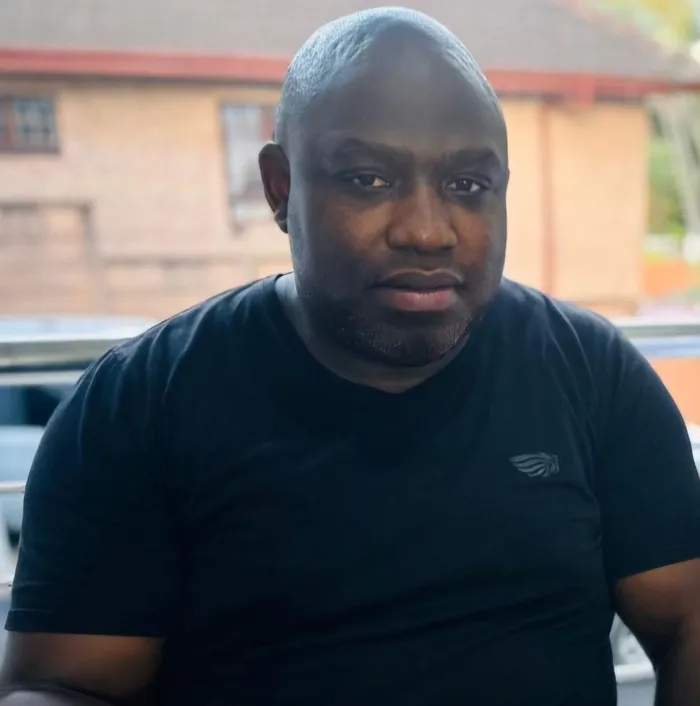
MHLABUNZIMA MEMELA
Image: SUPPLIED