

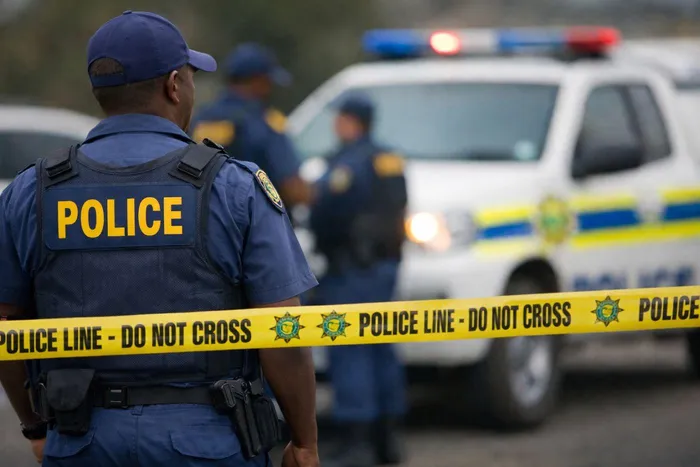
The South African Police Service isvcaught in a dangerous web of internal power struggles, corruption, and institutional decay that threatens the very foundation of the country's democracy, argues the writer.
Image: IOL
South Africa’s policing crisis is often framed as a problem of capacity, resources, or crime volume. This framing is convenient — and dangerously incomplete. The more uncomfortable truth is that the South African Police Service (SAPS) is confronting a deep and persistent integrity crisis, one that reaches into senior ranks and corrodes the institutions meant to uphold the rule of law.
Recent public disclosures and counter-disclosures within the Justice, Peace and Correctional Services (JPCS) cluster have again exposed SAPS not as a unified professional service, but as an arena of internal contestation for power, influence, and control over strategic resources. This is not new. What is new is the degree to which these struggles have surfaced publicly, forcing citizens to confront the depth of institutional decay.
Crime Inside the Police: A Documented and Enduring Reality
For more than two decades, official data and parliamentary disclosures have consistently shown that criminality within SAPS is neither incidental nor marginal. In December 2023, Parliament was told that 5 489 SAPS members had been arrested for various criminal offences since 2019. Strikingly, 3 981 of these officers — nearly three-quarters — remained in active employment, despite the seriousness of the charges against them.
This pattern is not a recent deviation but a structural feature of the service. As far back as 2013, Parliament was informed that between 1995 and 1999, an average of 1,320 police officers were convicted annually on criminal charges. The scale of those figures should have triggered a fundamental institutional reset. Instead, the problem was normalised.
More recent data suggests only marginal improvement. Between 2020 and 2025, 218 SAPS members were dismissed for corruption-related offences, while 163 officers were suspended during the 2023/2024 financial year alone. Yet suspension has increasingly become a holding pattern rather than a pathway to resolution.
In January 2026, it was revealed that more than R25 million had been paid over two years to 233 suspended SAPS members, many of whom were facing charges including rape, corruption, hijacking, and other serious offences. These payments — made while cases languished unresolved — illustrate an accountability system that is slow, ineffective, and misaligned with public interest. They also deepen public cynicism about a service seemingly unable, or unwilling, to cleanse itself of criminal elements.
When Police Become Crime Enablers
The consequences of this institutional failure extend far beyond reputational damage. South Africa’s experience shows that police corruption directly enables organised and violent crime. Firearms and ammunition used in serious offences are repeatedly traced back to police stores, evidence rooms, or SAPS-linked supply chains. Cash-in-transit robberies — among the most violent and sophisticated crimes in the country — continue to rise despite intelligence-led policing strategies, raising persistent concerns about leaks, collusion, and compromised intelligence.
Equally alarming are cases involving SAPS members implicated in sexual offences, including rape, often committed against detainees or vulnerable individuals. Such crimes represent a fundamental betrayal of public trust and raise the most basic question of democratic governance: how does a society protect itself when those tasked with protection are themselves perpetrators?
Crime Intelligence: From Strategic Asset to Factional Instrument
At the centre of SAPS’s dysfunction lies the persistent abuse of Crime Intelligence. International policing standards are unambiguous: intelligence structures exist to prevent and disrupt serious crime and threats to national security, not to serve internal factions, shield criminal networks, or surveil citizens unlawfully.
Yet in South Africa, Crime Intelligence has too often operated as a parallel power structure, insulated by secrecy, weak oversight, and discretionary funding. Instead of counter-intelligence protecting the state from infiltration by criminal syndicates, it has been repeatedly accused of being captured and weaponised — turned inward to manage internal rivalries and silence whistle-blowers like Sindiso Magaqa.
This inversion of purpose is fatal to democratic policing. Intelligence without accountability becomes a mechanism for impunity rather than public protection.
Leadership Instability and Strategic Drift
SAPS’s chronic leadership instability — marked by acting appointments, suspensions, reinstatements, and factional alignments — has produced a state of strategic drift. Without a stable ethical and operational centre, internal power struggles flourish.
In such an environment, senior officers are increasingly perceived not as custodians of public safety but as participants in a zero-sum contest for control over budgets, intelligence flows, and political access. Discipline becomes selective, reform performative, and accountability negotiable.
International Norms and a Failing Benchmark
International frameworks articulated by bodies such as the United Nations Office on Drugs and Crime and the OSCE emphasise five pillars of democratic policing: legality, accountability, transparency, proportionality, and respect for human rights. Central to these norms is the principle that counter-intelligence exists to protect citizens and constitutional institutions — not to be repurposed against society or internal rivals.
South Africa’s failure is not one of policy design but of implementation and political will.

Chris Maxon, is a dedicated social justice activist and academic enthusiast.
Image: File
A Democratic Test We Are Failing
The crisis within SAPS is ultimately a democratic test. When police officers implicated in serious crimes remain employed for years, when suspension becomes a paid limbo; when intelligence structures evade scrutiny; and when senior leadership is consumed by internal battles, the constitutional promise of equal protection under the law is hollowed out.
South Africa does not merely need a more efficient police service. It needs a credible, ethical, and accountable one. Until SAPS confronts its internal power struggles, decisively removes criminal elements at all levels, and restores Crime Intelligence to its lawful purpose, every claim of progress in the fight against crime will remain suspect.
In a constitutional democracy, the police are not above the law. When they behave as if they are, the cost is not only rising crime — it is democratic erosion.
(Maxon is a dedicated social justice activist and academic enthusiast, passionately committed to driving positive change and fostering equitable communities. His views don't necessarily reflect those of the Sunday Tribune or IOL.)