

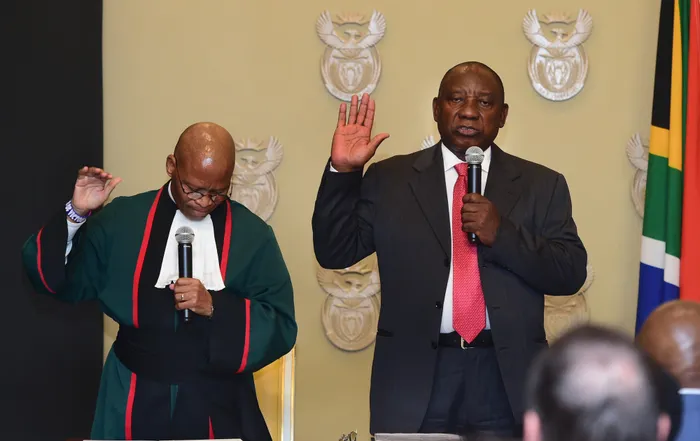
Then Chief Justice Mogoeng Mogoeng swearing in President Cyril Ramaphosa at Tuynhuis in Cape Town on February 15, 2018. Today marks exactly eight years of Ramaphosa in office. On Thursday, he delivered his ninth State of the Nation Address (Sona). As parties prepare for the Sona debate in the coming days, how have Ramaphosa's 2922 days in office been for South Africa as a nation?
Image: Kopano Tlape/GCIS
Today marks 2 922 days since President Cyril Ramaphosa was sworn in as South Africa’s head of state in 2018, succeeding Jacob Zuma, who resigned a day earlier. Ramaphosa ascended to office under the banner of anti-corruption, renewal and clean governance.
The mood in the country, particularly among investors and sections of the middle class, was euphoric. But the optimism was short-lived. Loadshedding became a daily reality. Infrastructure in several central business districts deteriorated.
State-owned enterprises continued to struggle, and public institutions buckled under financial and governance pressures. Economic growth has remained stagnant, forcing austerity measures that have squeezed social development, health and education budgets, even as the executive remains one of the largest and costliest in democratic South Africa.
The 2024 national and provincial election results delivered another political jolt. The ANC lost its outright majority and entered a Government of National Unity with parties that had long opposed it, including the DA and Freedom Front Plus.
For critics, this coalition cemented suspicions that Ramaphosa represents continuity with elite consensus politics rather than transformative change. His presidency has also been shadowed by unresolved controversies, from the sealed CR17 campaign funding records to the Phala Phala saga.
Comparisons with the so-called “nine wasted years” under Zuma further complicate the narrative. Economic data show that average annual GDP growth during Zuma’s tenure outperformed that of the Ramaphosa era. In the coming days, his State of the Nation Address debate will pit party opposition against his party defenders.
But beyond partisan point-scoring, how does South Africa move forward? Government must prioritise energy security through decisive reform; reduce the size and cost of the executive; fast-track infrastructure maintenance; protect frontline social spending; and ensure genuine accountability.
Most importantly, economic policy must shift from rhetoric to implementation, with measurable targets and transparency. South Africa does not need another cycle of hype and disillusionment. It needs disciplined governance, institutional integrity and a leadership willing to match promises with performance. The remaining Ramaphosa years must be defined not by slogans, but by results.