


Nco Dube, a political economist, businessman and social commentator
Image: Supplied
President Cyril Ramaphosa's recent State of the Nation Address unveiled unexpected changes to South Africa's electricity sector, particularly regarding Eskom's transmission assets. Nco Dube reveals how these seemingly technical reforms may fundamentally change the public character of electricity provision in South Africa, potentially benefiting private capital at the expense of national development priorities.
Image: File
There are moments in South Africa’s political life when the most consequential decisions are not announced with fanfare, nor debated robustly in public, but are instead slipped quietly into the national bloodstream under the guise of inevitability. President Cyril Ramaphosa’s State of the Nation Address (Sona) in 2026 contained one such moment.
On the surface, the President’s remarks on energy reform sounded reassuring, even triumphant. Load shedding, we were told, is behind us. The electricity sector is being modernised. Renewable energy is scaling rapidly. Competition is being introduced to ensure resilience and affordability. Transmission is being restructured to create a level playing field. Private investment will expand the grid. All of this, framed as the natural continuation of long-overdue reform.
Yet beneath this language of progress lies a profound shift in the political economy of electricity in South Africa. One that raises uncomfortable questions about ownership, control, accountability, and the future role of the state in securing a public good as fundamental as energy.
The President’s announcement that a “fully independent state-owned transmission entity” will have ownership and control of transmission assets, and that independent transmission projects will be opened to private investment, appears at first glance to be a logical extension of Eskom’s unbundling. But when placed alongside the Electricity Minister’s unbundling policy published barely weeks earlier, a troubling contradiction emerges.
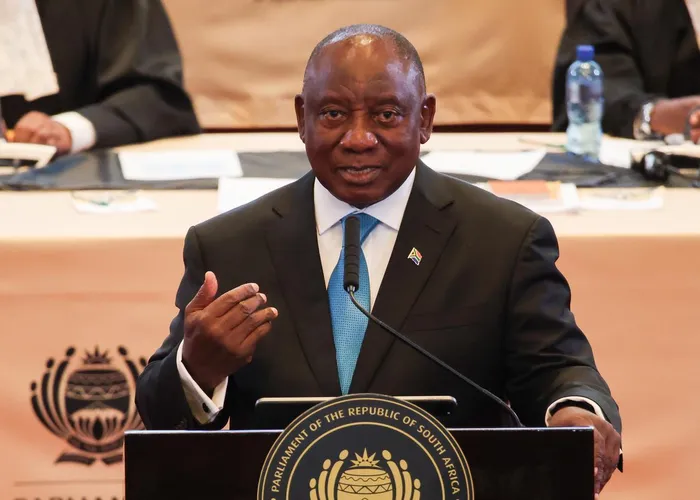
President Cyril Ramaphosa's statement on Eskom during last week's 2026 State of the Nation Address at the Cape Town City Hall revealed the power utility's silent transformation which threatens public ownership.
Image: HENK KRUGER Independent Newspapers
Minister Kgosientsho Ramokgopa’s policy framework envisaged a phased approach in which transmission assets would remain under Eskom Holdings, with the independent transmission system operator (TSO) evolving over time. This was not accidental. It reflected a cautious attempt to balance reform with institutional stability, recognising Eskom’s fragile recovery and the systemic risks of precipitous asset separation.
The President’s Sona intervention appears to override this approach entirely.
The question is not whether reform is necessary. That debate was settled long ago. The question is why this particular reform, in this particular form, and in this particular moment and crucially, for whose benefit.
The Applause of Capital and the Silence of the State
Organised business, through Business Unity South Africa (BUSA), wasted no time in applauding the President’s announcement. Their enthusiasm is telling. A transmission system divorced from Eskom’s ownership, governed by an ostensibly independent operator, and open to private investment in grid expansion is precisely the architecture global capital prefers.
From the perspective of private investors, this model reduces risk. It separates asset ownership from operational control, socialises grid access costs, and creates predictable revenue streams through regulated tariffs. It also insulates investors from the political and developmental obligations that have historically accompanied Eskom’s mandate.
But what is good for capital is not always good for the public.
South Africa’s electricity system was not built as a neutral marketplace. It was built as a strategic instrument of industrialisation, redistribution, and national development. Albeit one deeply distorted by apartheid, corruption, and mismanagement. Eskom’s failures are real and devastating, but they do not negate the fundamental truth that electricity is not merely a commodity. It is a public good.
The danger of the President’s approach is that it treats Eskom’s crisis as a justification for stripping the state of its strategic leverage, rather than rebuilding that leverage on sounder foundations.
The Transmission Question: Ownership Without Control, Control Without Accountability
At the heart of this debate lies the transmission grid.
South Africa requires more than 14,000 kilometres of new transmission lines to unlock renewable energy potential and stabilise supply. The estimated cost of around R440 billion is beyond the current fiscal capacity of both Eskom and the state. Private capital will undoubtedly be required.
But private capital does not arrive without conditions.
If existing transmission assets are transferred out of Eskom into a new TSO, and new transmission lines are privately funded, who owns those new assets? If private investors retain ownership of the infrastructure they finance, while the TSO merely manages access and dispatch, the state risks recreating the very structural imbalance that was used as justification for hollowing out Eskom in the first place.
Eskom’s historical problem was not simply that it was vertically integrated. It was that it was burdened with public obligations while being denied the financial and political support necessary to fulfil them. To now remove one of its most valuable asset, its transmission infrastructure, without a clear plan for balance sheet stabilisation is to invite a new crisis.
What happens to Eskom’s debt, much of which is secured against these assets? What happens to its revenue base when transmission charges flow elsewhere? What happens to its ability to cross-subsidise supply to poorer communities and municipalities?
These are not technical questions. They are political ones.
Eskom’s failures did not arise in a vacuum, nor were they the inevitable consequence of an unwieldy state utility incapable of reform. For years, Eskom warned government that new generation capacity was urgently required, presenting data and modelling that made the looming supply gap unmistakable.
Yet investment decisions were repeatedly delayed. Ideological battles over procurement paralysed planning. When the build programme finally arrived, it came late and was quickly compromised by political interference, corruption and mismanagement. Medupi and Kusile were not merely engineering failures; they were political failures, shaped by weakened governance, inflated contracts and a state that ignored its own technical warnings.
In this sense, Eskom’s crisis is as much the product of political choices as of institutional weakness. To now invoke those failures as justification for stripping the state of its strategic leverage is to repeat the cycle. Punishing the institution while absolving the decision‑makers who starved it of support and distorted its mandate.
It is a manoeuvre that converts political culpability into technocratic inevitability, clearing the path for reforms that would have been far harder to justify had the crisis not been allowed to deepen.
The Myth of the Neutral Grid
Proponents of an independent TSO argue that neutrality is essential. That Eskom cannot be both player and referee in a competitive market. This argument has merit, but it is often deployed selectively.
There is no such thing as a neutral grid. Decisions about access, pricing, expansion, and prioritisation are inherently political. They shape who gets power, at what cost, and on what terms. To pretend otherwise is to obscure power relations behind technocratic language.
If the grid is managed independently of Eskom but increasingly shaped by private investment imperatives, the risk is that expansion will follow profitability rather than need. Renewable-rich regions will be prioritised, while poorer, less commercially attractive areas remain underserved. Municipalities already struggling with infrastructure decay will fall further behind.
The state’s role, historically exercised through Eskom, was precisely to counteract these tendencies. Weakening that role without constructing an equally robust alternative is not reform. It is abdication.
Recovery at Risk: The Cost of Political Interference
Perhaps the most troubling aspect of the current moment is its timing.
Eskom’s recent stabilisation giving the country over 500 days with minimal load shedding, including extended periods without any did not happen by accident. It was the result of disciplined operational focus, improved governance, and a rare alignment between political oversight and managerial autonomy.
Under the leadership of Chairperson Mteto Nyati and Group Chief Executive Dan Marokane, Eskom was given space to do what it had long been denied: operate.
Crucially, this space was protected by a clear political structure. The creation of a dedicated Minister of Electricity reduced fragmentation and insulated Eskom from the destructive turf wars that previously saw it reporting to multiple centres of power. The result was coherence, accountability, and momentum.
The emerging tension between the Presidency and the Minister threatens to unravel this progress. Competing policy signals, overlapping task teams, and public contradictions reintroduce uncertainty at precisely the moment stability is most needed.
Eskom does not need another era of strategic drift disguised as reform.
Reform or Disguised Privatisation?
The uncomfortable question that must be asked is whether this restructuring amounts to a form of privatisation by stealth.
No one is proposing the outright sale of Eskom. But asset stripping, functional separation, and the gradual transfer of strategic control to market-oriented entities can achieve the same outcome without the political backlash.
If private players gain access to the grid at nominal cost, retain ownership of their infrastructure, and operate in a system where risk is socialised and profit is privatised, the public interest is diminished. Even if the state retains nominal ownership of the operator.
This is not an argument against private participation. It is an argument against asymmetry.
An integrated approach to energy reform is essential, but integration must be anchored in a strong, capable state operator. Eskom’s unbundled entities should be instruments of public policy, not conduits for dispossession.
Choosing the Path Forward
South Africa stands at a crossroads.
One path leads to a reimagined public energy system that is leaner, cleaner, more transparent, and more resilient. A path where private investment complements, rather than supplants, state capacity. The other leads to a fragmented system where the state bears the social costs while private capital captures the upside.
The President’s SONA announcement, for all its optimism, nudges us dangerously toward the latter.
Energy reform cannot be reduced to balance sheets and megawatts. It is about sovereignty, equity, and the kind of economy we are building. If Eskom is to be restructured, it must be strengthened, not hollowed out. If private capital is to be welcomed, it must operate within a framework that prioritises public value over shareholder returns.
The recovery Eskom has achieved is fragile. It deserves protection, not experimentation driven by ideological certainty or investor appetite.
The silence that greeted this announcement is itself a warning. When decisions of this magnitude pass without scrutiny, it is usually because their consequences will only be felt later. Felt the most by those with the least power to resist them.
(Dube is a noted political economist, businessperson, and social commentator on Ukhozi FM. His views do not necessarily reflect those of the Sunday Tribune or IOL)