
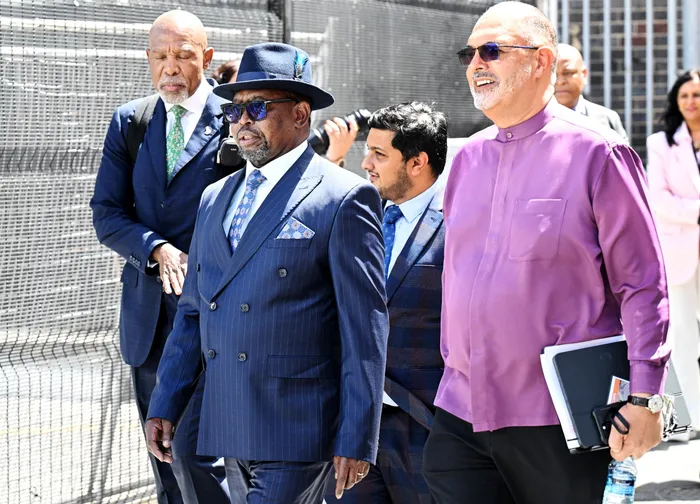
(From left) SA Reserve Bank Governor Lesetja Kganyago, Finance Minister Enoch Godongwana, 2nd Deputy Finance Minister Ashor Nick Sarupen and SARS Commissioner Edward Kieswetter ahead of the delivery of Budget 2026 in Parliament, Cape Town on February 25.
Image: Phando Jikelo/GCIS
Zamikhaya Maseti
When the Minister of Finance, Enoch “Madiba” Godongwana, tabled the 2026 Budget, he did so conscious of history’s recent verdict.
Five years ago, the Republic stood at the edge of fiscal and institutional erosion. State Capture had hollowed out public institutions and weakened state-owned enterprises. The economy had been downgraded to sub-investment grade by the last of the major credit rating agencies. The coronavirus pandemic paralysed global production. The Russia-Ukraine conflict unsettled commodity and energy markets.
And in 2023, the Financial Action Task Force (FATF) placed South Africa on its grey list, citing strategic deficiencies in the country’s anti-money laundering and counter terrorist financing regime, a decision that was not merely technical but a reputational indictment signalling to global markets that the integrity of South Africa’s financial architecture required urgent strengthening.
It is within that arc of decline and recovery that Godongwana now speaks of a turning point. Debt has stabilised for the first time in nearly two decades. The deficit narrows along a measured consolidation path. Debt service costs begin to ease.
South Africa has been removed from the Financial Action Task Force (FATF) grey list. The country has secured its first credit rating upgrade in sixteen years. Borrowing costs have moderated, and the language of crisis has gradually given way to the language of credibility.
Yet fiscal credibility, if it is to be meaningful, must translate into social substance.
The architecture of the 2026 Budget rests firmly upon the social wage. More than sixty per cent of non-interest expenditure continues to be directed toward redistributive programmes. In 2026 and 2027, R292.8 billion is allocated to social grants, reaching approximately 26.5 million beneficiaries.
The old age, disability and care dependency grants rise to R2 400 per month. The war veterans grant increases to R2 420. The foster care grant climbs to R1,300. The child support grant increases to R580.
In the abstract, these are fiscal line items. In lived reality, they are instruments of survival. In vast rural hinterlands and dense township settlements, social grants are the primary source of income. They finance food purchases, school uniforms, electricity tokens and informal micro enterprises. They anchor household consumption in a labour market still incapable of absorbing millions.
Godongwana understands, however, that redistribution without growth becomes fiscally brittle. Economic growth is projected at 1.6 per cent in 2026, rising gradually toward 2 per cent over the medium term. This is an improvement, but not a transformation. It is stabilisation, not acceleration.
Within that context, the continuation of the Social Relief of Distress grant, the R350 lifeline introduced during the pandemic, assumes profound significance. The grant remains in place for the year ahead.
For unemployed adults excluded from other forms of social assistance, it constitutes a minimal guarantee against absolute deprivation. It sustains consumption at the base of the income pyramid and injects liquidity into marginalised local economies.
Yet the philosophical question endures. Is the Social Relief of Distress grant a temporary counter-cyclical instrument, or the embryonic foundation of a permanent basic income support framework?
The Budget refrains from doctrinal declaration. It secures continuity while tightening administrative discipline. Enhanced biometric verification and income checks have terminated thousands of irregular grants. The message is clear: social solidarity must be matched by administrative integrity.
Parallel to this redistributive commitment, the Budget advances calibrated tax relief. Stronger than anticipated revenue performance enables the withdrawal of R20 billion in previously contemplated tax increases. Personal income tax brackets and rebates are fully adjusted for inflation, preventing bracket creep and protecting real disposable income. In an environment of rising fuel and excise adjustments, this relief shields the middle and working classes from silent fiscal encroachment.
The state simultaneously seeks to cultivate long-term financial resilience. The annual tax-free investment limit rises to R46 000. Retirement fund deduction ceilings increase significantly. These measures are not mere technical adjustments; they are strategic interventions aimed at lifting South Africa’s chronically low savings rate and deepening domestic capital formation.
Support for small businesses is similarly recalibrated. The VAT registration threshold increases to R2.3 million, reducing compliance burdens for emerging enterprises. Capital gains exemptions on the sale of small firms are expanded, enabling entrepreneurs to realise value more equitably. In a low-growth environment, small and medium enterprises remain vital employment multipliers.
Nevertheless, fiscal realism tempers generosity. Excise duties on tobacco and alcohol rise in line with inflation. Fuel levies are adjusted. Consolidation remains the lodestar. The approach is neither austerity nor exuberance. It is a disciplined equilibrium.
The transformative axis of the Budget lies in infrastructure investment. Over the medium term, public sector infrastructure spending will exceed R1 trillion. Transport and logistics receive substantial allocations. Road maintenance and resurfacing programmes continue.
Passenger rail corridors are rehabilitated with the ambition of restoring commuter volumes toward pre-decline levels. In energy, transmission infrastructure is unlocked through innovative credit guarantee mechanisms designed to crowd in private capital. Water investments target bulk augmentation schemes and the refurbishment of ageing systems.
Infrastructure, in this formulation, is the material foundation of inclusive growth. Without reliable electricity, industrial expansion falters. Without efficient rail and ports, export capacity stagnates. Without water security, agricultural productivity and urban resilience are imperilled.
By shifting the composition of expenditure toward capital formation, the state attempts to escape the structural bottlenecks that have long suppressed potential output.
Yet infrastructure spending divorced from governance reform risks futility. The Budget, therefore, acknowledges municipal distress and introduces performance-linked reforms in Metro trading services.
Revenue collected for electricity and water must be ring-fenced and reinvested in those same services. The municipal infrastructure grant is restructured to address chronic underspending and misuse. Institutional reform thus accompanies fiscal allocation.
The 2026 Budget, in its totality, reflects a conscious effort to reconcile sovereignty with solidarity. Removal from the Financial Action Task Force (FATF) grey list restores international confidence. Debt stabilisation restores macroeconomic space.
Social grants protect the vulnerable. The Social Relief of Distress grant cushions the unemployed. Tax relief preserves household income. Infrastructure investment lays the groundwork for growth.
The wager is clear. Fiscal stability and social justice are not antagonists; they are interdependent. A state captured by debt cannot sustain redistribution. A society fractured by poverty cannot sustain reform.
The true test now lies in execution. Growth must accelerate beyond modest projections. Infrastructure must deliver productivity gains. The Social Relief of Distress grant must evolve in concert with labour market activation and skills reform. Fiscal credibility must translate into lived improvement.
In navigating these crosscurrents, Gondongwana has articulated a disciplined yet humane vision. It is not a politics of spectacle. It is a politics of steady reconstruction. Whether the Republic advances along this path will depend upon institutional integrity, policy coherence and the collective resolve to align aspiration with implementation.
* Zamikhaya Maseti is a political economy analyst and holds a Magister Philosophae(M.Phil) in South African Politics and Political Economy from the erstwhile University of Port Elizabeth, now Nelson Mandela University.
** The views expressed do not necessarily reflect the views of IOL, Independent Media or The African.