

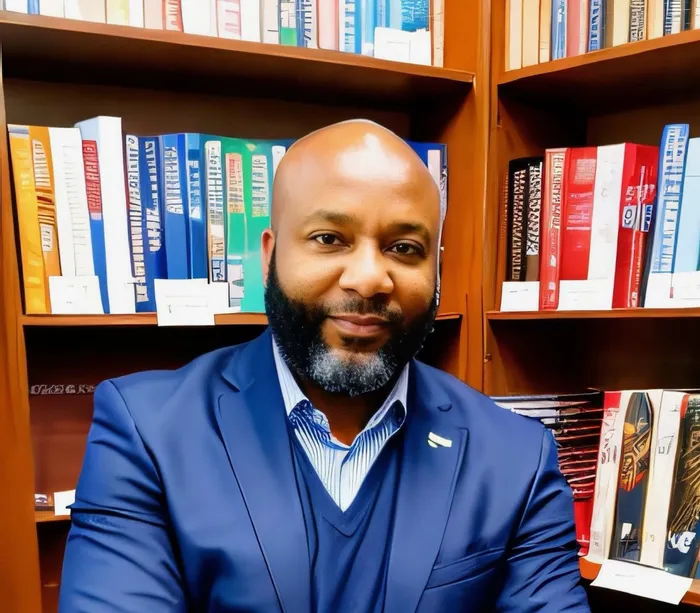
Nco Dube is a political economist, businessman and social commentator
Image: Supplied
What played out at the Ad-hoc Committee on the Mkhwanazi Allegations on Thursday, February 26, was not some freak incident or an unfortunate clash of personalities. It was a public unmasking of a Parliament that no longer seems sure of its own authority, unsure of its procedures, and increasingly comfortable with political theatre at the expense of institutional seriousness.
When Paul O’Sullivan stood up in the middle of proceedings, announced that he had had enough, said he was going to miss his flight, and walked out of a parliamentary committee, the shock was real. It was brazen. It was unprecedented. No witness in democratic South Africa has ever so openly and publicly treated Parliament with such disregard.
But the uncomfortable truth is this: that moment did not come out of nowhere. It was the predictable outcome of a process that had already gone wrong long before O’Sullivan pushed back his chair.
O’Sullivan’s conduct was arrogant, dismissive and deeply disrespectful. Not just to Members of Parliament, but to the institution itself and, by extension, to the people of South Africa. Parliament is not a podcast studio or a public debate forum. It is the supreme legislative body of the Republic, constitutionally empowered to summon people, compel testimony and hold power to account.
Yet authority does not exist simply because the Constitution says so. It has to be exercised consistently, confidently and without apology. On that score, Parliament failed.
The warning signs were there from the start. O’Sullivan made it clear, publicly and repeatedly, that he was reluctant to appear. He insisted on appearing virtually. He stated openly that he would not answer questions from members of the MK Party, ActionSA and the EFF. These were not private concerns raised behind closed doors. They were conditions announced in the public domain.
That should have been the end of the discussion. Parliament should have issued a subpoena and made it clear that this was not a negotiation.
Instead, the committee dithered.
When the committee sought to use Parliament’s summoning powers and issue a subpoena, they were stopped by the Speaker of the National Assembly, Thoko Didiza. Her reasoning was that there had not been sufficient procedure, meaningful engagement, or an overt refusal by O’Sullivan to appear.
This interpretation of parliamentary power is deeply troubling.
If the rules genuinely require a witness to first refuse to appear before Parliament can issue a subpoena, then those rules are not fit for purpose and need urgent revision. An invitation carries no legal force. A witness who appears voluntarily is under no obligation to stay, to answer questions, or to respect the authority of the committee beyond their own goodwill.
That is not a theoretical concern. It is exactly what happened.
By refusing to issue a subpoena, Parliament effectively told O’Sullivan that his appearance was optional and conditional. He acted accordingly.
Parliament’s summoning powers should not be treated as some extraordinary measure reserved for extreme cases. They should be standard procedure in serious inquiries of national importance. A subpoena is not about punishment. It is about clarity. It establishes legal obligations and consequences. It removes ambiguity.
Instead, Parliament chose caution over authority and paid the price.
Once a witness understands that Parliament cannot compel them to stay seated, the balance of power shifts immediately. When O’Sullivan stood up and walked out, he did not break the law. Parliament had no legal recourse. That is the most damning part of this entire episode.
If Parliament cannot compel cooperation in a matter involving allegations that strike at the heart of the criminal justice system, then its oversight role is little more than symbolic.
This is not about silencing witnesses or suppressing dissent. It is about ensuring that when Parliament calls someone to account, that call carries weight.
It would be dishonest to place all the blame on O’Sullivan or the Speaker. The Ad-hoc Committee itself has done much to undermine its own credibility.
From the outset, the committee has been deeply partisan, agenda driven and often unserious. Members frequently appear more interested in political point scoring than in uncovering the truth. Some have openly taken sides in a matter they are supposed to investigate impartially.
Witnesses are often treated badly. Questioning quickly turns into accusation. Aggression replaces precision. The Chair, Soviet Lekganyane, too often allows this behaviour to continue unchecked. Authority that is not exercised is authority that is surrendered.
This is not robust oversight. It is political theatre.
Certain members have become repeat offenders.
David Skhosana, Delereen James, Julius Malema and Glynnis Breytenbach often dominate proceedings with raised voices, badgering and confrontational posturing. Their interventions are loud, performative and designed for clips rather than clarity. They shout, interrupt and cast aspersions, often without allowing witnesses to complete answers.
The Chair’s failure to rein this in is glaring.
On the other side of the spectrum, members such as Vusi Shongwe, Ashley Sauls and Khusela Sangoni-Diko often appear less interested in probing uncomfortable truths than in protecting certain interests or individuals. Their questioning lacks urgency and edge. It feels defensive rather than inquisitive.
Then there are those who are simply missing in action. They attend sporadically, contribute little and ask nothing of consequence.
The result is a committee that swings between aggression and apathy, with very little seriousness in between.
Perhaps the most frustrating aspect of this entire process is the quality of questioning.
Too often, questions are poorly framed, repetitive or overtly political. There is little follow up. Lines of inquiry are not developed. Witnesses are allowed to evade, deflect or grandstand in return.
This is not how serious investigations are conducted.
The allegations raised by General Mkhwanazi present a rare and important opportunity. They go to the heart of the rot within South Africa’s criminal justice system. They raise questions about political interference, institutional capture, compromised policing and prosecutorial failure.
This should have been a moment for forensic questioning, legal precision and strategic patience. Instead, it has been reduced to spectacle.
What happened yesterday was not just embarrassing. It was corrosive.
When a witness can walk out of Parliament without consequence, public confidence takes a knock. When MPs shout instead of interrogate, credibility erodes. When subpoenas are treated as exceptional rather than routine, authority weakens.
Parliament cannot demand respect it does not enforce.
South Africans are watching these proceedings not as insiders, but as citizens desperate for accountability in a system that feels increasingly broken. What they are seeing is a Parliament that struggles to rise above factionalism and performance.
There is a deeper tragedy here.
South Africa’s criminal justice system is in crisis. Public trust is fragile. Allegations of corruption, political interference and institutional decay are not abstract. They shape daily realities of crime, impunity and injustice.
The Mkhwanazi allegations could have been a turning point. A moment where Parliament rose above party lines and treated the matter with the seriousness it deserves. A moment to interrogate systems, not personalities. Structures, not slogans.
Instead, the committee appears trapped in familiar political rhythms. Noise over nuance. Loyalty over truth. Performance over purpose.
Parliament still has choices to make.
It can revise its rules to strengthen its summoning powers. It can normalise the use of subpoenas in serious inquiries. It can enforce discipline among its members. It can insist on preparation, coherence and institutional dignity.
Or it can continue down this path, where authority is optional, accountability is selective and oversight is reduced to spectacle.
Yesterday’s scenes were avoidable. They were not inevitable. They were the result of decisions taken and decisions avoided by those entrusted with the highest legislative responsibility in the country.
The question now is whether Parliament has the humility and courage to learn from its own humiliation, or whether it will simply move on, as it so often does, leaving the deeper rot untouched.
South Africans are watching. And their patience is wearing thin.
Nco Dube is a political economist, businessperson and a social commentator on Ukhozi FM. His views don't necessarily reflect those of the Sunday Tribune or IOL.